
Lieferung heute & morgen

Qualitätsgarantie

Willkommens-Angebote freischalten: KOSTENLOSE Lieferung | Bis zu 80 % RABATT | Kostenlose 30-Tage-JoyPlus-Testphase
App herunterladen
An industrial bookcase 180 cm makes the most of your room’s height, offering open storage for books, files, plants and décor. At the same time, a tall shelf can quickly become impractical if its dimensions, weight capacity or anti-tip fittings don’t suit where you plan to put it. That’s why it’s worth taking a close look at the product specs, especially for living rooms, bedrooms, hallways or home offices.
With a 6-tier bookcase or a bookcase with 6 levels, the shelf height, shelf width and compartment layout can vary significantly. A unit may have six storage surfaces but be unsuitable for large art books, ring binders or tall decorative items. So be sure to check:
A figure like “75 pounds per shelf” doesn’t necessarily tell you the total load the freestanding unit can handle. What’s more, actual stability depends on even weight distribution, a level floor and proper assembly. Heavy books belong on the lower shelves, while lighter décor is better placed higher up.
A narrow bookcase offers vertical storage and takes up little floor space, but it can tip over if loaded unevenly or knocked accidentally. Any anti-tip kit supplied should be fixed to the wall following the instructions. In rented properties, you’ll need to consider the right wall plugs and the type of wall you’re working with.
A bookcase 180 cm tall will suit many rooms, but you shouldn’t order one without checking the available space. Measure the width, depth and height where it will stand, including skirting boards, radiators and the door’s swing arc. For tight alcoves, a model around 30 to 40 cm wide can work well. A wider unit, roughly 70 to 80 cm, gives you more display space instead.
Don’t forget the delivery route: the staircase, lift and doorways need to accommodate the package and shelf dimensions. For an industrial-style shelf, also think about how the wall colour, flooring and existing furniture will work with the brown or greige finish.
With a bookcase made from wood and metal, you’re typically looking at laminated particle board, MDF or other wood composites paired with a steel or iron frame. The material name alone doesn’t tell you much about stability, though. Look out for:
An E0 rating should be taken as a specific manufacturer claim, not a blanket statement for all shelves. If you’re unsure, the details on the product page and in the assembly manual are what count.
Don’t compare total load capacity and load per shelf in isolation. The lower – or more precisely defined – limit is the one that matters for your planning. The shelf must stand on a firm, level surface and be loaded evenly. Never exceed the permitted weight.
For households with children or pets, wall fixing is especially important. A decorative storage shelf isn’t designed for people to pull on, climb on or lean against.
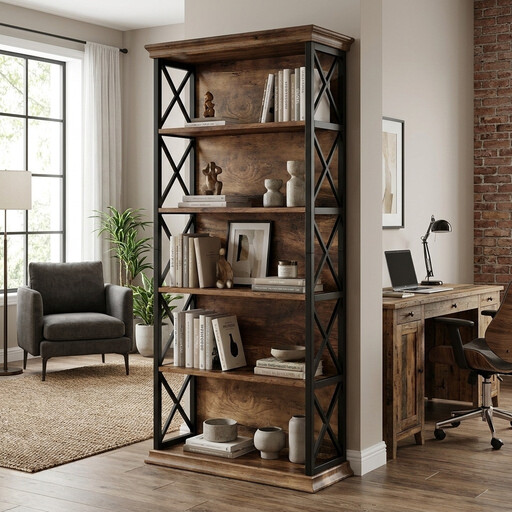
Why this product fits the profile: This open shelving unit combines a brown wood-effect finish with a black metal frame and can be used in the living room, bedroom or home office.
The product details mention 1.5 cm thick shelves, a metal frame and a load capacity of up to 75 pounds per shelf. The specific total load should be checked before filling the unit.
X-shaped side elements, five shelves as described, and assembly hardware included.
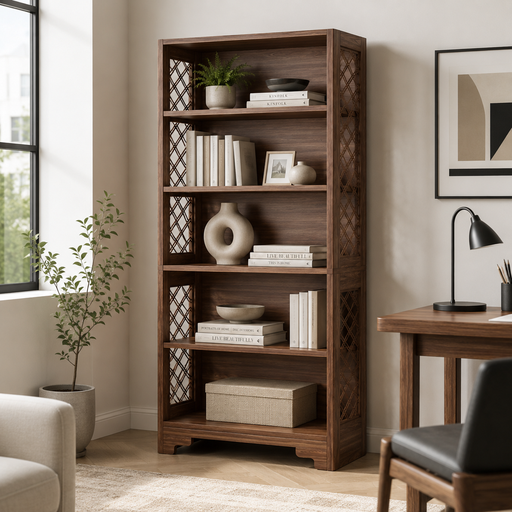
Why this product fits the profile: The combination of MDF shelves, a wooden back panel and metal struts is designed for an extensive book collection or a well-organised home office.
The product description gives dimensions of 30 x 80 x 180 cm, 1.5 cm thick shelves and up to 34 kg per shelf. Wall fixing is still advisable when heavily loaded.
Six tiers as per the product name, X-shaped side design and a back panel for structural support.
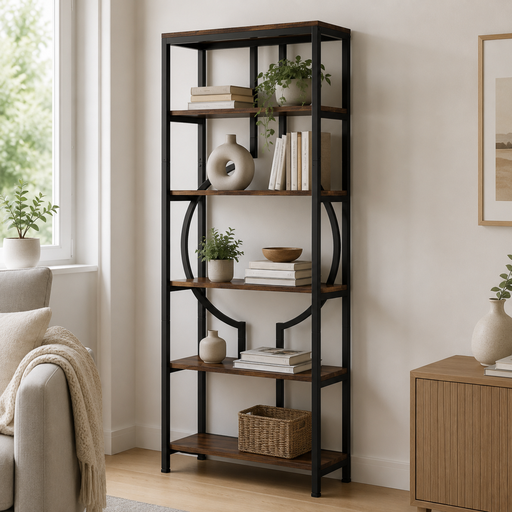
Why this product fits the profile: This model suits users who need six open tiers for books, plants and décor, and who want to take note of a stated total load capacity.
The details state a maximum total load of 100 kg along with guidance on even distribution. The shelf should stand on a level surface and not be used in damp areas.
Dimensions of 30 x 70 x 180 cm, a powder-coated metal frame and, according to the product details, scratch- and stain-resistant shelves.
We’ve put together a full, regularly updated list of products that meet these strict selection criteria and comply with EU safety regulations.
Before you start assembling, sort all the parts using the instructions. Tighten screws only lightly at first, align the frame, and then fully tighten them. Adjustable feet help with minor floor unevenness, but they don’t replace a stable base. Fit the anti-tip kit after assembly.
For cleaning, a dry or slightly damp cloth is usually enough for coated wood materials. Avoid prolonged moisture, harsh cleaning products and direct heat sources. After a few weeks, check the screw connections and try to distribute heavy books evenly across the lower shelves.
First, make sure the shelf is perfectly upright, then use the fixings supplied. The right wall plugs depend on the wall type – plasterboard, solid brick and concrete each need different solutions. Wall fixing should be used even with a wide shelf if the manufacturer recommends it.
That depends on the specific model. The product details mentioned here include up to 34 kg per shelf, 50 kg or 60 kg total load capacity, and a maximum total load of 100 kg for another model. These figures shouldn’t be treated as equivalent. Always refer to the individual product’s specifications and ensure even weight distribution.
A narrow bookcase can work well in small rooms, hallways or alcoves. However, with a slim width, you need to check that the shelves are deep and strong enough for the book collection you have in mind. Heavy books should go on the bottom; for large quantities, a model with a wider frame or additional wall fixing is recommended.