
Lieferung heute & morgen

Qualitätsgarantie

Willkommens-Angebote freischalten: KOSTENLOSE Lieferung | Bis zu 80 % RABATT | Kostenlose 30-Tage-JoyPlus-Testphase
App herunterladen
An industrial-style bookshelf is more than just a place to store books. It's a statement piece that brings urban charm and rugged functionality to your living room or office. However, the market is flooded with models that look impressive at first glance but quickly prove to be a poor investment. Before you decide on a model, it's crucial to understand the typical weaknesses that often only become apparent after the purchase.
This guide will help you distinguish quality from compromise. We'll highlight the three most common flaws in industrial shelving and show you which technical features to look for to make a durable and stable choice.
Many buyers focus on design and overlook critical quality indicators, which often leads to disappointment. Pay special attention to these three points:
To avoid the problems mentioned above, you should focus on objective and measurable parameters. These three aspects are crucial for the longevity and functionality of your shelf.
A good wood and metal standing shelf is defined by the quality of its components.
An industrial design shelf is often designed as an open-back bookshelf and must therefore be inherently stable.
Not every shelf fits every environment. Think carefully about the purpose the furniture will serve.
Here are some models that, based on their specifications, are suitable for different user profiles.

Why it's a great fit: Perfect for anyone looking to transform unused corners in their living room or home office into valuable storage space. The L-shaped design maximizes the use of space without appearing bulky.
The combination of a reinforced metal frame, adjustable feet, and an included anti-tip kit directly addresses the typical problems of instability on uneven floors.
Seven tiers provide an exceptional amount of storage. The shelves, made from E0-grade particleboard, and a high load capacity of up to 45 kg (approx. 100 lbs) per shelf (according to the manufacturer) allow for storing heavy items.
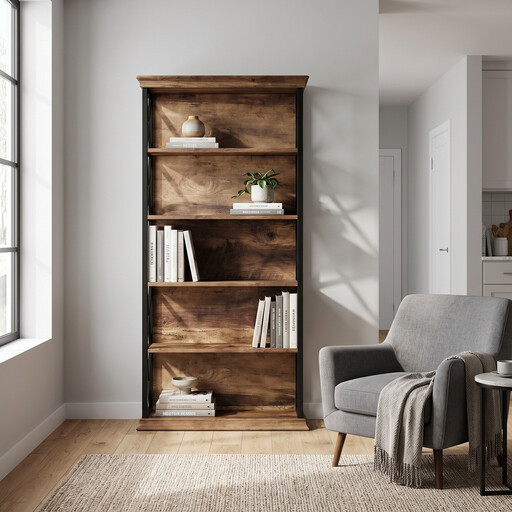
Why it's a great fit: Anyone who needs to accommodate a large library, heavy file binders, or collectibles requires one thing above all: high load capacity and stability. This model is designed for exactly that.
The use of E0-grade MDF and thick steel tubes ensures high structural stability. The specified load capacity of 34 kg (approx. 75 lbs) per shelf and the included anti-tip kit counteract the risks of overloading and instability.
The combination of high load-bearing capacity and a scratch-resistant, waterproof surface makes it a durable solution for intensive use in an office or as a central library wall in a living room.

Why it's a great fit: For those who see a shelf not just as storage, but as a central design element. Its unconventional shape makes it a true eye-catcher.
Despite its delicate appearance, it is described as having a sturdy construction from a powder-coated iron frame. The scratch- and stain-resistant surface of the laminated shelves counteracts the problem of inferior foils.
The distinctive geometric half-moon silhouette is unique and offers a creative display surface. It can be used flexibly as a bookshelf, room divider, or display rack.
We have curated a comprehensive, up-to-date selection of products that meet these strict selection criteria.
1. How much weight can an industrial-style bookshelf hold? The load capacity varies greatly depending on the model and construction. It is crucial to check the product description carefully. Look for the specified maximum load capacity per shelf. Values can range from 10 kg (approx. 22 lbs) for lighter decorative shelves to over 30 kg (approx. 66 lbs) for robust filing shelves. Always load the heaviest items on the bottom shelves to increase stability.
2. How do I care for the wood-look and metal surfaces? For daily cleaning, a soft, dry cloth is usually sufficient. For more stubborn dirt, a slightly damp cloth can be used. Avoid aggressive cleaning agents or abrasive sponges, as they can damage the powder coating on the metal and the melamine coating on the shelves.
3. Is assembling a tall bookshelf complicated? Most shelves are delivered as a kit with detailed instructions and the necessary assembly hardware. Assembly is generally straightforward. However, with tall shelves, it is particularly important to carefully complete the final step: securing it to the wall with the provided anti-tip kit. This ensures the safety and stability of the shelf in daily use.