
Lieferung heute & morgen

Qualitätsgarantie

Willkommens-Angebote freischalten: KOSTENLOSE Lieferung | Bis zu 80 % RABATT | Kostenlose 30-Tage-JoyPlus-Testphase
App herunterladen
An industrial-style bookshelf is more than just a storage unit; it's a statement piece that combines urban charm with functional aesthetics. The blend of rugged metal and warm wood tones effortlessly complements various interior designs, from modern lofts to cosy living rooms. However, the market is flooded with models of widely varying quality. Before you make a decision, it's crucial to understand the common weaknesses that often only become apparent after your purchase.
As your Joybuy Product Recommendation Officer, I'm here to help you separate the wheat from the chaff. This guide will walk you through the three most common pitfalls of buying an industrial shelf and highlight the key technical features to look for to ensure you find a durable and stable solution for your home.
Many buyers focus solely on looks and price, overlooking critical design features. This often leads to disappointment when the new piece of furniture fails to withstand the demands of daily use.
To avoid these pitfalls, you should check three core parameters before buying. These objective features determine the longevity and functionality of your new shelf.
A true freestanding wood and metal shelf is defined by the quality of both its components.
A stable shelf is essential, especially if it stands freely in a room or is heavily loaded.
The right dimensions determine whether a shelf just looks good or is also genuinely practical.
Based on the criteria above, we have identified a few models that are well-suited for different user profiles.
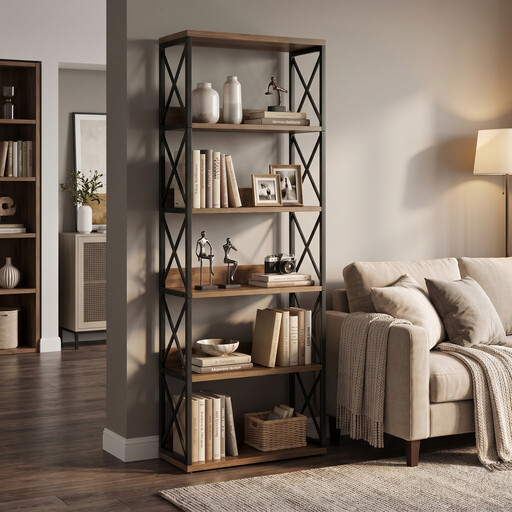
Why it's a good fit: A classic and functional interpretation of the industrial style, without any unnecessary frills. Ideal for a first apartment or a student room where a balance of style and budget is key.
Addresses the stability problem with an included anti-tip kit and a solid metal frame, avoiding the typical "wobble trap" of entry-level models.
Straightforward assembly and a versatile height of 177.5 cm (70 inches) that fits in most rooms. The 30 cm depth is sufficient for books and most decorative objects.
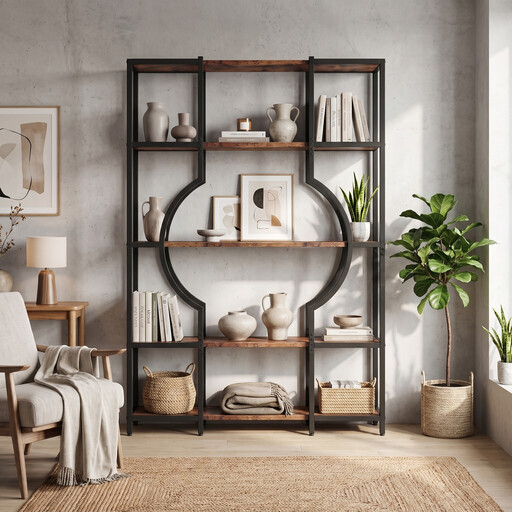
Why it's a good fit: For those who see a shelf not just as storage, but as a decorative centrepiece. The curved silhouette and 12 asymmetrical compartments are perfect for showcasing books, plants, and collectibles.
Unlike standard shelves, the shape itself provides structural integrity. The numerous small compartments distribute weight effectively, preventing the sagging of long, unsupported shelves.
Unique, curved design and 12 versatile display compartments that allow for creative arrangements. The manufacturer specifies a total load capacity of 113 kg (250 lbs).
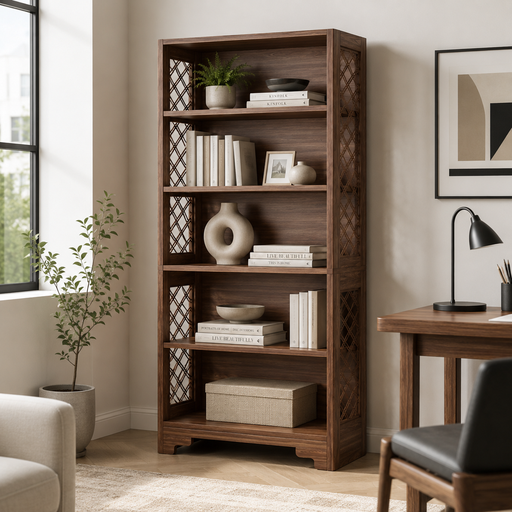
Why it's a good fit: Perfect for a home office bookshelf or for users with a large book collection. Its high load capacity is crucial for heavy binders and hardcover books.
Counteracts the "material deception" with thick MDF shelves and a wooden back panel for added stability. The specified load capacity of 34 kg per shelf is a verifiable metric.
High load capacity per shelf (34 kg / 75 lbs according to the manufacturer) and extra stability from the back panel and side X-braces. The 180 cm height maximises vertical storage space.
We have compiled a complete, up-to-date list of products that fully meet these strict selection criteria and safety standards.
Look for models with cross-bracing on the back and adjustable feet to compensate for uneven floors. However, the most important step is to use the included anti-tip kit to securely fasten the shelf to the wall. This is essential for stability and safety.
For standard A4 or letter-size binders, a shelf depth of at least 29-30 cm (approx. 11.5-12 inches) is required. Always measure the usable interior depth of the shelves before buying, not just the external dimensions of the unit, to ensure your binders will fit completely.
Most models are designed for self-assembly. A good, illustrated manual, clearly numbered parts, and included basic tools are indicators of a straightforward assembly process. Typically, one person can complete the assembly in under an hour.