
Lieferung heute & morgen

Qualitätsgarantie

Willkommens-Angebote freischalten: KOSTENLOSE Lieferung | Bis zu 80 % RABATT | Kostenlose 30-Tage-JoyPlus-Testphase
App herunterladen
An industrial borescope with a two-way articulating probe can reveal hard-to-reach areas without having to dismantle components completely. For vehicle owners, garages, electricians, plumbers and technical service providers, screen size and camera quality aren’t the only things that matter. The key is whether the probe, lighting, range of movement and recording features suit the job.
The figure “210 degrees” describes the camera tip’s possible range of movement. In practice, it also matters how precisely you can guide the probe using the controls, and whether the cable holds its position well enough. A flexible probe that bends back unpredictably inside an access point can make inspection more difficult.
Look for a combination of two-way control, a position-holding probe cable and a length that suits the job. For engine or brake inspections, a compact diameter may matter more than an especially long cable.
A video borescope can only produce useful images if the area being inspected is well lit. Engines, cavities, wall linings and machinery often have very little ambient light. An endoscope with lighting and adjustable LED brightness gives you more control than a camera with fixed lighting.
It’s also worth considering the advertised screen or camera resolution in relation to how you’ll actually use the device. A basic wall inspection has different requirements from checking for small cracks, deposits or damage inside an engine cylinder.
If you need to document damage, share your findings with customers or compare the condition of a component over time, you’ll need photo and video functions. With a basic monitor-equipped borescope, check whether you can save recordings, what storage media it supports and what resolution the files are created in.
An 8.5 mm endoscope is suitable for many larger access points, such as those found in vehicles, machinery, wall cavities or certain brake components. However, the diameter must fit the access point you have. A 5.5 mm probe may be better for narrower openings.
Depth of field also matters. The single-lens Teslong TD450S is specified for a range of 20 to 100 mm. For the dual-lens model, the stated ranges are 20 to 100 mm for the main camera and 10 to 70 mm for the side camera. These figures help you judge how far away details can be while still appearing sharp.
A 210-degree articulating probe lets you look in different directions without constantly repositioning the cable. Check whether the camera moves in two directions or whether you need additional axes. For engine inspections, pipework and hard-to-reach areas of machinery, precise two-way control may be all you need.
A built-in IPS screen makes a flexible endoscope independent of a smartphone, Wi-Fi and an additional app. Other useful features include:
Before buying, check the manufacturer’s specifications against what’s actually included in the box. Accessories such as a memory card, charger or carry case aren’t automatically included with every model.
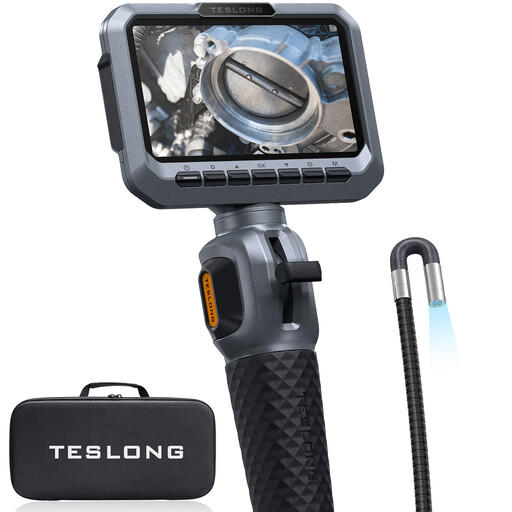
Why this product suits this need: The 5.5 mm probe is designed for relatively narrow access points. The built-in 5-inch screen and 210-degree control let you inspect vehicles, HVAC systems and machinery directly.
The slim probe reduces the risk of getting stuck at an access point. Six LEDs with adjustable brightness help illuminate dark inspection areas.
5-inch IPS screen, 210-degree two-way camera head, photo and video recording, and a 3,000-mAh battery, according to the product description.
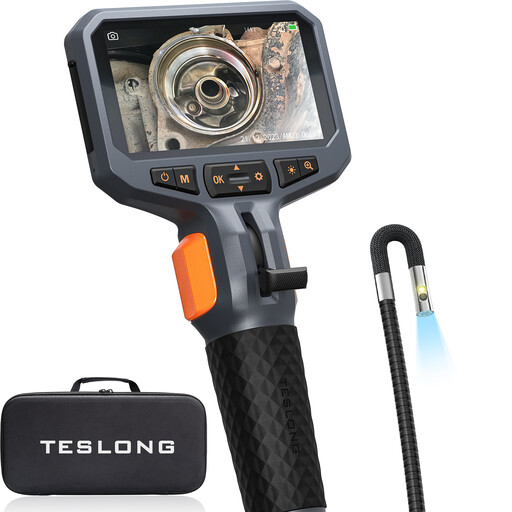
Why this product suits this need: As well as a main camera, the dual-lens version has a side camera. This can provide additional viewing angles when inspecting cylinder walls, brake systems or hard-to-reach components.
The side view means you don’t have to rely as much on mechanically repositioning the whole probe. Even so, check that the 8.5 mm probe diameter will fit the access point before buying.
Dual-lens camera, 4.5-inch IPS screen, 210-degree articulation range, and photo and video recording, according to the product specifications.
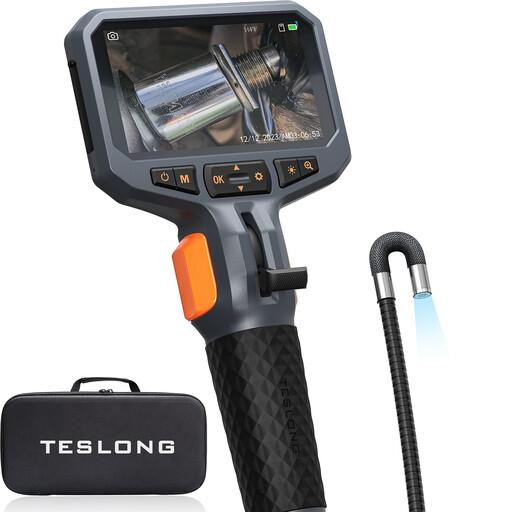
Why this product suits this need: This model combines a 1.55 m flexible, position-holding probe with a 4.5-inch colour screen. That makes it suitable for regular inspections of walls, vehicles, engines and technical components.
The position-holding, flexible probe can be bent into the position you need. Recording at up to 1,920 × 1,080 pixels makes it easier to document your findings afterwards.
1.55 m probe, 2.0-megapixel single lens, 3,500-mAh battery, USB-C port and TF card slot, according to the manufacturer.
We’ve put together a complete, regularly updated list of products that meet these strict selection criteria and fully comply with the safety regulations in force in the EU.
First, check the battery, memory card and lens cover. Insert the probe slowly and without applying too much pressure. Adjust the LEDs so that shiny metal surfaces aren’t overexposed. If the vehicle has moving or hot parts, switch off the engine and allow it to cool sufficiently. Always follow the instructions for the specific device.
You can’t estimate the probe’s service life from its diameter alone. Its lifespan and performance depend on factors including bend radius, pulling force, moisture, chemicals and storage. Avoid tight bends, don’t pull the cable out by the camera head, and clean the probe only as directed by the manufacturer.
For a battery-powered device, normal running costs are mainly for charging and, where applicable, storage. A TF card slot can be useful if you regularly need to document inspections. You should also factor in wear and tear, cleaning and the possibility of needing a replacement battery. So before buying, look beyond the device price and check what’s included, the warranty terms and the availability of spare parts.