
Lieferung heute & morgen

Qualitätsgarantie

Willkommens-Angebote freischalten: KOSTENLOSE Lieferung | Bis zu 80 % RABATT | Kostenlose 30-Tage-JoyPlus-Testphase
App herunterladen
Reliable cooling is essential for many people on the go. Whether you're camping, on a long road trip, or commuting, fresh food and cold drinks significantly enhance comfort. A compressor cooler offers a high-performance solution that far exceeds the capabilities of conventional cool boxes. This article serves as a guide to help you understand the technical features and find a model that meets your needs.
The right model depends on your individual needs. You should consider three core factors in your decision to purchase a functional and durable car cooler or a portable camping fridge.
Power supply flexibility is a crucial factor. Most compressor models are designed as 12V/230V electric coolers. This means they can be operated via the 12V/24V socket in a vehicle (cigarette lighter) as well as a standard 230V wall outlet. Pay attention to the average power consumption, often specified in watts (W), and look for energy-saving modes (often called "ECO mode"). Integrated, multi-stage battery protection also prevents the vehicle's battery from being drained.
Unlike thermoelectric coolers, a compressor cooler can actively cool and even freeze, regardless of the ambient temperature. Many models can reach temperatures as low as -20°C, functioning as a fully-fledged portable freezer. For users who want to cool and freeze simultaneously, a dual-zone cooler is an excellent option. These units have two separately controlled compartments, allowing for maximum flexibility in food storage.
If you plan to run the cooler in a campervan or truck overnight, you should consider the noise level. A quiet compressor cooler operates at a noise level below 45 decibels (dB), which is roughly equivalent to a quiet conversation. Modern convenience is often provided by a cooler with app control. This allows you to conveniently set and monitor the temperature from your smartphone via Bluetooth or Wi-Fi without having to open the cooler.
Based on the criteria mentioned, we have compiled a selection of models with different specialities for you.
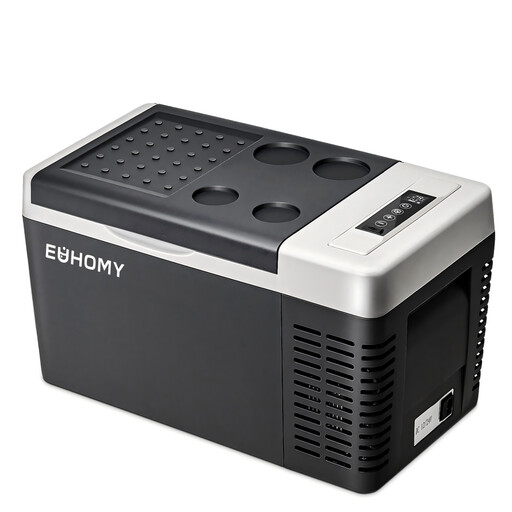
Why It Stands Out: This model is distinguished by its compact design and rapid cooling performance. According to the manufacturer, the compressor cools the contents from 10°C to 0°C in just 15 minutes. A special feature is the magnetic lid seal, which ensures a tight closure and improves insulation performance.
Advantages:
Best for: Ideal for solo travellers, commuters, or as a supplement in a car for short trips where a small footprint and rapid cooling are the priority.

Why It Stands Out: The Alpicool cooler combines a large 49-litre capacity with the flexibility of two separately controllable temperature zones. Thanks to robust wheels and a retractable handle, it's easy to transport despite its size. Practical details like an integrated cutting board and a reversible door increase its utility for outdoor use.
Advantages:
Best for: Perfect for families, van life enthusiasts, and longer camping trips where a large amount of food needs to be stored flexibly.

Why It Stands Out: The ECOFLOW GLACIER focuses on high performance and self-sufficiency. With an optional 298Wh battery pack, it can operate off-grid for up to 39 hours, according to the manufacturer. The cooling performance is also remarkable: it can cool down from 25°C to 0°C in just 40 minutes. Its robust design and versatile charging options, including solar, make it a companion for demanding adventures.
Advantages:
Best for: Users seeking maximum independence and performance, such as for off-grid camping, boat trips, or as part of an existing EcoFlow energy ecosystem.
Haven't found the right model for your needs yet? In our wider selection, you'll find units with different capacities, features, and for various budgets.
Discover our entire range of camping coolers here.
1. What is the difference between a compressor cooler and a thermoelectric cooler? The main difference lies in the cooling technology. A compressor cooler works like a conventional refrigerator and can actively cool and freeze, regardless of the ambient temperature. A thermoelectric cooler can typically only lower the internal temperature by a certain amount (e.g., 20°C) below the ambient temperature and is less effective in high outdoor temperatures.
2. How much power does a compressor cooler use? Power consumption depends on several factors: the set temperature, ambient temperature, insulation, and how often the cooler is opened. Most models have a rated power consumption of about 45-60 watts. However, during operation, the compressor only runs intermittently to maintain the temperature. An ECO mode can further reduce consumption.