
Lieferung heute & morgen

Qualitätsgarantie

Willkommens-Angebote freischalten: KOSTENLOSE Lieferung | Bis zu 80 % RABATT | Kostenlose 30-Tage-JoyPlus-Testphase
App herunterladen
In industry, trade, and logistics, efficiency often depends on clear and durable markings. A faded or smudged mark on a component, material delivery, or storage location can lead to costly errors and delays. Standard office markers are rarely up to the task in these demanding environments. They fail on oily, damp, or smooth surfaces, and their resistance to UV light or abrasion quickly deteriorates.
This article serves as a practical guide to help you find the right industrial marker for your specific requirements. We will analyse the key features and present a selection of proven tools for professional labelling on all surfaces.
The choice of the right marker is based on objective criteria derived directly from its field of application. Three factors are of central importance.
Not every marker adheres equally well to every material. Therefore, the first consideration should always be the surface you need to write on.
The marker's base significantly determines its properties and potential uses.
The marker's tip defines the legibility and level of detail of the marking.
Based on the criteria mentioned, we have curated three specialised products from Staedtler Lumocolor for various industrial applications.
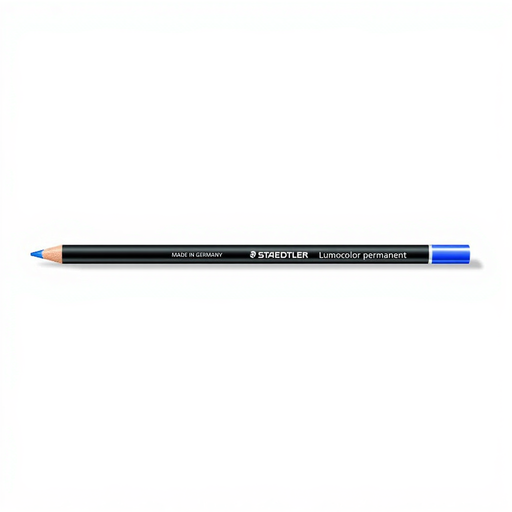
Why it stands out: This wood-cased, pencil-style marker combines the precision of a pencil with the durability of an industrial marker. Its special lead enables opaque and waterproof markings on a variety of surfaces, especially on smooth and dark materials.
Advantages:
Ideal for: Users who need precise, controllable marking on smooth or transparent surfaces, such as in laboratories, quality control, or for labelling plastic parts.
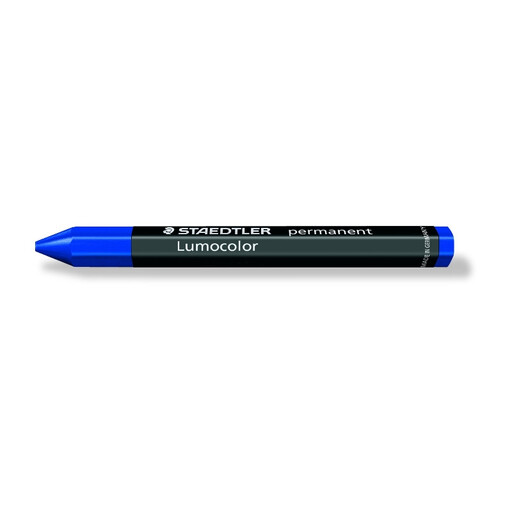
Why it stands out: This industrial wax crayon is designed for extreme conditions. Its wax-based formula adheres reliably where ink-based markers fail: on wet, dusty, and even slightly oily substrates.
Advantages:
Ideal for: Tradespeople on construction sites, in forestry and woodworking, and in metal fabrication who need an absolutely robust marking solution for demanding and contaminated surfaces. A classic jobsite marker.
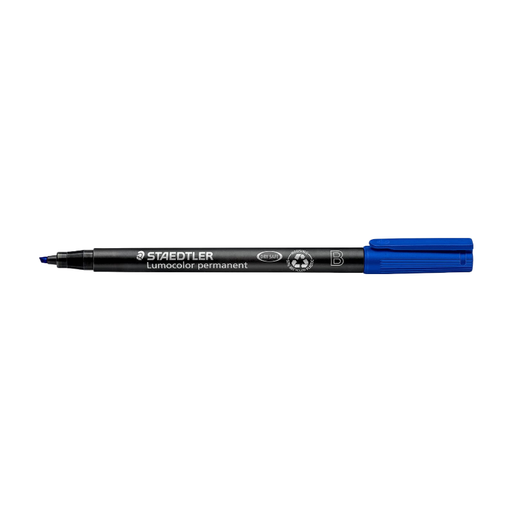
Why it stands out: A classic all-purpose marker with thoughtful professional features. The chisel tip allows for flexible line widths, and its DRY SAFE technology is a significant practical advantage in a fast-paced work environment.
Advantages:
Ideal for: Professionals in logistics, warehousing, shipping, and manufacturing who need a reliable and versatile permanent marker for daily labelling of cardboard boxes, plastic containers, metal parts, and films.
The models presented cover a broad spectrum of professional applications. However, if you are looking for a different colour, a specific line width, or a model for a highly specialised purpose, you can find more alternatives in our comprehensive category.
Discover our entire selection of blue markers here.
The main difference lies in durability and surface adhesion. Industrial markers are formulated with inks or wax leads specifically designed to adhere to non-porous, rough, or contaminated surfaces (e.g., oily, damp, dusty) where standard markers would fail. Their composition is also often more resistant to abrasion, chemicals, and UV light.
Yes, certain types are designed specifically for this purpose. Wax-based markers (industrial crayons) are particularly effective on wet or oily substrates, as the wax displaces moisture and oil to adhere directly to the material. It is important to check the product specifications to confirm its suitability for such surfaces.
By design, these markings are permanent and difficult to remove. The method depends on the surface and the type of marker. On smooth, non-porous surfaces like glass or metal, solvents such as isopropyl alcohol or acetone can be effective. However, it is essential to test the solvent on an inconspicuous area first to avoid damaging the surface. From porous materials like wood or concrete, removal is often only possible by abrading or sanding the surface.