
Lieferung heute & morgen

Qualitätsgarantie

Willkommens-Angebote freischalten: KOSTENLOSE Lieferung | Bis zu 80 % RABATT | Kostenlose 30-Tage-JoyPlus-Testphase
App herunterladen
An inflatable bouncy castle with water slide combines a bouncing area, climbing elements, slide and paddling pool in one outdoor play structure. For families with children aged around 3 to 10, it can be a versatile addition to the garden, patio or children’s birthday party. However, models vary considerably in terms of footprint, load capacity, blower power and features.
Anyone who focuses solely on colourful product images or a long list of play features can easily overlook important details. Three common purchasing misconceptions are particularly widespread:
Before buying, you should consider not only the product dimensions but also the required safety clearances. A model with an inflated size of 460 × 343 × 190 centimetres needs more than just its footprint. There should be sufficient space around it for access, anchoring and supervision.
For a smaller garden, a more compact bouncy castle with paddling pool may be more suitable. One example is a model with an inflated size of 364 × 315 × 239 centimetres. Its greater set-up height may also affect your space planning, for example near trees, canopies or overhead cables.
Important: The dimensions come from the respective product specifications. Manually measured dimensions may vary slightly.
A water bouncy castle for children should be used in accordance with the recommended age range and maximum number of children. For example, a product with a total load capacity of 135 kilograms may be designed for up to three children, with the product specifications stating that each child must weigh no more than 45 kilograms.
Another model specifies a total load capacity of 180 kilograms and a maximum of four children in the recommended age range of 3 to 8 years. These figures cannot be applied to other products. The same applies to a bouncy castle for children aged 3 and over: adult supervision is still required, particularly around the water and slide areas.
Pay attention to:
The models listed are made from Oxford fabric or PVC Oxford fabric. The name alone is not decisive; you should also check the specific product description. Is the material described as water-repellent or waterproof? Is it intended for dry and wet use? Are there instructions for cleaning and storage?
An inflatable bouncy castle with blower remains permanently connected to the blower during use. If the blower is switched off, the structure loses its shape. The supplied blowers for the models featured have power ratings between 450 and 750 watts. This affects electricity consumption and should be taken into account during longer play sessions.
The following points are also relevant when using one in a UK garden:
An indicated EN-71 certification should be viewed as product-specific information. Buyers should check that the marking and the associated safety instructions are clearly documented in the product materials.
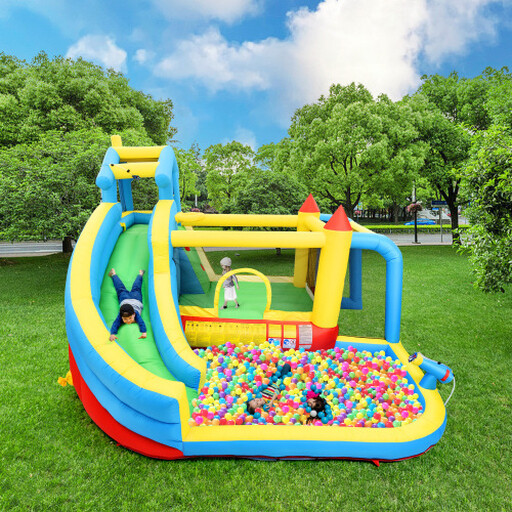
Why this product suits this profile: The combination of bouncing area, slide, paddling pool and football net caters to several types of play. Measuring 364 × 315 × 239 centimetres, its footprint remains relatively manageable compared with larger water parks.
The product specifications state the age range, maximum number of children, total load capacity and individual weight limit. This makes it easier to understand the usage limits before buying.
Designed for dry and wet use; blower rated at 550–750 watts included, according to the product specifications.
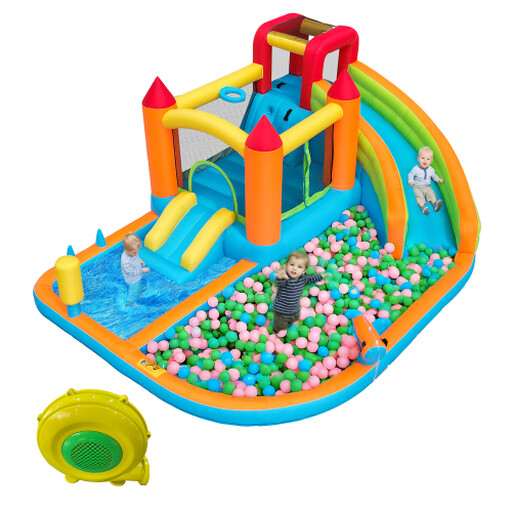
Why this product suits this profile: This model offers two pool areas, a large and a small slide, plus additional play stations. Measuring 460 × 343 × 190 centimetres, it is designed for larger gardens and a variety of play options.
The stated total load capacity of 180 kilograms and maximum of four children are clearly specified. The product description also mentions Oxford fabric and EN-71 certification.
450-watt blower included, according to the product specifications; designed for dry and wet use, with additional basketball, climbing and throwing games.
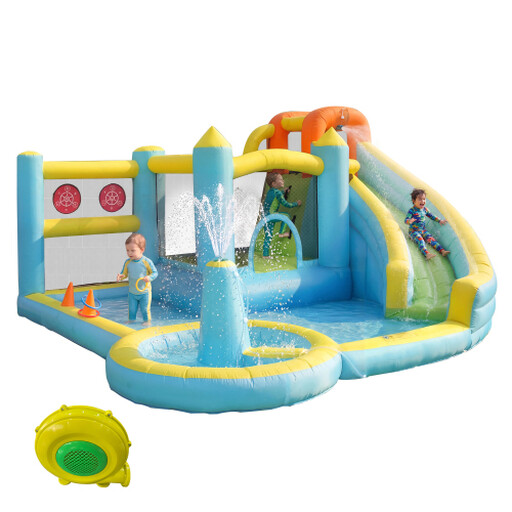
Why this product suits this profile: Measuring 430 × 390 × 210 centimetres, this inflatable water playground is suitable for families, summer parties or organisations with plenty of outdoor space.
The product description states the maximum load of 135 kilograms, a maximum of three children and the requirement to keep the blower running continuously during play.
450-watt blower, according to the product specifications; combination of slide, trampoline, climbing area, paddling pool, fountain and ring-toss game.
We have put together a complete, regularly updated list of products that fully meet these strict selection criteria and the safety regulations applicable in the EU.
An outdoor bouncy castle requires a sufficiently large, level area and a power supply for the blower. It may be possible to use one on a patio if the load capacity, space and surface are suitable. Nurseries or children’s party organisers should also plan for access, supervision, storage and a clearly defined maximum number of children.
If you are planning to use it all year round, you can choose a model designed for both dry and wet use. During the colder months, however, the structure should be stored somewhere dry and protected. Suitability for outdoor winter use does not automatically follow from the description “for all seasons”.
Spread the bouncy castle out on a clear, level surface, connect it to the blower and secure it with the supplied pegs. When using water, connect the hose as described in the instructions. The blower must remain switched on while children are playing. Before setting it up, remove any sharp objects, branches and stones.
It is not possible to give a reliable, general lifespan. This depends on factors including the material, UV exposure, frequency of use, surface, cleaning and storage. The bouncy castle should be allowed to dry completely after every use with water. Check for damaged seams, tears or loose fastenings before the next use.
Electricity consumption mainly depends on the blower’s power rating and how long it runs. A 450-watt blower uses 0.45 kilowatt-hours per hour of operation, while a 750-watt blower uses 0.75 kilowatt-hours. The actual cost depends on the usage time and your individual electricity tariff. Water consumption, cleaning and any replacement parts are additional costs.