
Lieferung heute & morgen

Qualitätsgarantie

Willkommens-Angebote freischalten: KOSTENLOSE Lieferung | Bis zu 80 % RABATT | Kostenlose 30-Tage-JoyPlus-Testphase
App herunterladen
An inflatable guest bed can replace a spare room, save space in a tent, or serve as a portable sleeping solution at festivals and while travelling. The range stretches from a simple airbed to a raised airbed with a built-in pump. However, it’s not just the price that matters: dimensions, weight capacity, pump type and the surface you place it on all determine whether a model will be practical in everyday use.
A single airbed around 76 cm wide is easy to transport, but offers less room to move than a model that is 99 cm wide. For two people, widths of 137 cm or 152 cm are standard. Before you buy, check whether the bed will fit in your guest room, tent or vehicle, and whether there is enough space around it to get up comfortably.
An inflatable guest bed with pump may use an electric, USB, hand or foot pump. A built-in electric pump requires a 220–240 V mains socket. A USB pump is more flexible, but needs a suitable 5-volt power source, such as a power bank. With an airbed that doesn’t include a pump, you’ll need to factor in a compatible device separately.
A higher airbed makes getting in and out easier, but it isn’t automatically designed to support heavier loads. What matters is the maximum weight capacity stated by the manufacturer. For the models we’ve selected, these figures are, for example, 136 kg for several single beds and 272 kg for certain double beds. These figures are not a recommendation for a specific body height or sleeping position, and must not be exceeded.
For one person, suitable options include:
A two-person airbed offers significantly more space at 137 × 191 cm or 152 × 203 cm. For couples, you should also check the maximum weight capacity. The external dimensions may differ from the actual sleeping surface due to rounded sides.
A height of 22 to 25 cm keeps you a little way off the floor and makes rolling the bed up easier. Models that are 30 or 46 cm high can make getting up simpler, but they need more storage space and are less suitable for small tents. A flocked surface reduces the risk of bedding slipping. However, it doesn’t replace an extra blanket or a fitted sheet.
PVC (or vinyl) is the main outer material used in the air mattresses listed here. Polyester fibres inside can help with stability, as with the Fiber-Tech construction of INTEX models. Look out for:
A folding camping bed made of steel and polyester is an alternative to an air mattress. It doesn’t need inflating and sits raised off the ground, but when folded it usually takes up more storage space.
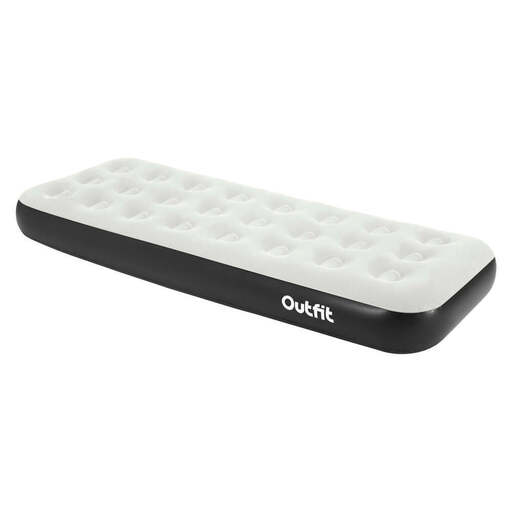
Why this product fits the profile: This 191 × 73 × 22 cm single mattress is designed for occasional overnight stays, camping and indoor use. At just 1.45 kg, it’s relatively easy to transport.
The product details clearly state that a hand, foot or electric pump is required. This avoids any false impression of a built-in pump.
Compact single size, PVC construction and included repair kit.
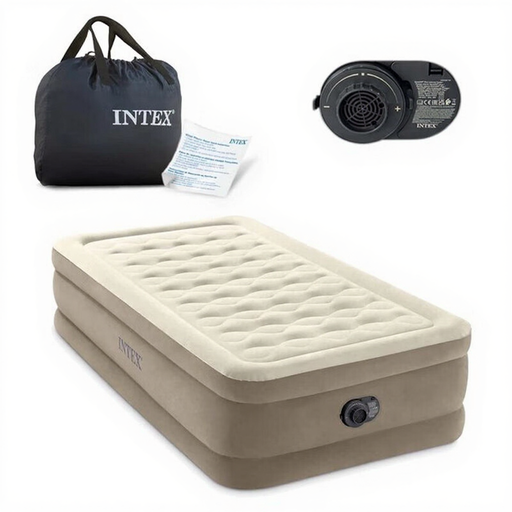
Why this product fits the profile: This 191 × 99 × 46 cm single bed is designed as a comfortable airbed for home use and offers a raised sleeping position.
The pump is permanently built in and designed for 220–240 V. The maximum weight capacity of 136 kg is clearly stated.
46 cm height, flocked surface, weight capacity up to 136 kg and inflation time of approximately 2.5–3 minutes according to the product details.

Why this product fits the profile: This folding camping bed measuring 213 × 79 × 50 cm is ideal for regular use in the garden, camping, fishing or as a guest bed without the need for inflation.
Because no air inflation is needed, there is no risk of low air pressure during use. The stated weight capacity is 200 kg.
Steel frame with X-construction, non-slip feet, side pocket and folded dimensions of approximately 106 × 16 cm.
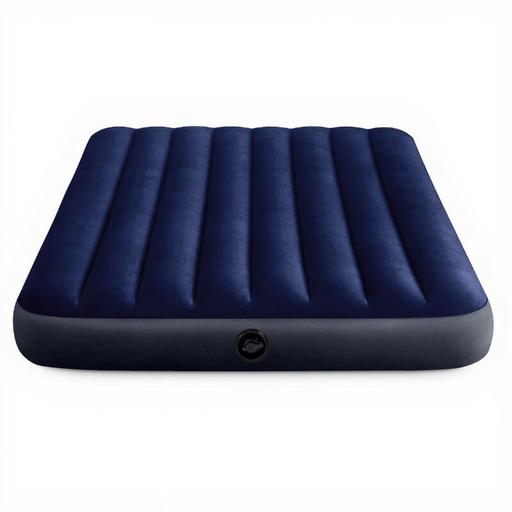
Why this product fits the profile: This 137 × 191 × 25 cm air mattress is designed for two people and can be rolled up for guests, festivals or travel.
The details indicate that a separate pump is required. This allows you to plan the necessary accessories before you buy.
Two-person sleeping surface, 2-in-1 valve and stated maximum weight capacity of 272 kg.
We’ve put together a full, regularly updated list of products that fully meet these strict selection criteria and the safety regulations in force in the EU.
Always place an airbed on a level, dry and clean surface. In a tent, a protective groundsheet is advisable, as long as it doesn’t create creases or sharp edges. Clean flocked surfaces with a slightly damp cloth. Harsh cleaning products can damage PVC and coatings.
After the first use, the material may stretch a little. For this reason, the product details of several INTEX models describe topping up the air later. Inflate only to the desired firmness and avoid jumping, standing or walking on the mattress. The bed must be completely dry before storing. Keep it away from direct sunlight, intense heat, naked flames and pets with sharp claws.
That depends on the pump type and the size. The built-in electric pump of the INTEX Ultra Plush Airbed takes approximately 2.5 to 3 minutes, according to the product details. A USB model may take around 4 minutes. With a hand pump or foot pump, the pump type, air volume and desired firmness are the deciding factors.
It’s not possible to give a fixed lifespan. It depends on the material, the load, the surface, storage conditions and how often it’s used. Check the airbed for cracks before every use, and store it in a dry, cool place away from direct sunlight.
Yes, as long as the dimensions fit inside your tent and the surface is protected. For camping without a mains socket, models with a foot pump, hand pump or USB pump are suitable. If you regularly sleep outdoors and prefer a raised, air-independent sleeping spot, you might consider a single camping bed with a folding steel frame.