
Lieferung heute & morgen

Qualitätsgarantie

Willkommens-Angebote freischalten: KOSTENLOSE Lieferung | Bis zu 80 % RABATT | Kostenlose 30-Tage-JoyPlus-Testphase
App herunterladen
An infrared patio heater can provide targeted warmth for seating areas, conservatories and covered outdoor spaces. However, a high wattage is not the only factor that matters when choosing one. Claims such as “for 35 m²”, “IP65” or “3000 W” are only meaningful when they match the installation location, room layout and intended usage time.
The following guide from the Joybuy Product Recommendation Officer will help you avoid common buying mistakes and assess the technical specifications objectively.
The claim “for 35 m²” is not a universally applicable heating guarantee. Important factors include:
A 3000 W patio heater may be designed for a limited seating area. On a completely open patio, however, heat is distributed differently from how it is in an enclosed conservatory. The manufacturer’s coverage figure should therefore be treated as a guide only.
An IP65 patio heater is protected against dust and water jets from various directions according to its protection rating. This does not mean that the appliance may be submerged or left permanently unprotected in the rain.
In practice, this means:
An appliance with a power rating of 3000 W uses around 3 kWh per hour of operation when running at full power. Approximate costs can be calculated as follows:
Power in kW × operating time in hours × electricity price per kWh
With several heat settings, actual consumption may be lower. A remote control or app control does not automatically reduce energy consumption. It does, however, make it easier to switch the appliance off in good time and select a suitable power setting.
For an electric patio and balcony heater, power and adjustability are particularly important. 3000 W provides a high maximum power setting, while several settings allow more precise use according to your needs. An appliance with just one setting will often run for longer and at a higher power level than necessary.
Look out for:
Restaurants, cafés and event venues should also check whether several appliances may be operated on the same circuit.
A fixed heating direction mainly warms the area in front of the appliance. A patio heater with oscillation can distribute warmth across a wider angle. It is important to distinguish between models where the entire heating element swivels and those where only part of the appliance moves.
An oscillation range of 180 degrees can be useful for seating groups. However, it does not replace correct positioning. The appliance must stand securely and must not be aimed directly at people, curtains or other flammable materials.
A patio heater with remote control is convenient to operate from a distance. App control can provide additional functions, such as selecting a heat setting or setting a timer. Before buying, check whether the app requires a permanent internet connection and whether it is compatible with your smartphone.
A timer, for example with a 24-hour setting, can help prevent unnecessary running times. However, it is no substitute for safe positioning or disconnecting the appliance from the mains when you will be away for an extended period.
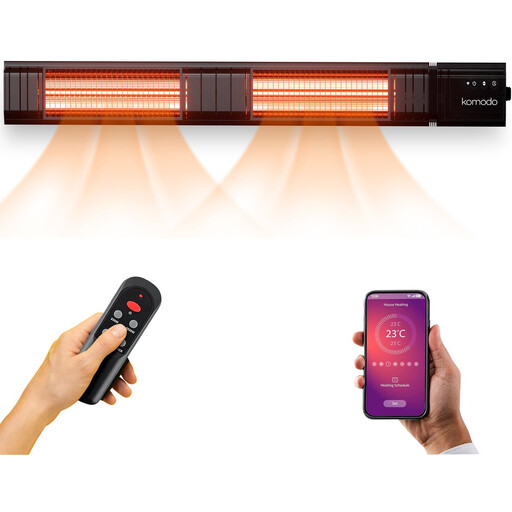
Why this product suits the profile: This model combines 3000 W of power with 9 settings, allowing it to be adjusted for different seating distances and usage scenarios. Its stated suitability for indoor and outdoor areas of up to 35 m² provides a clear guide when choosing a model.
The multiple heat settings mean you do not have to heat exclusively at full power. Nevertheless, the IP65 rating should not be interpreted as permission to submerge the appliance or store it permanently without protection.
9 heat settings, 180-degree oscillation, LED display, remote control and app control. A 24-hour timer is also specified.
Why this product suits the profile: For homes, conservatories or covered catering areas, the precise controls and swivelling heat distribution are practical, provided the local positioning and connection requirements are met.
The technical specifications state specific control functions rather than making only general promises about convenience. Even so, check before buying that the app, socket and installation location are suitable for your intended use.
Carbon-fibre construction according to the product information, LED display, 180-degree swivel function and control via remote or app.
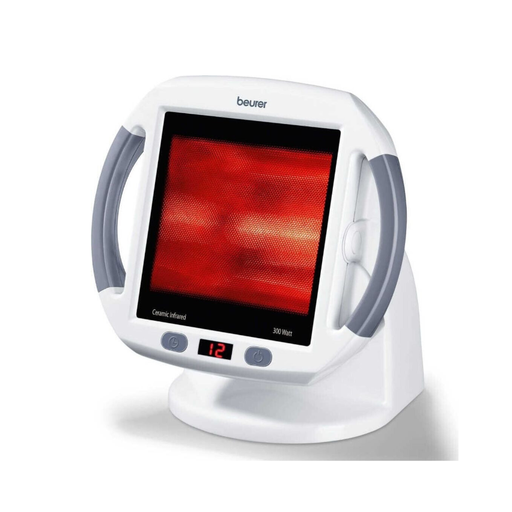
Why this product suits the profile: This model is intended for a specific indoor application and is not a substitute for a patio heater. It may be of interest if you are looking for a compact, directional heat source with a timer.
This clear distinction prevents it from being confused with an outdoor patio heater. The stated power output of 300 W should not be compared directly with the 3000 W of a patio heater.
300 W of power, an adjustable angle of approximately 0 to 50 degrees and a timer with automatic shut-off according to the product information.
We have put together a complete, regularly updated list of products that fully meet these strict selection criteria and the safety regulations applicable in the EU.
Before switching on the appliance, place it on a level, stable surface. Keep it away from:
Do not cover the heater while it is operating. Allow the surface to cool down before moving or storing the appliance. Stop using it if the plug or cable is damaged. Local regulations apply to permanent electrical installations; if you are unsure, consult a qualified electrician.
At full power, consumption is approximately 3 kWh per hour. The actual cost depends on your electricity tariff and the heat setting selected. A timer and a lower power setting can limit the operating time and power consumption.
The IP65 protection rating describes protection against dust and water jets. It does not mean that the appliance can be permanently exposed to all weather conditions or submerged in water. Keeping it in a sheltered position and storing it somewhere dry will extend its practical service life.
Use the seating area as your guide rather than looking only at the total floor area. Position the patio heater so that the heat reaches the area where people are sitting while maintaining sufficient distance from flammable materials. In open, windy areas, the zone that can actually be heated comfortably may be smaller than the manufacturer’s stated coverage.