
Lieferung heute & morgen

Qualitätsgarantie

Willkommens-Angebote freischalten: KOSTENLOSE Lieferung | Bis zu 80 % RABATT | Kostenlose 30-Tage-JoyPlus-Testphase
App herunterladen
An infrared thermometer for babies and children should be ready to use quickly, measure without contact wherever possible and allow checks at night. In practice, however, devices vary considerably in their measurement methods, operation, memory functions and additional modes. A low price alone therefore says little about whether a thermometer is suitable for family life.
Many devices advertise a reading within one second. This primarily describes how quickly the result is displayed, not necessarily how accurate it will be under all conditions. The distance from the forehead, measuring angle, ambient temperature and the child’s movements can all affect the result. Clear instructions and unambiguous positioning guidance are therefore more important than an especially impressive speed claim.
A forehead thermometer measures the temperature at the surface of the skin. An ear thermometer, on the other hand, works in the ear canal. Depending on the situation, the two methods may show different readings. For babies and toddlers, you should observe the relevant age approval and use the device correctly according to the instructions. The temperature of objects, milk or bath water is also not equivalent to a body temperature measurement.
A fever alert with a colour display or audible signal is intended as a guide. Thresholds may be set differently depending on the model and measurement method. A red display is not a substitute for medical assessment. If readings are unusual, your child is generally unwell or you are unsure what to do, follow the instructions and seek medical advice.
First, consider which functions you actually need:
The “3-in-1” and “6-in-1” descriptions should be checked against the specific measurement modes provided. What matters is whether the functions you need for everyday life – such as measuring the temperature of milk and bath water – are genuinely available and clearly explained.
Babies, children and adults have different reference ranges. Some devices offer age-specific readings or a colour display. According to the product description, the Braun ThermoScan BNT400WE features an Age Precision function for the groups 0–3 months, 3–36 months and 36 months and over. Such a display can make readings easier to interpret, but should not be viewed as a diagnosis.
If you want to use a thermometer for adults and children, you should also look for switchable units. Being able to choose between Celsius and Fahrenheit is particularly useful when travelling.
A closed, wipe-clean measuring surface makes cleaning easier. However, the device should only be cleaned as specified by the manufacturer and must not be immersed in water. A silent thermometer, or one with a signal that can be switched off, can be useful when taking measurements while your child is asleep.
You should also check:
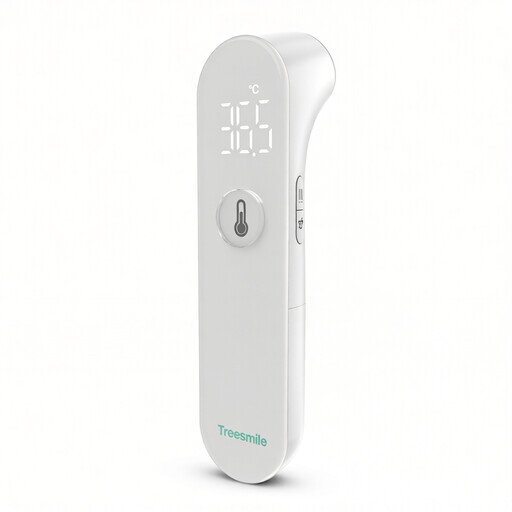
Why this product suits this profile: This model focuses on forehead and object measurement, making it suitable for families looking for straightforward operation for everyday use.
The measurement modes are clearly limited to forehead and object measurement. This avoids giving the impression that several different body measurement methods are included.
According to the product details: large LED display, 35 memory slots, mute function and automatic switch-off after 30 seconds.
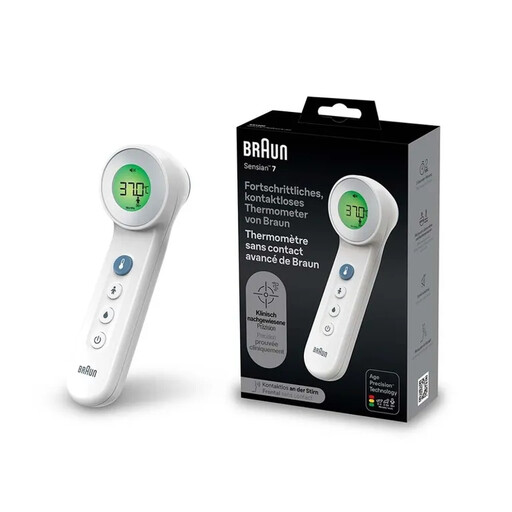
Why this product suits this profile: The combination of contactless and contact forehead measurement, positioning guidance and age-specific display is aimed at users who value guided operation.
According to the product description, PositionCheck technology provides guidance on positioning. This can help reduce user errors caused by holding the device at the wrong distance.
According to the manufacturer: dual technology, 3-in-1 measurement for body, liquids and food, plus a silent mode.
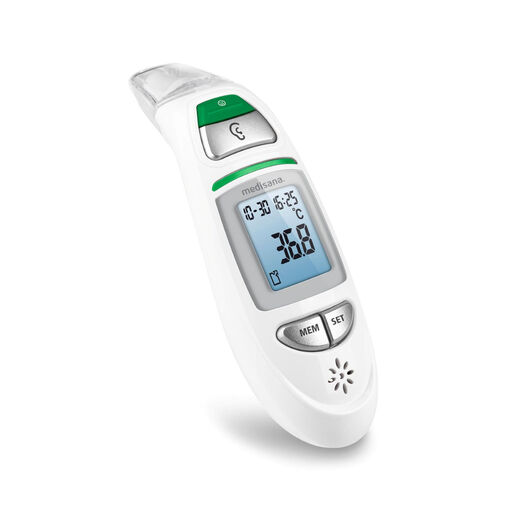
Why this product suits this profile: This model measures body, surface, liquid and room temperature, making it suitable for households with a wide range of measuring needs.
The six advertised functions are divided into specific measurement methods. Before buying, you can therefore check whether ear and forehead measurement, as well as liquid and room temperature measurement, are genuinely needed.
According to the product description: LCD display with date and time, visible fever alert, storage pouch and batteries included.
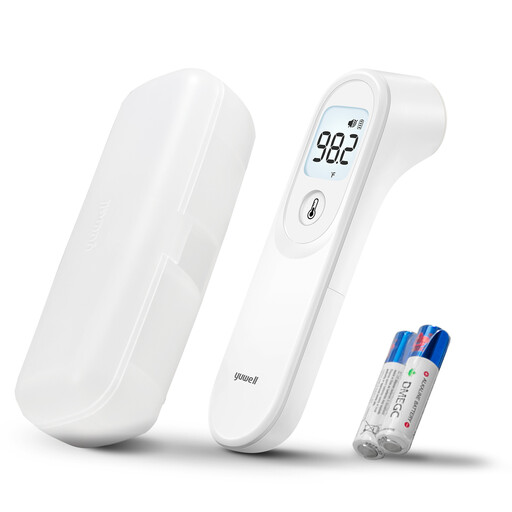
Why this product suits this profile: The contactless forehead measurement from a distance of around 5 cm and the quiet mode stated by the manufacturer are designed for quick checks of babies and children.
According to the product details, a distance sensor supports correct positioning. The fixed distance provides useful guidance instead of relying on guesswork.
According to the product description: measurement within one second, three sensors, orange display for temperatures above 37.5 °C, plus two AAA batteries and a storage box.
We have put together a complete, regularly updated list of products that fully meet these strict selection criteria and the safety regulations applicable in the EU.
Position the device on the forehead as specified in the manufacturer’s instructions, or use the designated ear mode. Pay attention to the distance, angle and an unobstructed measurement area. If readings remain unusual or your baby has symptoms, seek medical advice.
The service life depends on battery care, cleaning, storage and mechanical wear. No fixed general lifespan can be specified. Batteries should be replaced if the display becomes weak or readings seem implausible. Damaged devices should no longer be used.
For the battery-powered models described here, normal operation mainly involves the cost of replacement batteries. Devices with memory, lighting or frequent signal use may place greater demands on the batteries. If needed, a silent mode can switch off the audio output, but it does not fundamentally change the energy consumption of the measurement.