People who sit in one place
If you usually sit at a desk or in a reading spot, an infrared panel could be a good choice, provided it can heat the area without obstruction.


If you usually sit in one place and the panel can heat that area without obstruction, an infrared panel could work as an occasional supplementary heater. If you want to warm the air throughout a small room, a convector heater with clear airflow is likely to be a better fit. Choose based on how you’ll use it and how you want the heat distributed. Consider the power rating, running time and your electricity tariff, and check the installation requirements and documentation for the specific heater and controller combination before buying. The type of heater alone is no indication that it will use less electricity.
If you usually sit at a desk or in a reading spot, an infrared panel could be a good choice, provided it can heat the area without obstruction.
If a higher air temperature throughout the room matters more to you than heating one particular spot, a convector heater with clear airflow could be a good option.
If floor space is limited, check the available wall space, cable routing and required clearances. A freestanding setup is suitable only if it is approved for the specific model.
Bosch Home Comfort describes infrared heaters as providing warmth for people and surfaces in their path, while Electrical Safety First classifies convector heaters as warming the room air. So first consider whether you mainly want to heat one particular spot or the room as a whole.
| What matters to you | What to look for | Who this is especially relevant to |
|---|---|---|
| Warmth where you sit | Check whether the panel can heat the spot without obstruction and whether the installation method is approved for the model. | If I usually sit in one place, the panel’s direction matters to me. Around 31% of consumers prioritise targeted warmth where they sit. |
| Warmth throughout the room | Consider the room size, insulation and clear airflow. A power rating alone does not guarantee a particular room temperature. | If I spend time in different parts of a small room, I’d prefer to warm the room air. Around 25% of consumers prioritise warmth throughout the room. |
| Electricity costs and controls | Compare the rated power, thermostat and timer, and work out the running cost using your actual tariff per kWh. | If the heater will be used regularly, I want to understand how its power rating and heating schedule will affect costs. Around 25% of consumers focus mainly on ongoing electricity costs and controls. |
| Fitting it into a small space | Check the instructions, cable routing, approved installation method and required clearances from objects and air inlets or outlets. | If there’s little free floor space in my home, the heater needs to fit in a suitable, approved spot. Around 19% of consumers prioritise safe placement. |
The type of heater mainly describes how and where it gives off heat. It doesn’t prove that it will always use less electricity to provide the same amount of heat. With extended use, running costs can add up; co2online highlights this drawback of electric heaters.
First decide whether you need targeted warmth where you sit or warmer air throughout the room. Then consider the power rating, actual running time and your electricity tariff.
Depending on the model, controls may not be included and may need to be purchased separately. ETHERMA explains that the BASIC version requires a suitable external controller to comply with Ecodesign requirements; the Könighaus P Series is also available without a thermostat.
Check the specific heater version you’ve ordered, the recommended controller and the relevant manufacturer documentation together.
Depending on the combination, you may need a compatible external controller and installation.
Available installation methods can vary between models and even between versions in the same range. For example, VASNER states that its feet are not suitable for the 300 W version of the Citara T.
Choose where you want to place the heater and check it against the instructions for the specific version before deciding which one to buy.
For freestanding use, you may need model-specific feet or other installation accessories.
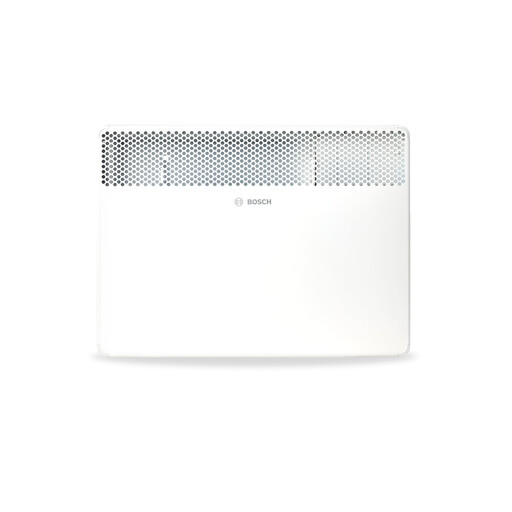
The CNS 500 Plus LCD is a 500 W wall-mounted convector heater for supplementary or transitional heating.
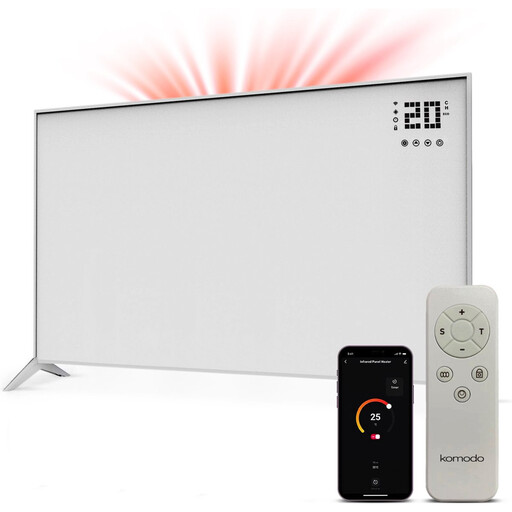
The Mon Soleil Frame 600 Wifi is a 600 W infrared panel.
The LAVA BASIC 3.0 range includes slim infrared panels for permanent wall or ceiling installation.
The P Series includes wall-mounted infrared panels in several power ratings, including a 600 W version.
The Citara T is a slim infrared wall panel available in several power ratings.
The selection below includes infrared heating panels for targeted warmth and electric convector heaters for warming the room air. Compare the power rating and installation options with your room, and check the documentation for the specific heater version before buying.
 No image available
For targeted infrared warmth, with the option of wall-mounted or freestanding use.
The product title lists Wi-Fi app control and IP24, as well as wall-mounted and freestanding use.
 No image available
For situations where the main aim is to warm the air in the room.
The product description says it’s designed for rooms up to 15 m² and lists a weekly programme, open-window detection and wall-mounted or freestanding use. Feet are available separately.
 No image available
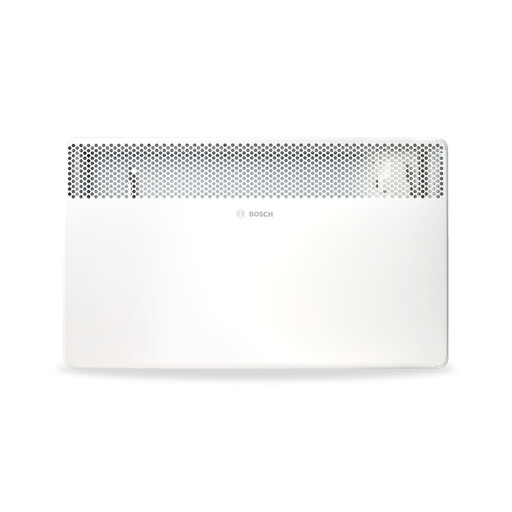
For situations where the main aim is to warm the air in the room.
The product description says it’s designed for rooms up to 20 m² and lists a weekly timer, open-window detection and wall-mounted or freestanding use. Feet are available separately.
 No image available
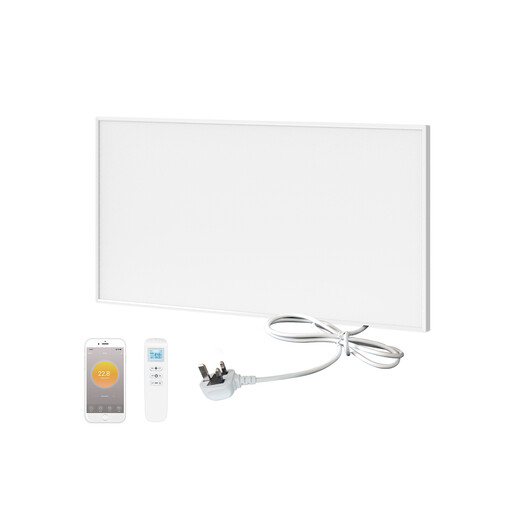
For targeted infrared warmth, with the option of a slim panel for wall-mounted or freestanding use.
The description lists a surface temperature of 80–100 °C, along with a remote control and overheat protection. Keep the specified distance from children and flammable materials.
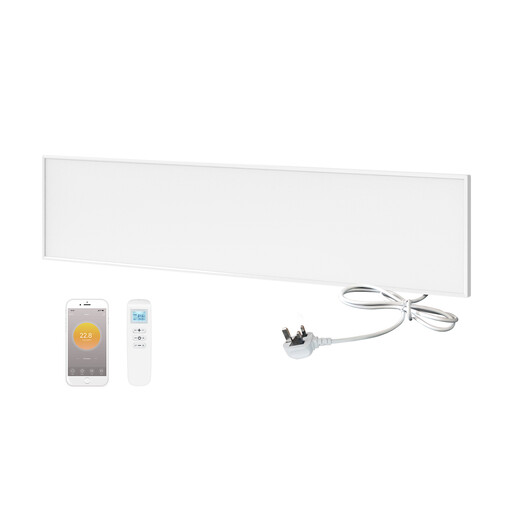 No image available
For targeted infrared warmth, with the option of a slim panel for wall-mounted or freestanding use.
The description lists a surface temperature of 80–100 °C, along with a remote control and overheat protection. Keep the specified distance from children and flammable materials.
Multiply the rated power in kilowatts by the actual operating hours to estimate consumption in kilowatt-hours. A 600 W heater running continuously at full power for four hours would use 2.4 kWh; thermostat cut-outs will affect actual consumption. Then multiply the figure by your tariff rate.
Only if the manufacturer approves freestanding use and suitable feet for that specific version. Eurom lists feet for the Mon Soleil Frame 600 Wifi; VASNER says feet aren’t suitable for the 300 W version of the Citara T.
Follow the instructions for the specific model, especially those covering installation, surroundings, connection and safety warnings. Check regularly that the appliance is in good condition. If you’re using a convector heater, don’t block the areas needed for air circulation.
The European Commission excludes electric local space heaters from the energy labelling rules for this product group. Ecodesign requirements may still apply, so the absence of an energy label alone doesn’t tell you whether a specific appliance complies.
The revised Ecodesign requirements under Regulation (EU) 2024/1103 apply to covered electric local space heaters placed on the EU market for the first time from 1 July 2025. Check the details for the specific heater version and, where relevant, its controller. The German Federal Institute for Occupational Safety and Health also explains the applicable CE marking requirements for electrical products; the marking alone is not an independent safety test of the specific heating panel.