
Lieferung heute & morgen

Qualitätsgarantie

Willkommens-Angebote freischalten: KOSTENLOSE Lieferung | Bis zu 80 % RABATT | Kostenlose 30-Tage-JoyPlus-Testphase
App herunterladen
An inspection camera endoscope helps you examine cavities, engines, walls or pipework without completely dismantling components. However, not every camera is suitable for every application. A probe that is too large, an inflexible cable or weak lighting can significantly limit its practical usefulness.
Before buying, you should therefore look beyond a high screen resolution or a large number of accessories. The key factors are the dimensions, probe manoeuvrability, image recording and power supply.
A probe with an 8.5 mm diameter may be sufficient for many engine or wall openings. However, for narrow gaps, HVAC systems or certain areas of a vehicle, a 5.5 mm probe may be the better choice. Check the smallest access point before buying and allow a little extra clearance.
A flexible cable can be bent, but that does not automatically mean you can guide the camera head precisely around obstacles. A pivoting endoscope camera with an articulating tip can provide more controlled changes in viewing direction. What matters here is the actual range of movement, not just the marketing claim of a “more flexible camera head”.
A display alone is often not enough for documented maintenance work. Photos and videos can be useful for customer jobs, later comparisons or internal maintenance records. Adjustable LED lighting is equally important, as is a battery that can run for long enough for your planned application.
For a pipe camera or automotive endoscope, the diameter of the camera unit is a key specification. 5.5 mm offers more possibilities in tight access points. 8.5 mm, on the other hand, may be a suitable option where the access point is larger and a more robust probe format is required.
Also check the specified depth of field. For example, the Teslong TD450S is stated to offer a range of 20 to 100 mm for the main camera. A second side camera can extend visibility in certain installation situations.
A probe with 210° two-way articulation allows you to guide the camera head around corners or components. The length should suit the intended application: for engines, walls and smaller machines, around 1.55 m or 5 ft is often sufficient. For long sections of pipework, you may need a different camera system.
A semi-rigid probe cable can offer a practical compromise. It can be shaped and holds its position better than a completely soft cable.
An integrated colour display allows you to use the device without a smartphone or additional app. Before buying, check the following:
For additional tasks, an LED inspection light may be useful. A rechargeable work light with magnetic mounting illuminates the work area while the camera is being used inside a component. A UV torch, on the other hand, serves a different purpose and should not be considered a replacement for an inspection camera.
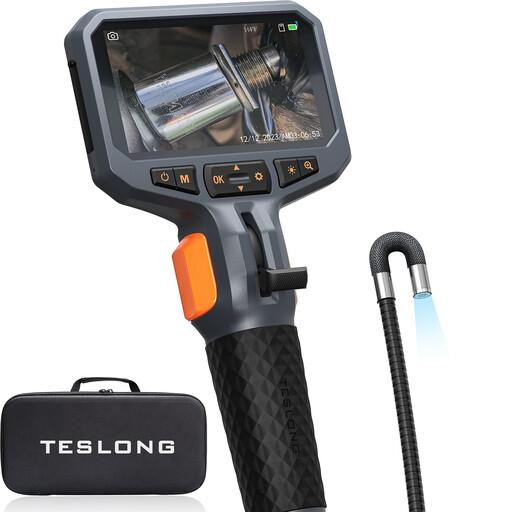
Why this product suits this profile: This device combines an 8.5 mm probe with an integrated 4.5-inch colour display, making it suitable for basic inspections of vehicles, walls and engines.
The technical specifications clearly state the probe diameter, probe length, display resolution and battery capacity. This makes it easier to compare the product’s suitability with the available access point before buying.
4.5-inch colour LCD, 1920 × 1080 pixel photo resolution and a 3500 mAh lithium battery.
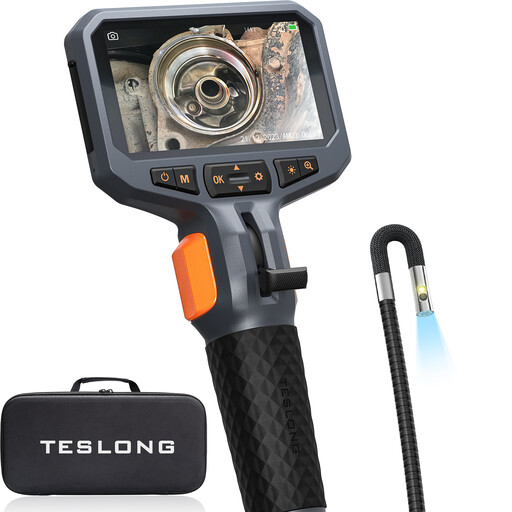
Why this product suits this profile: The dual-lens design is aimed at users who want to inspect areas to the side of the main view and document their inspections.
The articulating tip is controlled using a control element and can move by up to 210°, according to the product specifications. This is more meaningful than simply stating the flexibility of the cable.
Main and side cameras, video recording up to 1920 × 1080 pixels, plus TF card and USB connection.
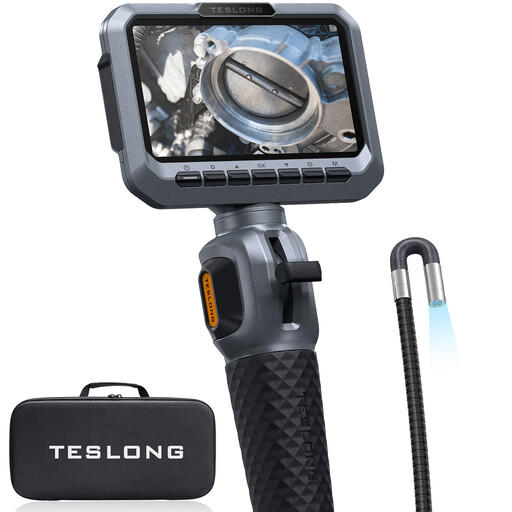
Why this product suits this profile: The slimmer probe is ideal for users who regularly inspect narrow access points in vehicles, HVAC systems, machinery or installations.
The 5.5 mm diameter reduces the access opening required. Six-level LED lighting allows you to adapt the brightness to different surfaces and internal spaces.
5-inch IPS display, 210° two-way articulation, 3000 mAh battery and supplied carry case.
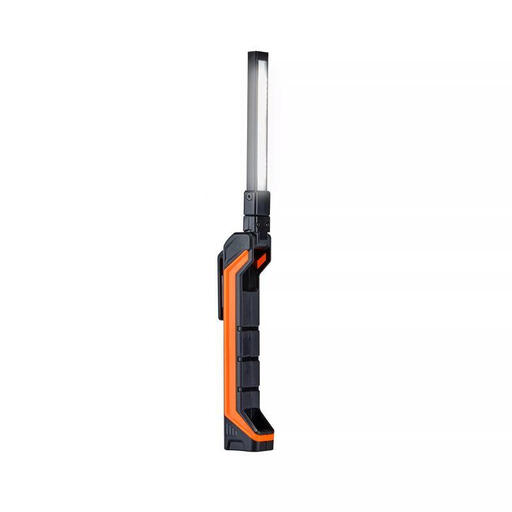
Why this product suits this profile: As a complement to an inspection camera, this compact magnetic work light illuminates the surrounding work area and enables hands-free working.
The stated light levels, run times and mounting features make the operating limits clear. This makes it easier to choose a light that suits the required working time.
Up to 200 lm, 180° pivoting, 360° rotation, magnetic mounting and up to 3 hours of run time in low mode.
A rechargeable work light is particularly useful when the camera is being used inside a component while the surrounding area still needs to remain visible. The OSRAM LEDinspect POCKET200 is specified with three lighting functions and brightness of up to 200 lm. Follow the manufacturer’s safety instructions: do not look directly into the LED beam and keep magnetic mounting points away from sensitive electronic devices.
A UV torch can be used as an additional tool for specialist visual inspections. The WUBEN E19ULV LED Penlight UV Light is described as offering IP68 water protection and a rechargeable design. However, it is intended for UV illumination and does not replace a camera with image recording or an articulating probe.
We have put together a complete, regularly updated list of products that fully meet these strict selection criteria and the safety regulations applicable in the EU.
It depends on the smallest access opening. For tight spaces, 5.5 mm is advantageous. Where openings are larger, 8.5 mm may be sufficient. You should also check the probe length, depth of field and range of movement.
Battery life depends on display brightness, LED power, recording function and battery capacity. The Teslong models mentioned come with batteries rated at 3000 and 3500 mAh respectively. For a specific operating time, refer to the manufacturer’s specifications or the instruction manual.
A pivoting model is useful when you need to inspect around obstacles, angles or side surfaces. For a straightforward visual inspection inside a straight cavity, a less manoeuvrable camera may be sufficient. The deciding factor is whether you need to position the camera head precisely at the point of use.