If you make several cups of instant coffee a day, a hot water dispenser that pours set portions can be handy, provided its footprint, tank access and dispensing options suit your kitchen and mugs. For the occasional cup, a kettle filled with only the water you need may be enough. The Verbraucherzentrale recommends filling a kettle with only the required amount of water; this does not mean that every portion-dispensing machine will necessarily cost more to run.
Who might want to buy one?
Coffee drinkers with limited worktop space
If you make instant coffee in a small kitchen, check the appliance’s width and depth, as well as the space needed to remove the tank. CASO Design lists the HW 610 at 145 × 305 × 270 mm and the HW 630 at 150 × 300 × 295 mm (W × H × D).
People who make individual cups several times a day
If you need hot water for each cup, dispensing a portion straight into your mug can save you a few steps. CASO Design lists preset dispensing quantities for the HW 610.
Buyers who care about maintenance and costs
If you want to understand the upkeep and ongoing costs before you buy, check the tank, descaling instructions and whether the filter may need replacing. CASO Design lists a descaling reminder and removable tanks for the HW 610 and HW 630.
What should you consider when buying?
Portion-dispensing hot water dispenser
A good fit if: You make individual cups several times a day and can find a dispensing quantity that suits you. CASO Design lists preset quantities for the HW 610, while the HW 630 offers additional quantities and continuous dispensing.
The trade-off: The appliance takes up permanent worktop space and needs maintaining. CASO Design lists removable tanks and a descaling reminder for both models.
Kettle filled with only the water you need
A good fit if: You only need hot water occasionally, or you’d rather not keep another appliance on your worktop.
The trade-off: The water is heated in the kettle rather than directly in your mug. The Verbraucherzentrale recommends filling it with only the amount you need; compare electricity use based on how you actually use it.
| Buying priority |
What to check before buying |
Who it matters most to |
| Worktop space and tank access |
Compare the width, height and depth, how the tank is removed and the space for your mug. CASO Design lists the HW 610 at 145 × 305 × 270 mm and the HW 630 at 150 × 300 × 295 mm (W × H × D). |
If I have limited worktop space, the tank also needs to be easy to remove. Around 36% of consumers put space requirements first. |
| Quick individual cups |
Check whether the appliance dispenses set portions and what quantities you can select. |
If I make individual cups several times a day, dispensing straight into my mug matters most. Around 29% of consumers prioritise the convenience of making a single cup. |
| Suitable water quantity and temperature |
Compare your mug’s capacity with the dispensing quantities and check which temperature settings are available. CASO Design lists 150, 200, 250 and 300 ml for the HW 610; the HW 630 offers additional quantities and continuous dispensing. |
If my mug doesn’t suit a preset portion, I need a choice of quantities. Around 21% of consumers prioritise getting the right portion. |
| Cleaning and ongoing requirements |
Check the descaling instructions, whether the tank is removable, and the compatibility and replacement schedule of any filter you use. |
If I want to keep maintenance simple, I look at the tank and any filter requirements. Around 14% of consumers put ease of maintenance first. |
Common buying mistakes
-
Comparing only the appliance’s width
An appliance may be narrow enough but still take up too much depth or make it difficult to reach the tank.
Measure the width and depth of the space, and allow room for your mug and to remove the tank.
-
Assuming a fast dispensing time means lower electricity costs
A short stated dispensing time does not, by itself, prove that an appliance will cost less to run. The Verbraucherzentrale recommends filling a kettle with only the amount of water you need.
Choose based on how often you’ll use it, and compare how much water you actually heat for a typical cup.
-
Overlooking filter and descaling requirements
If an appliance uses a filter cartridge, you’ll need to replace it as part of ongoing use. You should also factor descaling into your maintenance routine.
Check whether you want to use a filter and which replacement is suitable for the specific model.
Brands and models to consider
The details below relate to the models and product ranges listed; a brand being mentioned does not mean that its products are available at Joybuy.
CASO Design
The HW 610 and HW 630 are designed to dispense set portions of hot water. CASO Design lists four preset quantities for the HW 610, while the HW 630 offers additional quantities and continuous dispensing.
- CASO Design lists a removable 2.5-l tank and a descaling reminder for both models.
- Check the footprint and tank access; if you use a compatible filter, remember to factor in replacements.
Philips
The Philips ADD5910M/10 may be worth considering if you want more than just instant coffee, with a choice of hot water portions and temperature settings.
- Philips lists six preset temperatures for this model, along with quantities of 150, 250, 300, 400 and 500 ml, as well as other quantities.
- The F.A.Z. buying guide describes this model’s child lock as awkward to use. Check whether the controls will suit your daily routine.
ProfiCook
According to ProfiCook, the PC-HWS 1168 is a hot water dispenser with a removable tank and adjustable temperature and quantity settings.
- ProfiCook lists a 2.2-l tank and a temperature range from 45 °C to 100 °C.
- If worktop space is limited, compare the dimensions of the specific appliance with the space you have available.
Seeger
The Seeger InstantHeat SGR1150BK is another option, with a choice of portion sizes.
- Seeger lists four quantities of 150, 250, 350 and 500 ml, as well as temperature settings up to 100 °C; 90 °C is recommended for coffee and instant drinks.
Hot water dispensers at Joybuy
This selection includes countertop hot water dispensers for hot water and drinks. For each model, check the footprint, tank access and the settings specifically listed.
 No image available
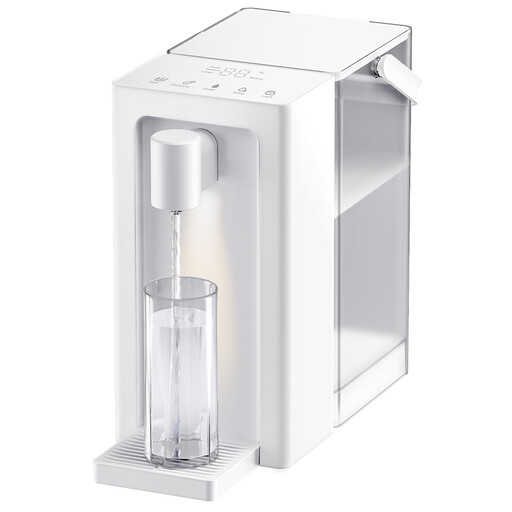
Hot water dispenser with 3-l tank and 25–100 °C temperature selection
For instant coffee if you want to choose the temperature and use a removable tank.
Touch controls and memory function.
View at Joybuy
 No image available
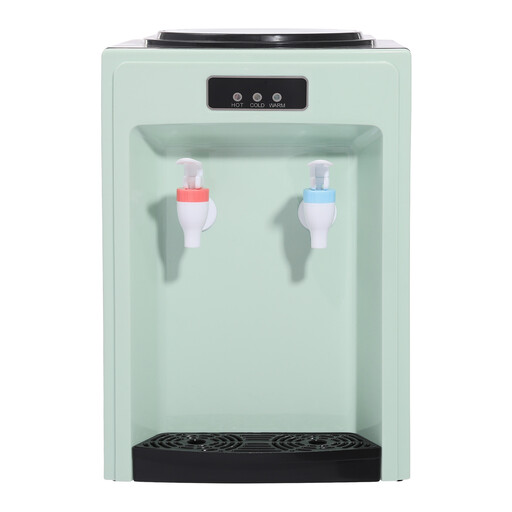
Compact electric hot water dispenser, green
A countertop appliance for hot water if you’re looking for a compact design.
Green finish.
View at Joybuy
 No image available
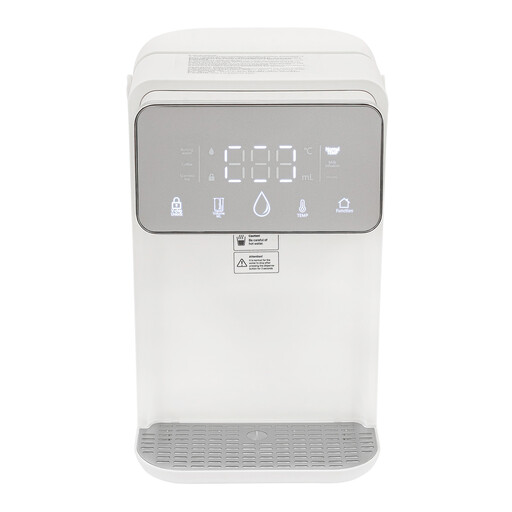
Countertop hot water dispenser, 3.5 l
For coffee and other hot drinks if you’re looking for a countertop appliance.
Digital display; listed for use with coffee, tea and milk-based drinks.
View at Joybuy
 No image available
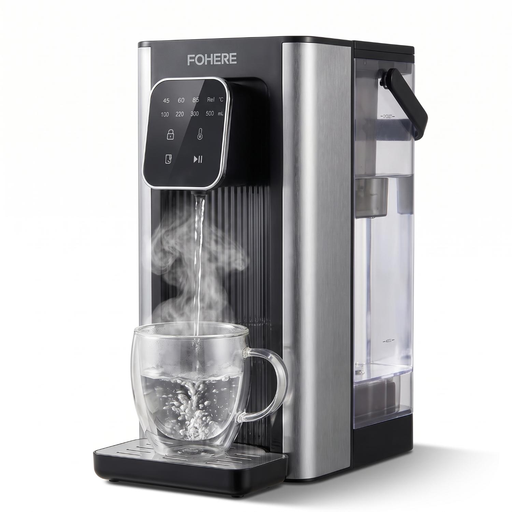
FOHERE hot water dispenser, 2.5 l, 2600 W
For instant coffee if you want a choice of temperature settings.
Four temperature settings and a child lock.
View at Joybuy
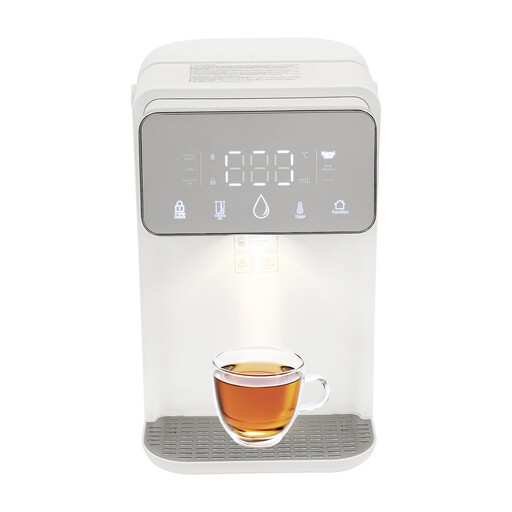 No image available
Countertop hot water dispenser, 3.5 l, 2000 W, 150–500 ml
For portioned instant coffee if you want to adjust the water quantity and temperature.
Temperature settings from 25 °C to 99 °C.
View at Joybuy
Frequently asked questions
What should I consider when setting one up in a small kitchen?
Measure not only the width, but also the depth, space for your mug and room to remove the tank. CASO Design lists the HW 610 at 145 × 305 × 270 mm and the HW 630 at 150 × 300 × 295 mm (W × H × D); also follow the set-up instructions in the relevant user manual.
Do I need water at 100 °C for instant coffee?
You don’t necessarily need to assume that 100 °C is essential. Follow the preparation instructions for your instant coffee and check whether the appliance has a suitable setting. A temperature setting on the appliance does not automatically measure the temperature in your mug.
What additional running costs might there be?
If you use a compatible filter, remember to budget for replacements. CASO Design says that each filter in its replacement filter set lasts around four to six weeks and has a capacity of 160 l; replacement needs and ongoing costs depend on usage and compatibility with your appliance. You should also factor in descaling and electricity use.
Is CE marking an independent safety test?
No. New mains-powered appliances covered by Germany’s 1. ProdSV, particularly those operating at 50 to 1.000 V AC, must meet the relevant safety and conformity requirements. The Federal Institute for Occupational Safety and Health and the EU information site Your Europe explain that CE marking is the manufacturer’s declaration that the relevant requirements have been met, not an independent test mark.


