Parents short on time in the evening
If you need to prepare porridge quickly, it’s worth looking for flakes specifically labelled as quick-dissolving or very fine. You can then check whether the porridge has the texture you want as you prepare it.


For a quick, unsweetened porridge, you could choose instant oats or fine flakes specifically labelled as quick-dissolving, with a straightforward ingredients list. However, ‘no added sugar’ does not mean ‘sugar-free’: the nutrition information on the specific pack matters too. Whether porridge works as an evening meal depends on the meal as a whole and your child’s needs.
If you need to prepare porridge quickly, it’s worth looking for flakes specifically labelled as quick-dissolving or very fine. You can then check whether the porridge has the texture you want as you prepare it.
If you want to choose the ingredients in your porridge yourself, check both the ingredients list and the ‘of which sugars’ line in the nutrition information. A recipe with no added sugar can still contain sugar.
If your child has coeliac disease or has been advised by a doctor to follow a gluten-free diet, ordinary oats are not automatically suitable. Look for an explicit gluten-free label and follow individual medical advice.
Start by checking the ingredients and sugar information, then look at the stated solubility and the porridge texture you want. Any medical requirement to avoid gluten takes priority over these general selection criteria.
| Criteria | What to check when buying | Who it matters most to |
|---|---|---|
| Sugar and ingredients | Read the ingredients list and the ‘of which sugars’ figure per 100 g; don’t assume ‘no added sugar’ means ‘sugar-free’. | If I want to control the sweetness of the oat base myself, I need to distinguish added ingredients from the stated sugar value. Around 42% of consumers would put this question first when buying. |
| Solubility and texture | Look for ‘quick-dissolving’, ‘instant’ or ‘melt-in-the-mouth’, and check the preparation instructions. | If dinner needs to be ready quickly, I look for an oat base that can be mixed to the soft texture I want. Around 33% of consumers would put this feature first. |
| Gluten and allergens | If gluten must be avoided for medical reasons, check for an explicit gluten-free label; for other allergies, check the ingredients and precautionary allergen information. | If my child needs to avoid gluten for medical reasons, I can’t rely on the word ‘oats’ alone. This reassurance would be the main concern for around 17% of consumers. |
| Role in the meal | Consider how the oat base fits in with other meals and, where appropriate, suitable additions. | If I’m planning porridge for dinner, I don’t want to assume it’s a complete meal just because of the type of flakes. Around 8% of consumers would mainly want to clarify this. |
An oat base with no added sugar can still contain sugar. The Rural Service Centre Rhineland-Palatinate explains that the ‘sugar-free’ claim allows no more than 0.5 g of sugar per 100 g or 100 ml. Kölln states that its instant oats contain 1.2 g of sugar per 100 g.
Compare the ingredients list with the ‘of which sugars’ figure per 100 g, rather than relying only on a claim about added sugar.
The type of flakes alone doesn’t tell you how the meal fits into your child’s diet across the day. The Federal Centre for Health Education considers regular meals in the context of the whole day.
Think of porridge as a possible base and take your child’s age, appetite, other meals and any suitable additions into account.
Ordinary oat products aren’t suitable for coeliac disease or a medically advised gluten-free diet just because they’re made from oats. An explicit gluten-free label is a separate selection criterion in these cases.
Choose products according to their labelling and your individual medical or dietary advice.
Kölln describes its instant oats as a quick-dissolving product made from 100% wholegrain oats.
Alnatura describes its melt-in-the-mouth organic oats as ultra-fine, quick-dissolving wholegrain flakes.
The organic oats described by REWE provide an oat base, but aren’t specifically labelled as instant.
Brüggen says it processes and packages products including oats, and REWE lists the company as a contact for an organic oat product.
This selection includes instant oats and an oat cereal porridge. If you’re specifically looking for a product labelled as instant, don’t assume the two types are interchangeable.
 No image available
An instant oat base for anyone who wants to mix up some porridge in the evening. Check the ingredients, sugar content and preparation instructions on the specific pack; ‘instant’ doesn’t mean sugar-free or that it’s a complete meal.
 No image available
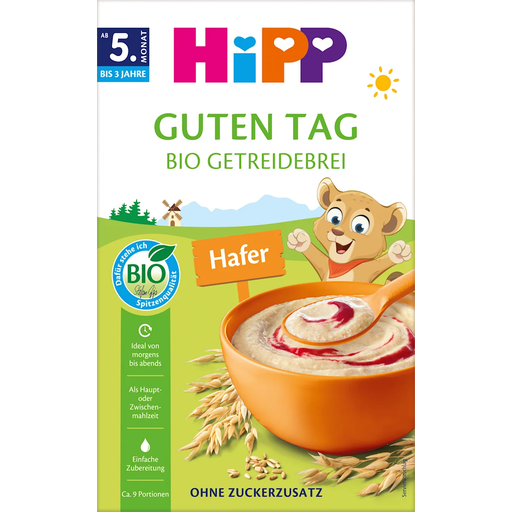
An oat cereal porridge for families who want to consider a product described as porridge rather than instant flakes. The product name says it’s suitable from 5 months; this doesn’t confirm that it’s instant or that the porridge alone makes a complete evening meal. Check the current pack labelling and preparation instructions.
No. ‘No added sugar’ and ‘sugar-free’ mean different things. According to the Rural Service Centre Rhineland-Palatinate, ‘sugar-free’ means no more than 0.5 g of sugar per 100 g or 100 ml; Kölln states that its instant oats contain 1.2 g per 100 g.
Not automatically. Porridge is a cereal base; whether it’s suitable as a meal also depends on your child’s age, appetite, any additions and their diet throughout the day. The Federal Centre for Health Education places individual meals within a regular daily routine.
No, a gluten-free speciality product isn’t necessary just because your child is a toddler. If they have coeliac disease or have been advised to follow a gluten-free diet for medical reasons, look for products explicitly labelled gluten-free and follow individual medical advice; ordinary oats aren’t automatically interchangeable with these products.
Follow the preparation instructions on the specific pack and check the texture before serving. Kölln and Alnatura describe their respective quick-dissolving oat products as suitable for mixing with warm or cold liquid; if you prepare it warm, let the porridge cool sufficiently before serving.