
Lieferung heute & morgen

Qualitätsgarantie

Willkommens-Angebote freischalten: KOSTENLOSE Lieferung | Bis zu 80 % RABATT | Kostenlose 30-Tage-JoyPlus-Testphase
App herunterladen
Interactive baby toys combine movement, sounds, lights or changeable play elements. For babies and toddlers, this can be engaging because their own action directly triggers a reaction. At the same time, the choice can be overwhelming: age recommendations, battery operation, materials and safety information vary significantly.
As a Joybuy Product Recommendation Officer, I filter the most important selection criteria from the product details. This helps you better assess marketing claims and avoid making the wrong purchase.
A toy with music, lights, buttons and movement may look versatile at first glance. For younger babies, however, large, clearly recognisable controls can be more useful than lots of small features. What matters is whether the child can trigger an action themselves and whether the response is easy to understand.
With motor skills toys for babies, grasping, pressing, turning or tracking should be the focus. A long list of features is no substitute for age-appropriate design.
“For babies” is not a precise enough description. A product intended for 6 months may be used differently by a crawling baby compared with a two-year-old toddler. Additionally, warning labels may specify a higher minimum age.
So pay attention to:
The CE mark is a legally required conformity marking, not an independent quality seal. When looking at offers, you should also be able to verify the manufacturer’s details, warnings and information about the responsible person in the EU. The EN 71 standard covers various requirements for toy safety, including mechanical and physical properties and flammability.
Claims such as “BPA-free” or “rounded edges” should be treated as specific product features. They do not replace checking for damaged parts, loose elements or an unsafely accessible battery compartment.
For babies from around six months, floor-level products that can be reached while sitting or lying on their tummy are often suitable. A moving toy can encourage eye contact and reaching, but should only be used on a clear, flat surface. For toddlers between one and three years old, activity cubes or play tables with multiple ways to interact may be more interesting.
The right activity toy from 6 months should be chosen not just by calendar age but also by the child’s current mobility. For products with wheels, cables or small accessories, direct supervision is especially important.
ABS plastic is commonly used in many electronic toys. Check whether the manufacturer provides information about materials, edges and any loose parts. Smooth surfaces make cleaning easier; plush products, on the other hand, often have special care instructions.
A sensory toy should offer visual and auditory stimulation within a controllable range. A volume control or a sleep mode is practical in everyday life, especially in flats, when travelling or during shared quiet times.
With baby toys with lights and music, you should check:
With regular use, battery costs and disposal can become relevant. Rechargeable batteries are a possible option, provided the manufacturer allows them for the product. Batteries should always be kept out of children’s reach.
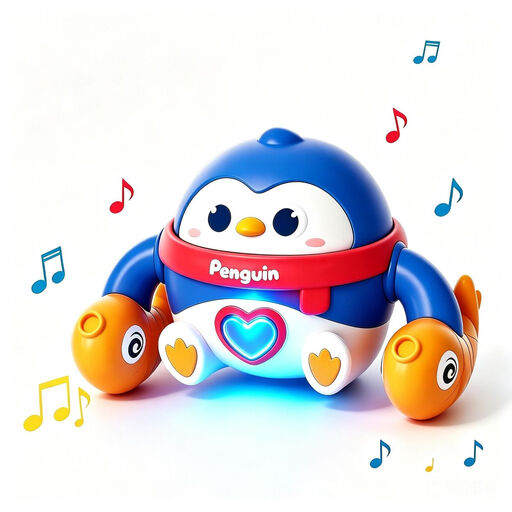
Why this product fits the profile: The rolling penguin toy combines movement, lights and melodies in a compact format. According to the product details, it is intended for 6 to 36 months; batteries are not included.
The features are clearly described: 360-degree rolling, motion sensor, LED heart and music. This makes it easier to assess before buying whether the child can understand the responses.
ABS plastic, BPA-free material claim, rounded edges and a sensor to restart by clapping or tapping.

Why this product fits the profile: According to the product details, the cube is aimed at children aged 1 to 3 years and offers multiple play surfaces for different play interests.
The age limit and dimensions of 23 × 23 × 24 cm are stated. This makes it easier to check whether the toy fits the available play area.
Eight described play areas with piano, guitar, telephone, gears and music; carry handle for transport.
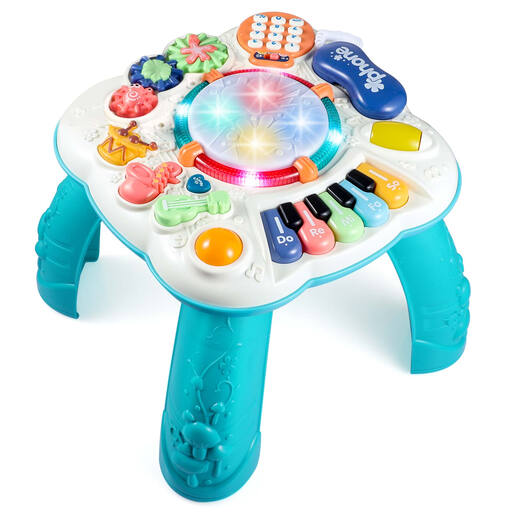
Why this product fits the profile: According to the product description, the removable legs allow it to be used as a floor play mat or as a table for standing children.
A stated volume control and a sleep mode help manage the music in everyday life. Before use, the stability should be checked according to the child’s posture.
Six play zones with piano, drum, telephone, gears and instrument keys; two usage modes thanks to removable legs.
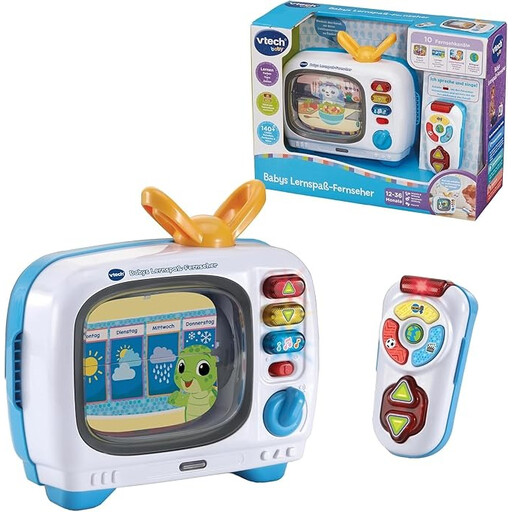
Why this product fits the profile: According to the product details, this electronic learning toy is intended from 12 months and works with buttons, lights, songs, animal sounds and concepts for numbers, shapes and colours.
The age warning mentions small parts and excludes use under one year. This defines the target group more clearly than generic baby claims.
Stated for children from 12 months, 2 AAA batteries included according to product data, multiple button and learning functions.
We have put together a complete, regularly updated list of products that fully meet these strict selection criteria and the safety regulations in force in the EU.
Even suitable learning toys for babies should be checked regularly. Before each use, check:
Electronic toys must not be immersed in water unless this is expressly intended. If the toy is not used for a long time, it is advisable to remove the batteries as per the manufacturer’s instructions. For children under three, warning labels must be followed particularly carefully.
That depends on the specific product. Some items are stated by the manufacturer as suitable for 6 to 36 months, others only from 12 months or 3 years. The age marking, warnings and the child’s abilities are always decisive.
A generally applicable volume limit cannot be derived from the product description without specific measurement data. Choose models with volume control where possible, avoid placing them directly next to the ear and only use music for limited periods.
The lifespan depends on the material, frequency of play, batteries, cleaning and storage. Simple mechanical elements can remain interesting across several developmental stages, while electronic functions may be limited by wear or flat batteries. Check the toy regularly and replace it if damaged.