
Lieferung heute & morgen

Qualitätsgarantie

Willkommens-Angebote freischalten: KOSTENLOSE Lieferung | Bis zu 80 % RABATT | Kostenlose 30-Tage-JoyPlus-Testphase
App herunterladen
Interactive baby toys are designed to spark curiosity, engage the senses and encourage babies to reach, press and move. However, choosing the right product is not always easy for parents, grandparents and other family members. Many products use terms such as “Montessori”, “educational toy” or “sensory development”, even though important details may only become clear in the small print.
A baby activity cube with numerous buttons, melodies and moving elements can offer plenty of variety. What matters, however, is whether the functions are suitable for the child’s age and easy to use. Too many stimuli can be confusing, particularly for younger children. So look for a clearly stated age recommendation and check whether the individual activities work without complicated instructions.
BPA-free materials are a useful indication, but they are not proof on their own that a toy is safe. You should also check:
Toys for babies and toddlers should always be used under supervision, even when the product is intended for a particular age group.
A toy with lights and music can focus a child’s attention and encourage cause-and-effect learning. However, this does not guarantee any particular learning or developmental benefit. Look for volume control, automatic shut-off and the option to switch off the light or sound functions when needed. With musical toys for babies, keeping the volume moderate in everyday use is particularly important.
For babies aged 0 to 6 months, lightweight rattles, soft activity books and toys with different textures are suitable options. From around 6 months, larger buttons, drums and moving elements may become more interesting. For toys for 6 to 36 months, robust shapes, a stable base and controls that are easy to reach are important.
Products with wheels or movement require sufficient clear floor space. A rolling toy can encourage a child to reach out and crawl after it, but it may not suit every home.
ABS plastic is often used for robust activity cubes and musical toys. Features such as BPA-free materials, rounded edges and no loosely fitted small parts are useful points of reference. Nevertheless, check regularly for cracks, sharp edges or damaged battery compartments.
Size matters too. A 23 × 23 × 24 cm cube may reduce the number of separate toys needed in a child’s room, but it is larger to take out and about than a small activity book. Soft books should be cleaned according to the manufacturer’s instructions; electronic units must be removed before washing.
For toys that encourage fine motor skills, pressing, turning, sliding, gripping and inserting are all relevant play activities. A motor skills toy with a few clearly distinguishable tasks may be more practical for everyday use than a product with lots of similar buttons.
Look out for these technical features:

Why this product suits the profile: This compact cube combines several types of play, including a piano, guitar, telephone, gears and musical functions, in one product for children aged 1 to 3 years.
The individual activities are distributed around the cube and can be operated by turning, pressing or sliding. Before buying, check the age recommendation, batteries and current warnings.
The product description states that it is made from ABS and BPA-free material, with rounded edges and dimensions of 23 × 23 × 24 cm; it also has a carry handle.
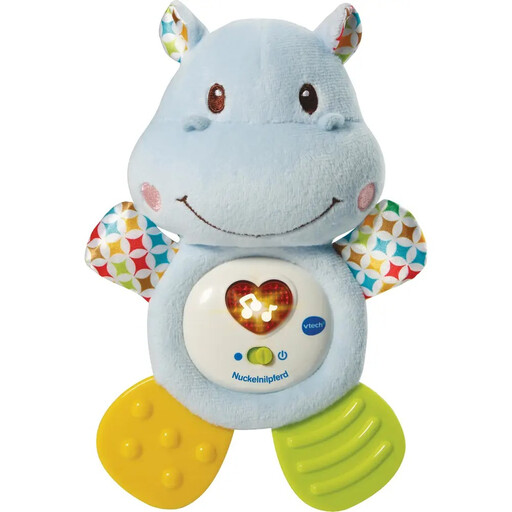
Why this product suits the profile: According to the product details, this soft baby toy is suitable from 0 to 2 years and combines different materials with lights, sounds and teething feet.
The product details mention volume control, a childproof battery compartment and automatic shut-off. Check these details against the packaging before buying.
Three sung songs, ten melodies, different textures and two soft teething feet; the description states that demo batteries are included.
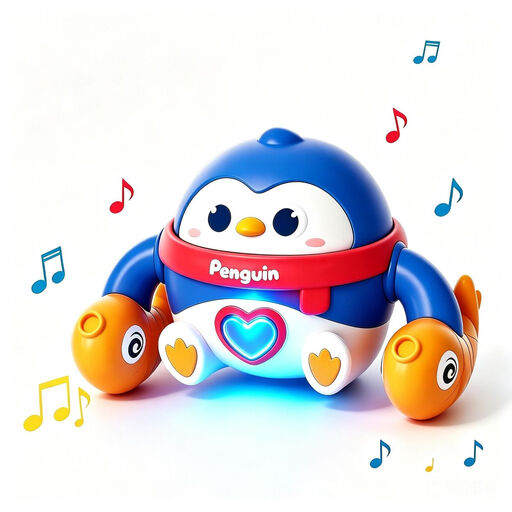
Why this product suits the profile: For families with sufficient play space, this penguin combines rolling movement, LED lights, music and a motion sensor. The stated age range is 6 to 36 months.
The movement function is clearly described. As batteries are not included and the toy rolls, plan ahead for the power supply, available floor space and supervision.
360-degree rolling movement, a sensor that responds to clapping or tapping, and a glowing heart; according to the product description, it is made from ABS, BPA-free and has rounded edges.
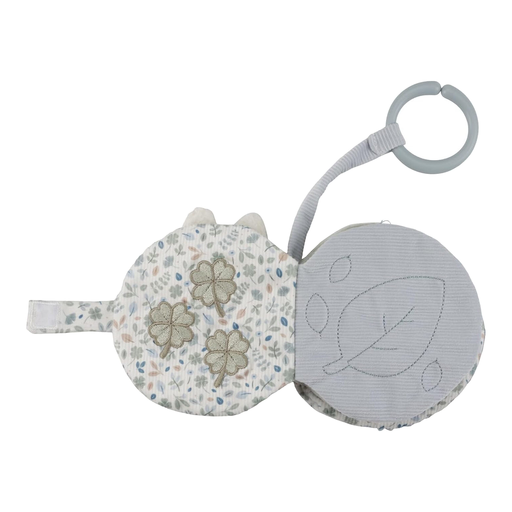
Why this product suits the profile: According to the product details, this soft activity book is suitable from birth. With a ring, crinkle paper, sounds and a mirror, it is ideal for prams or short periods of play.
The book does not require batteries and offers a range of fabric textures and sounds. Important: the product details also include a warning about possible small parts and recommend supervision.
Compact dimensions of 13.5 × 13.5 × 6 cm, 100% polyester according to the description, and an attachment ring for the pram.
We have put together a complete, regularly updated list of products that fully meet these strict selection criteria and the safety regulations applicable in the EU.
From 6 months, easy-to-grip toys with large buttons, different textures, music or simple cause-and-effect functions may be suitable. A toy should stand securely or move in a controlled way. Small parts, long cords and difficult-to-access battery compartments should be checked carefully.
Battery life depends on the battery type, volume, length of use and the number of light or sound functions. Before buying, check whether batteries are included. With products without automatic shut-off, switching the toy off frequently can help extend battery life. Batteries must be kept out of children’s reach and removed if the toy will not be used for an extended period.
For many products, the term “Montessori” refers to an approach based on independent discovery, but it is not a standardised safety or quality seal. Electronic functions do not automatically rule out this type of design. What matters is that the controls are straightforward, the materials are age-appropriate and the child can take an active role. Interactive baby toys should be viewed as a supplement, not a replacement for playing, talking and moving together.