
Lieferung heute & morgen

Qualitätsgarantie

Willkommens-Angebote freischalten: KOSTENLOSE Lieferung | Bis zu 80 % RABATT | Kostenlose 30-Tage-JoyPlus-Testphase
App herunterladen
Interactive learning toys for babies and toddlers should keep them occupied, encourage them to explore and suit their stage of development. In practice, however, choosing the right toy is not always easy. Many product descriptions list numerous features but leave important details about age suitability, volume, cleaning and small parts unclear.
Parents, grandparents and gift buyers should therefore look beyond the number of play modes. The key factors are a suitable age range, clear safety information and a design that fits the child's everyday life.
An activity cube, baby activity table or musical toy may include several buttons, lights and sounds. This is useful if a child enjoys switching between different activities. For younger babies, however, too much stimulation can be confusing. Check whether the functions are clearly separated and whether the child can operate them independently.
The “from 1 year” recommendation is an important guide, but it is not a complete safety guarantee. For products with batteries, shape sorters or moving parts, you should also read the warnings. Small parts must be kept out of reach of children for whom the toy is not yet suitable. It is also sensible to check every baby toy regularly for cracks, loose components or sharp edges.
Musical toys for toddlers can quickly become loud in everyday use. A volume control or quiet mode is particularly useful in flats, during nap time or when travelling. Also check whether batteries are included, which battery size is required and whether the battery compartment can be closed securely.
For babies from around 6 months, toys that can be reached while lying down or during tummy time are generally more suitable. A rolling sensory toy can encourage eye contact and grasping without requiring the child to stand. A baby activity table with removable legs, on the other hand, can adapt as the child progresses from floor play to standing play.
For learning toys from 1 year, pressing, turning, sorting and sliding are typical ways to play. A motor-skills loop or shape sorter is suitable for children who can grasp objects purposefully and experiment with simple relationships. For children from 2 years, active toys such as an inflatable bouncy toy may also be appealing.
Look for smooth, rounded surfaces and a sturdy construction. For plastic products, details such as ABS or BPA-free can be helpful, but they do not replace checking the complete product information. CE indicates the required conformity within the European Economic Area; EN 71 refers to toy safety requirements. The specific markings and warnings should be clearly shown on the product itself or in the instructions.
For wooden toys, a splinter-free surface, neatly finished openings and secure joints are important. The Hauck shape sorter, for example, is stated to be made from wood sourced from FSC-certified forests. Even so, damaged or loose parts should be removed immediately.
A toy with lots of features is only practical for everyday use if it is easy to clean and store. Compact dimensions and a carry handle can be useful for visits, travelling or trips to restaurants. Electronic toys should generally only be cleaned with a slightly damp cloth. Water must not get into the speaker, battery compartment or charging ports.

Why this product suits this profile: The compact cube combines eight activities, including piano keys, gears, telephone and musical elements, in a 23 × 23 × 24 cm footprint. It is a space-saving option for families looking for a variety of play prompts in one product.
The 1 to 3-year age range, rounded edges and indication that there are no loose parts make it easier to shortlist. Volume and battery requirements should still be checked before purchase.
Eight different controls, a compact format and an integrated carry handle, according to the product description.
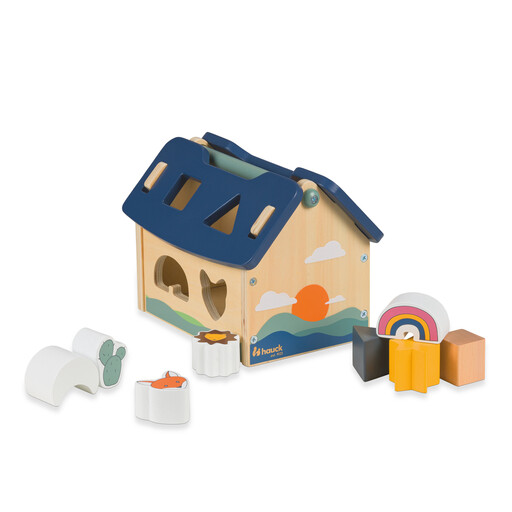
Why this product suits this profile: Made from FSC-certified wood, this shape-sorting house is designed for children from 12 months. It focuses on shapes, colours and matching blocks, without electronic sounds or batteries.
The manageable number of eight blocks keeps the activities clear and straightforward. As small parts are included, the age limit should be observed and children should be supervised during use.
FSC-certified wood according to the product details, a removable roof and storage space for the blocks.
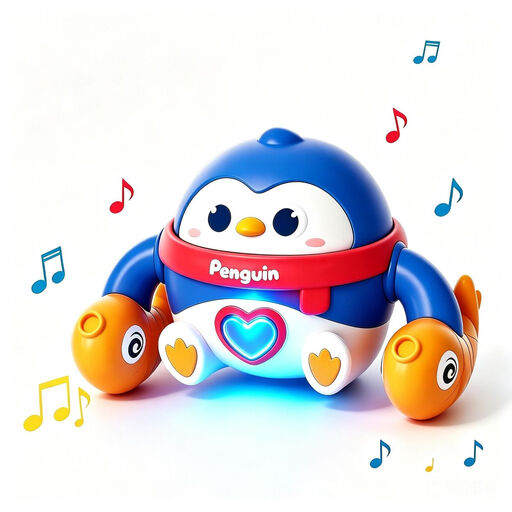
Why this product suits this profile: Designed for 6 to 36 months, the rolling penguin combines movement, lights and music. It is a good fit for families looking for a sensory toy for floor play and crawling stages.
The age recommendation and indication of rounded edges help with assessing suitability. As batteries are not included and the toy moves around, plan for the power supply, clear floor space and supervision.
360-degree rolling movement, a motion sensor and a light-up element according to the product description.
We have put together a complete, regularly updated list of products that fully meet these strict selection criteria and the safety regulations applicable in the EU.
For children from 1 year, suitable options include shape sorters, motor-skills toys, activity cubes and simple musical toys. The important thing is that the functions can be operated by pressing, turning, sliding or sorting, and that the toy does not contain unsuitable small parts. The age recommendation for the individual product remains decisive.
Lifespan depends on the materials, use, storage and care. Electronic products should be protected from moisture. With wooden toys, regular checks of the joints and surfaces are advisable. Damaged parts should not be used any further, even if the toy still works otherwise.
For battery-operated products, replacement battery costs depend on how often the toy is used. Some models, for example, require two AAA batteries, while other devices use rechargeable batteries. Before buying, it is worth checking the power supply, automatic switch-off function and volume control.