
Lieferung heute & morgen

Qualitätsgarantie

Willkommens-Angebote freischalten: KOSTENLOSE Lieferung | Bis zu 80 % RABATT | Kostenlose 30-Tage-JoyPlus-Testphase
App herunterladen
Interactive learning toys for babies and toddlers combine movement, sounds, lights and simple controls. However, choosing the right product is not always easy for parents and relatives. Many products promote Montessori concepts, early-years development or an especially wide range of functions. What matters is not the number of effects, but whether the toy suits the child’s age, home environment and stage of development.
A baby activity cube with several sides may appear versatile. However, for a six-month-old baby, large, easy-to-reach elements are more important than complex sequences of buttons. Conversely, a simple musical toy for a three-year-old can quickly lose its appeal.
You should therefore look for:
Musical toys, children’s keyboards and kids’ drum sets can quickly become loud indoors. A volume control or mute mode is therefore particularly useful in homes with several households. Also check whether batteries are included, which type of battery is required and whether the product has an automatic shut-off function.
Terms such as “non-toxic”, “shatterproof” or “safe for babies” should not be accepted without checking. More meaningful information includes specific details about the material, age range, warnings and product labelling. A CE marking indicates the manufacturer’s declaration that the product complies with relevant EU requirements; it does not replace an adult’s review of the instructions for use. Supervision is particularly important for products with small parts, battery compartments or moving components.
Baby toys from 6 months are generally suitable when they have large, easy-to-grip elements and no loose small parts. A rolling toy can encourage crawling, but should only be used on a clear, level surface. A musical table for babies is a good choice once the child can sit or stand securely, or if the product is explicitly approved for use as a floor play board.
For children between one and three years old, motor skills toys, rotary knobs, cogs, buttons and simple role play are appealing. From around the age of three, programmable robots or learning pens can offer additional activities, provided the warnings are followed.
For plastic toys, details such as ABS, BPA-free and rounded edges are useful. Nevertheless, check the following before first use:
The product details in the selection below mention ABS plastic, rounded edges and BPA-free materials. These details relate to the respective product descriptions and should be checked against the packaging and instructions.
Sensory toys should engage several senses without constantly overwhelming the child with stimuli. Useful features include a clear connection between an action and its response, adjustable volume and switchable light or sound effects. A children’s keyboard encourages children to press individual keys, while a moving toy can also involve visual tracking and gross motor activity.
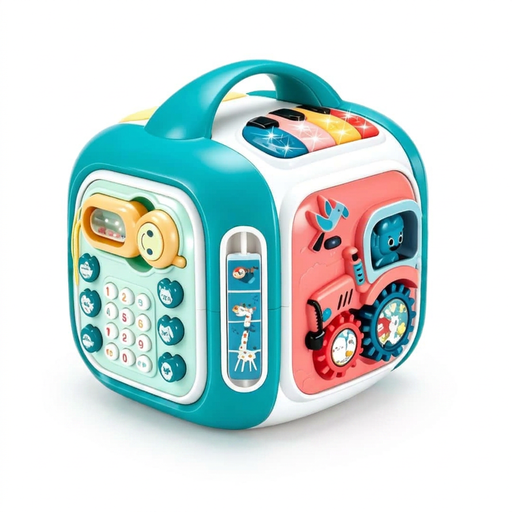
Why this product suits the profile: This compact cube combines eight play areas, including a piano, guitar, telephone function, cogs and a musical windmill. It is ideal for families looking for several sources of stimulation in one product.
The age range and dimensions of approximately 23 × 23 × 24 cm are specified. This makes it easier to assess whether the cube is suitable for the child and the intended play area.
ABS, BPA-free material, rounded edges and a carry handle. The different twisting, pressing and rolling activities support fine motor skills.
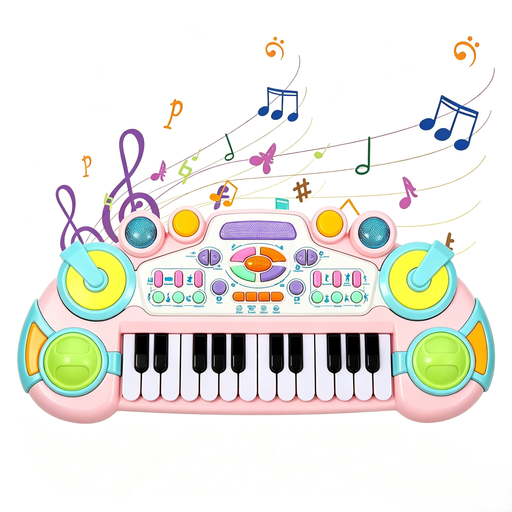
Why this product suits the profile: According to the product description, the keyboard has 24 keys, several sound modes, light effects, volume control and a mute function. It is a good fit for families who want to incorporate musical play into everyday life in a controlled way.
The adjustable volume and mute mode reduce the risk of the instrument being used at an uncomfortably high volume indoors.
Twenty-four standard keys, animal sounds and drum rhythms provide a variety of ways to play. According to the product information, batteries and microphone are not included.
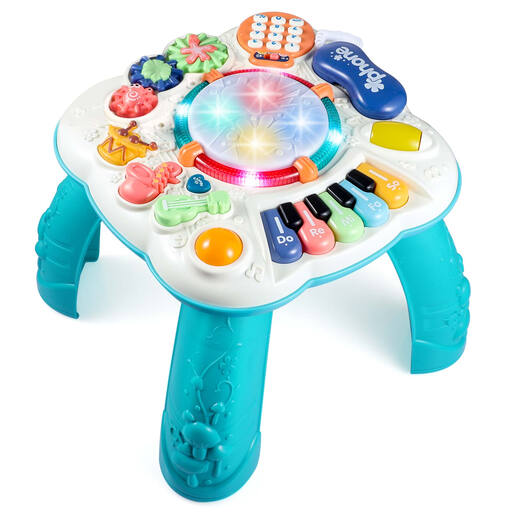
Why this product suits the profile: The table combines six play zones, including piano keys, a drum, telephone, cogs and instrument sounds. According to the description, the detachable legs also allow it to be used as a floor play board.
The adjustable configuration means the toy is not limited to just one playing position. The volume control and quiet mode are useful features for indoor use.
BPA-free ABS plastic, rounded edges and six clearly described play areas. Batteries are not included.
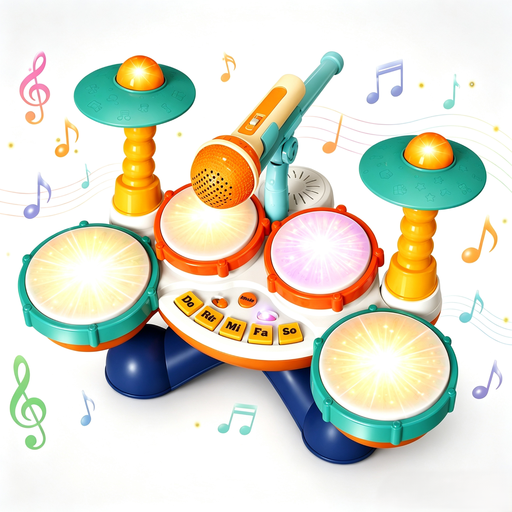
Why this product suits the profile: This set is designed for children who want to discover music through drumming, singing and role play. According to the description, it includes four illuminated drum pads, two cymbals, a microphone and several sound modes.
The volume can be adjusted. The wide base and the anti-slip base described in the product information are useful points to check for active play.
The microphone, illuminated drums, animal sounds and built-in melodies make it possible to enjoy music together. Batteries are not included.
We have put together a complete, regularly updated list of products that fully meet these strict selection criteria and the safety regulations applicable in the EU.
That depends on the product. Some sensory toys are designed for babies from six months, while cubes, children’s keyboards and drum sets are often intended for children aged one and over. The stated age range, warnings and the child’s abilities are the key considerations.
Battery life depends on the battery type, volume, frequency of use and automatic shut-off function. As batteries are not included with several of the selected products, parents should check the product data sheet and keep spare batteries out of children’s reach.
No. “Montessori-inspired” initially describes a design concept, but it is not a uniform quality seal. What matters is whether the toy encourages independent exploration, is age-appropriate to use and suits the child’s interests. Interactive learning toys can complement free play and time spent playing together.