
Lieferung heute & morgen

Qualitätsgarantie

Willkommens-Angebote freischalten: KOSTENLOSE Lieferung | Bis zu 80 % RABATT | Kostenlose 30-Tage-JoyPlus-Testphase
App herunterladen
Interactive toys combine movement, sounds, lights or controllable functions with active play. For parents, grandparents and relatives, however, choosing the right one isn’t always straightforward: product pages often promise “learning through play” but only mention important details in passing. What really matters isn’t the sheer number of features, but the right combination of age, safety, usability and practicality for everyday life.
A toy with a piano, phone, lights, music and several spinning parts may look versatile. But for a baby, too many stimuli can be overwhelming. For toddlers, it’s also important to check whether the buttons, switches and moving parts can actually be reached and operated independently.
An activity cube for babies or a baby activity table shouldn’t just have lots of play zones. You should also check whether the height, the size of the controls and the stability are appropriate for your child’s developmental stage.
“From 6 months” doesn’t automatically mean a product is suitable for every six-month-old baby. Some functions already require targeted grasping, sitting or standing. For toy cars, remote-controlled models and products with small accessories, higher age limits often apply.
Pay attention to the manufacturer’s age labelling, safety warnings and the actual play situation. A product intended for children aged 3 and over must not be passed on to younger siblings if it contains small parts.
Battery-operated products can add extra costs in daily use. Check whether batteries are included, what size is needed and whether there’s an automatic shut-off function. For rechargeable models, consider the charging time, charging cable and instructions for handling the battery.
Cleaning also matters: toys for babies should be wipeable with a slightly damp cloth and shouldn’t have hard-to-reach areas where dirt can collect.
For babies from around 6 months, simple shapes for grasping, pressing, turning or tracking are ideal. A sensory toy for babies with lights, music or moving elements can engage different senses. The volume should be adjustable or at least limited to a level that’s comfortable for the environment.
From 1 year, Montessori toys, motor skills toys and musical toys that demonstrate cause and effect become suitable. These include gears, flaps, buttons, drums or a push-along toy that moves when pushed.
For children aged 3 and over, toy cars for children and vehicles for role play can be interesting. A remote-controlled car for children should only be chosen once the child can safely operate the remote control. Models with stunt functions and small components are generally intended for older children.
Look for clear information about the material, age group and safety warnings. For the products featured here, ABS plastic, rounded edges and BPA-free materials are mentioned. However, you should always cross-check this information against the specific product page, packaging and instruction manual.
The CE mark indicates that the manufacturer declares compliance with the applicable EU requirements for that product. It doesn’t replace a check of the actual condition. Before each use, inspect the casing, wheels, battery compartment, hinges and moving parts to make sure they’re intact. For small parts: keep them out of reach of younger siblings.
Musical toys can quickly become disruptive in flats, on trips or in shared spaces. A volume control or quiet mode is therefore very practical. For an activity table, you should also check its stability, whether the legs are removable and whether it can be used on the floor.
For on-the-go use, compact products with a carry handle or without batteries are often easier to manage. Large vehicles, on the other hand, need plenty of clear floor space and are better suited to living rooms, children’s bedrooms, patios or level outdoor areas.
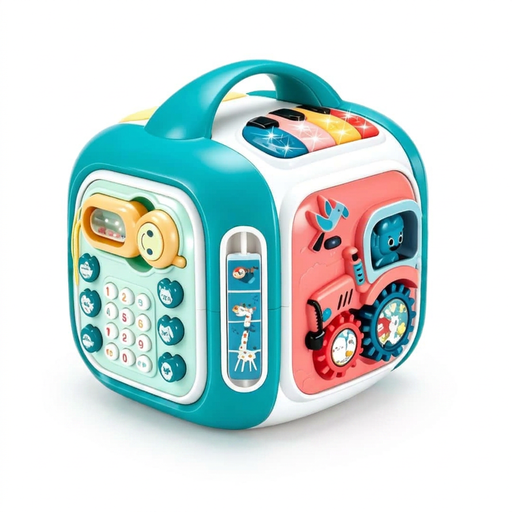
Why this product fits the profile: The compact cube combines eight play areas, so it takes up less floor space than several individual products. According to the product details, it’s intended for children aged 1 to 3 and comes with a carry handle.
The age recommendation, dimensions of 23 × 23 × 24 cm, and details about materials and edges are clearly stated. Before buying, parents should also check the volume and battery supply.
Compact design, multiple ways to play, and ABS plastic with rounded edges according to the product description.
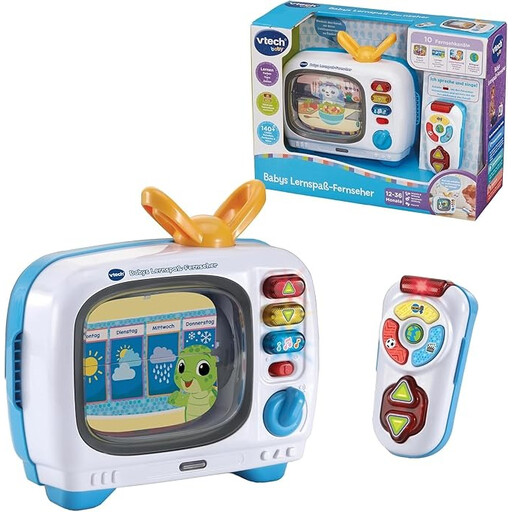
Why this product fits the profile: According to the details, this electronic learning toy is designed for children aged 12 months and up, combining buttons, lights, music and animal sounds in a sturdy casing.
The product data lists dimensions, weight, battery requirements and a warning about small parts. This makes it easier to assess space and safety needs in advance.
Electronic control surfaces, 2 AAA batteries reportedly included, dimensions of 13.3 × 32.5 × 24.1 cm.
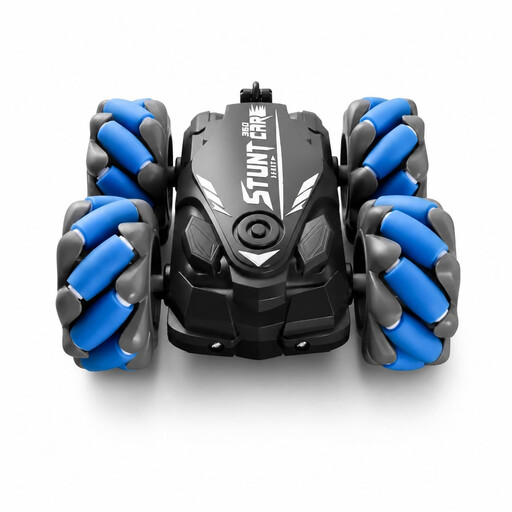
Why this product fits the profile: According to the description, this model is aimed at children aged 8 and over and offers both remote control and gesture control. For older children looking for a controllable vehicle, this combination of features is relevant.
The age limit, 2.4 GHz control, integrated lithium battery and charging instructions are all provided. Before use, the wheels, casing and battery must be checked.
Two control modes, four-wheel drive, USB charging cable, plus LED light and music effects according to the product description.
We’ve put together a complete, regularly updated list of products that fully meet these strict selection criteria and the safety regulations in force in the EU.
For learning toys from 6 months, products with large, easily reachable elements and no loose small parts are ideal. An activity table, a drum or a rolling baby toy could be suitable, provided the manufacturer’s instructions confirm it’s appropriate. Babies should always be supervised during play.
The lifespan depends on the material, how often it’s used, the battery compartment, moving parts and how well it’s looked after. Toys with lots of electronic functions can be more sensitive to moisture, drops and incorrect batteries. Storing them in a dry place and checking them regularly won’t guarantee a longer life, but it does help to spot damage early.
The cost depends on how often the toy is used, the type of batteries and whether it has an automatic shut-off. Products with a rechargeable battery can reduce battery consumption, but they need safe charging practices. For toys that get a lot of use, it’s worth comparing the stated battery requirements and the availability of suitable batteries before you buy.