
Lieferung heute & morgen

Qualitätsgarantie

Willkommens-Angebote freischalten: KOSTENLOSE Lieferung | Bis zu 80 % RABATT | Kostenlose 30-Tage-JoyPlus-Testphase
App herunterladen
If you’re looking for an iPhone 16 privacy tempered glass screen protector, you’ll usually want it to do two things: protect your display from scratches and everyday knocks, while keeping messages, passwords and work-related content private from people sitting next to you. Not all privacy screen protectors meet these expectations equally well.
That’s why it’s worth checking model compatibility, glass quality and the stated viewing angle before you buy. The product name alone won’t tell you whether a screen protector will really suit the way you use your phone every day.
The term 9H toughened glass screen protector describes the hardness of the surface. It may indicate increased resistance to everyday scratches, but it doesn’t guarantee protection against every break or screen damage caused by a drop. Even 9H glass is no substitute for careful handling and a suitable case.
An iPhone privacy screen protector typically darkens the display when viewed from the side, while keeping it readable from the front. How strong the effect is depends on factors including the viewing angle, screen brightness and surroundings. Claims such as “360 degrees” shouldn’t be taken to mean complete privacy in every situation.
The iPhone 16, iPhone 16 Plus, iPhone 16 Pro and iPhone 16 Pro Max differ in their dimensions and display design. An iPhone 16 Pro screen protector won’t automatically fit a standard model. Before buying, check the model name, screen size, cut-outs and whether the protector is compatible with cases.
Don’t choose a screen protector based on screen size alone. What matters is the seller’s stated compatibility with your exact model:
An iPhone 16 Plus tempered glass screen protector shouldn’t be confused with one designed for the iPhone 16 Pro. If a listing contains conflicting details, check compatibility with the retailer before you buy.
There are several details to consider when choosing a scratch-resistant iPhone screen protector, including the toughened glass, stated hardness rating and adhesive layer. For example, the VoxorAI model for iPhone 16 Pro is listed as having a 380AB adhesive layer and an OCA bonding process. These details describe the materials and bonding technology, but don’t on their own guarantee a trouble-free installation.
For best results, fit an easy-to-install screen protector using an installation tool and the instructions, in a dust-free environment. Dust trapped beneath the glass can cause bubbles and affect adhesion.
An anti-glare tempered glass screen protector may reduce distracting reflections with an anti-reflective coating. At the same time, privacy screen protectors can make the display look darker from certain side angles. Product descriptions say hydrophobic and oleophobic coatings help reduce the build-up of water, skin oils and fingerprints. This is a handy feature, but it doesn’t guarantee a perfectly clean surface for good.
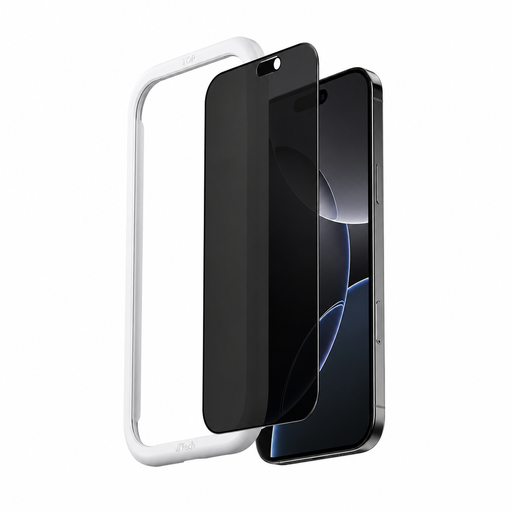
Why this product suits this user: Designed for iPhone 16 Plus, it’s aimed at people who want side-on privacy while commuting or working in the office.
The model name explicitly specifies iPhone 16 Plus, making it easier to check the fit than with a general-purpose universal screen protector.
According to the product details: 9H toughened glass, privacy coating, fingerprint protection, an installation tool and instructions.
Why this product suits this user: Suitable for iPhone 16 Pro owners who value clearly stated model compatibility, privacy and a smooth, fingerprint-resistant surface.
The product details list iPhone 16 Pro as a compatible model and mention an installation tool. This reduces the risk of choosing a screen protector based on screen size alone.
According to the product details: 9H toughened glass, OCA bonding process, high light transmission, an oleophobic coating and privacy when viewed from the side.
Why this product suits this user: For frequent users of the large Pro Max display who want to shield work or personal content from side-on viewing in public places.
The product page lists iPhone 16 Pro Max as a compatible model. Before fitting it, you should still check that your case leaves enough clearance around the edge of the glass.
According to the product details: 9H toughened glass, AR coating, privacy protection, fingerprint protection and a supplied installation tool.
We’ve put together a complete, regularly updated list of products that meet these strict selection criteria and the safety regulations in force in the EU.
If you use a case, check whether its edge lifts the tempered glass. Otherwise, even a screen protector that seems to fit may start to come away at the corners.
The display should be completely clean and dry. Dust is the most common cause of visible particles and bubbles. Carefully align the glass before pressing it down, and use an installation tool if one is supplied.
Its lifespan depends on scratches, knocks, cleaning products and how often you use your phone. Replace the screen protector if it develops cracks or chipped edges, or if touch response is noticeably affected. Avoid removing it frequently.
According to the product details, the display should retain high light transmission when viewed from the front. The picture may intentionally look darker from the side. In direct sunlight, you may need to adjust the brightness.