
Lieferung heute & morgen

Qualitätsgarantie

Willkommens-Angebote freischalten: KOSTENLOSE Lieferung | Bis zu 80 % RABATT | Kostenlose 30-Tage-JoyPlus-Testphase
App herunterladen
A new iPhone deserves screen protection that suits both its specific model and your everyday routine. However, anyone buying an iPhone tempered-glass screen protector will often encounter bold claims such as “9H”, “military-grade protection”, “invisible installation” or “360° Privacy”. Not every specification can be compared directly with the others.
Whether you are a commuter, using your phone at work or using it every day with a protective case, the most important factors are exact model compatibility, the quality of the glass and clearly explained, dependable installation assistance.
The label 9H tempered glass generally describes scratch resistance according to a specific testing scale. It is not automatically consistent proof that a screen will survive every drop undamaged. A 9H screen protector can reduce the risk of scratches and everyday wear, but it does not replace a protective case or careful handling.
You should also look for:
iPhone 16, iPhone 16 Plus, iPhone 16 Pro and iPhone 16 Pro Max differ in their dimensions, display bezels and, in some cases, their cut-outs. The same applies to iPhone 17, iPhone 17 Pro and iPhone 17 Pro Max.
An iPhone 16 screen protector is therefore not automatically suitable for the Pro variants. Before buying, check the exact model name in your device settings or on the original packaging. Product details stating “for iPhone 16 Pro Max”, for example, should not be treated as applying to the standard model.
A bubble-free installation is not solely a product feature. Dust, skin oils or slightly misaligned positioning can lead to visible particles and lifting around the edges, even with a high-quality protector. Installation aids, applicators and electrostatic adhesion make the process easier, but they cannot remove dirt from the display.
A case-friendly screen protector leaves enough space around the edges so that the rim of a case cannot catch underneath the glass. Protectors that are too large may be lifted by the case, while models that are too small offer less protection for the edges.
Check the following:
A clear iPhone screen protector should alter the display as little as possible. For one product, for example, the product details state more than 92 per cent light transmission. Such figures are only meaningful when the testing conditions are clear and verifiable. Also look for information about colour reproduction and touch sensitivity.
Privacy glass works differently: an iPhone privacy screen protector or privacy screen protector for iPhone reduces visibility from the side. This can be useful on trains, in cafés or at work, but it may affect perceived brightness and the viewing angle from the side. For sharing photos with others, a clear protector is generally more suitable.
A hydrophobic and oleophobic coating can reduce contact with oil, sweat and fingerprints. It does not keep the surface permanently clean. Clean the protector with a soft cloth and avoid harsh cleaning products.
When it comes to the edges, precise manufacturing is important. One supplier states that a TORRAS model features a reinforced edge construction with a load rating of more than 250 N. This figure comes from the product description and should not be equated with a general impact-resistance guarantee for the entire smartphone.
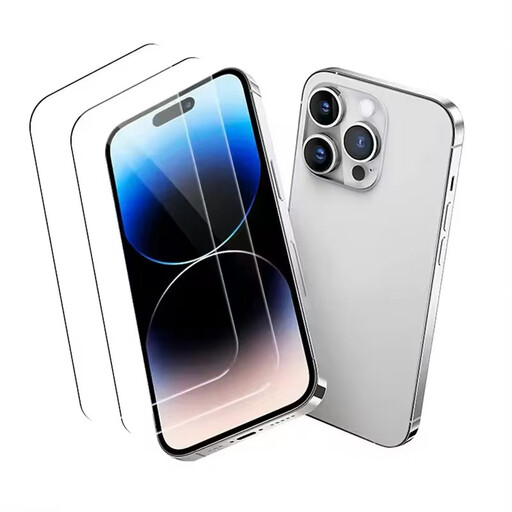
Why this product suits this profile: For iPhone 16 users looking for a clear tempered-glass iPhone screen protector with an installation tool and case compatibility. According to the product details, it offers 9H hardness, high transparency and an anti-fingerprint coating.
The model name is specifically focused on iPhone 16, helping to avoid the common confusion with Pro or Plus variants. Even so, you should check your device name before buying.
9H glass, hydrophobic and oleophobic coating, plus a supplied alignment tool.
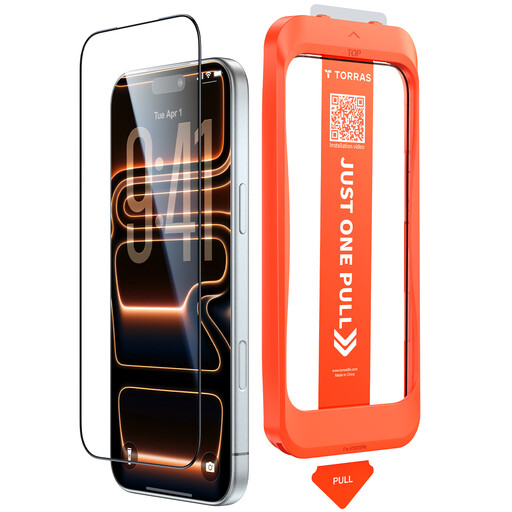
Why this product suits this profile: Suitable for people who prefer a clear display, a case-friendly design and guided installation for iPhone 17 Pro. According to the product description, light transmission is more than 92 per cent.
The product details specify precisely shaped edges for use with protective cases. This reduces the risk of a case catching on the edge of the protector.
9H hardness, oleophobic surface, stated edge reinforcement and static adhesion for alignment.
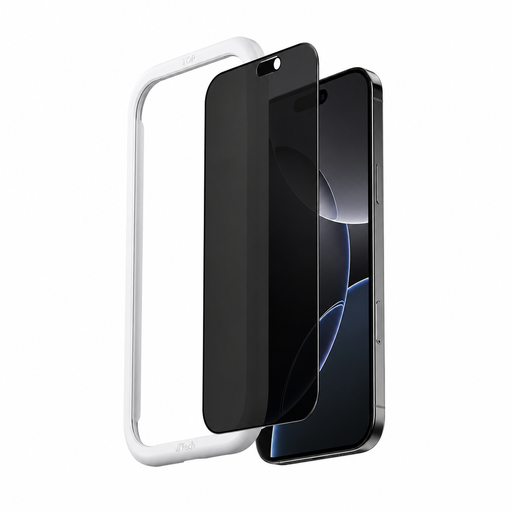
Why this product suits this profile: For commuters and office workers who want to make messages, login details and other content less visible from the side while out and about. According to the product details, the screen becomes darker beyond a certain viewing angle.
The privacy specification is linked to a specific use case. At the same time, buyers should bear in mind that privacy glass can affect side viewing and brightness.
9H toughened glass, privacy coating, fingerprint protection and an applicator for easier installation.
We have put together a complete, regularly updated list of products that fully meet these strict selection criteria and the safety regulations applicable in the EU.
For a clean application, follow this sequence:
If the glass is damaged, chipped at the edge or continually comes away, it should be replaced for safety reasons. For privacy products, the product details often advise against removing and reapplying them repeatedly, as this can affect the display’s oleophobic coating.
Choose a model explicitly designed for iPhone 16 Pro. Protectors for iPhone 16, iPhone 16 Plus or iPhone 16 Pro Max have different dimensions and may vary in their cut-outs or edge coverage.
There is no fixed lifespan that applies in every case. It depends on friction, impacts, keys in your pocket or bag, the protective case and cleaning. Replace the protector if scratches interfere with operation, the coating has noticeably worn away or cracks or chips become visible.
That depends on how you use it. An iPhone privacy screen protector can reduce side visibility in public areas. If you often share content with others or need a consistent display from different angles, a clear tempered-glass iPhone screen protector is generally the more practical choice.