For ironing with limited space
If you only iron a few pillowcases and put the appliance away afterwards, ease of use and compact storage often matter more than a large water tank.


If you only iron a few cotton pillowcases and put the appliance away afterwards, a lightweight steam iron is usually the most practical place to start. A steam generator iron may be a better fit if you regularly work through larger piles and have room for the base and hose. The care label on the pillowcase and the features of the specific appliance variant are key. Before buying, also check that it has the required markings.
If you only iron a few pillowcases and put the appliance away afterwards, ease of use and compact storage often matter more than a large water tank.
If you want smooth cotton and neatly pressed seams, the care label, a suitable temperature setting and the shape of the soleplate are important points to compare.
If you regularly iron lots of pillowcases one after another, tank capacity and continuous steam output may matter more. However, a steam generator iron also needs room for its base and hose.
First, compare your available storage space with the amount you usually iron. Then consider fabric care, steam and how much maintenance you’re happy to do.
A good fit if: You iron a few or a moderate number of pillowcases laid flat, then want to put the handheld appliance away.
Things to consider: The tank and steam generator are part of the handheld appliance, so you may need to refill it during longer ironing sessions.
A good fit if: The care label rules out steam, or you want to tackle a few light creases without using steam.
Things to consider: There’s no steam to help with stubborn creases. Check whether steam can be switched off completely on the model you choose.
A good fit if: You regularly iron larger piles and have room to set up the steam generator.
Things to consider: You’ll need to set up and store the base and hose as well. There’s no evidence that this will save time for this household.
A good fit if: You also want to steam hanging garments as well as pillowcases.
Things to consider: It doesn’t have the traditional iron soleplate needed to press a pillowcase laid flat across its surface.
| What matters | What to check when buying | Who is it important to? |
|---|---|---|
| Putting it away and storing it | Check the appliance dimensions and a safe place to set it down. For a steam generator iron, remember to allow for the base and hose too. | If I need to put everything away in a small laundry space after ironing just a few pillowcases, storage space matters especially. Around 36% of consumers put storage first. |
| Smoothing creases and seams | Compare the care label, temperature settings, pointed tip and stated continuous steam output in g/min. | If I want to smooth cotton and seams, I follow the care label and use the iron’s pointed tip where needed. Around 29% of consumers prioritise the finished result. |
| Water marks and maintenance | Check the water recommendations and descaling instructions in the manual. Don’t assume that an anti-drip feature prevents every source of moisture. | If I want to minimise water marks and regular appliance cleaning, I pay attention to care and descaling instructions. Around 21% of consumers prioritise ease of maintenance. |
| Larger piles of ironing | Check the tank capacity, continuous steam output and the space needed for the complete steam generator iron. | If I’m ironing lots of pillowcases one after another, I want to stop less often and can make room for extra storage. Around 14% of consumers prioritise longer ironing sessions. |
A steam boost figure doesn’t tell you how much steam the iron produces continuously during longer strokes. For example, Tefal lists separate figures for the FV5736: 45 g/min of continuous steam and a 220 g steam boost. For the SV6115, the figures are 120 g/min and 280 g.
For longer ironing sessions, compare continuous steam output and tank capacity separately from the steam boost.
Even a steam generator iron described as compact consists of a handheld iron, a separate base and a hose.
Before choosing one, measure the space you have to set up and store the complete appliance.
Philips also lists condensation on the ironing board cover as a possible cause, alongside issues with the appliance. This doesn’t indicate how often the issue occurs with any particular model.
Check the temperature setting, descaling instructions and ironing board cover using your model’s manual.
A worn ironing board cover may need extra care or replacing.
Verbraucherzentrale distinguishes statutory claims against the seller from a voluntary guarantee, which is subject to its own terms and conditions.
Keep a separate record of the seller, the guarantee provider and the terms that apply to each.
The FV5736 and SV6115 give you a basis for comparing a handheld steam iron with a steam generator iron.
The DST5030/20 is a handheld steam iron with an integrated Calc-Clean function. Philips also makes steam generator irons.
The TexStyle 7 Pro SI 7160 BL is a specific handheld model you can use to compare different soleplate designs.
The Focus Excel DW5310 offers features to compare, including its pointed tip, tank and steam controls.
This selection features handheld steam irons for pillowcases laid flat, which can then be put away for storage.
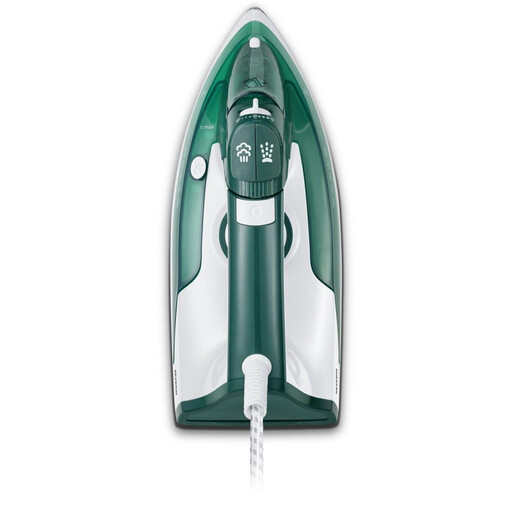 No image available
The continuously adjustable temperature and variable steam output give you options for different ironing needs.
2400 W; stainless steel soleplate; 30 g/min continuous steam; 175-ml tank; anti-drip and self-cleaning functions. The steam boost is listed as 85 g and should not be confused with continuous steam output.
 No image available
This handheld iron is designed for fabrics laid flat. The product description also mentions dry ironing.
Five temperature settings; 350-ml tank; anti-drip function. The product description lists continuous steam but doesn’t give an output in g/min.
 No image available
The stated continuous steam output may be worth comparing for longer ironing strokes. Always follow the care label when treating the fabric.
2500 W; 40 g/min continuous steam; 160 g steam boost; stainless steel soleplate; anti-drip and anti-scale systems. Steam boost and continuous steam are separate specifications.
 No image available
The stated continuous steam output is a useful point to consider when comparing irons for longer sessions.
Up to 50 g/min continuous steam; 280 g steam boost; Micro-Calc filter; anti-drip function; automatic shut-off. The steam boost isn’t a continuous steam figure.
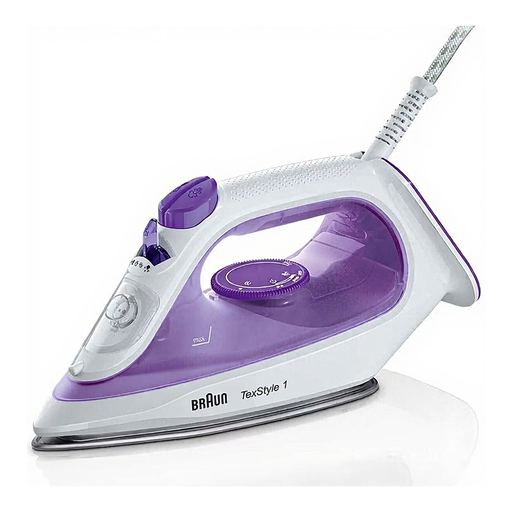 No image available
The listed compact design and precision tip may be useful if you have limited storage space or want to work around seams.
Dimensions: 280 × 120 × 140 mm; 25 g/min continuous steam in Turbo mode; SuperCeramic soleplate; dry ironing mode and self-cleaning function.
No. The fibre type alone doesn’t determine how the fabric can be treated. Always check the care label on the specific pillowcase. GINETEX GERMANY’s guide distinguishes between temperature settings and also highlights ironing prohibitions and restrictions on using steam.
Check your model’s instructions, temperature setting, descaling guidance and ironing board cover. Philips lists condensation on the ironing board as a possible cause. An anti-drip feature doesn’t rule out other sources of moisture.
No. Your statutory rights relate to claims against the seller if goods are faulty. A manufacturer’s guarantee is an additional voluntary offer, subject to its own terms. According to Verbraucherzentrale, a typical online purchase also generally comes with a right to cancel, usually within 14 days of receiving the goods. Exceptions and the specific contract should be taken into account.
If a new electrical appliance falls within the scope of the Low Voltage Directive 2014/35/EU, the required CE marking must be present. The Federal Institute for Occupational Safety and Health outlines the scope of the directive, while the European Commission clarifies that CE marking isn’t an independent safety approval from a public authority. Check the marking on the specific product variant you’re buying.