Focus on collars and cuffs
If you want to tackle narrow areas neatly, pay particular attention to an easy-to-manoeuvre soleplate tip and adjustable steam.


For a few shirts at a time, a steam iron with an easy-to-manoeuvre tip and adjustable steam is a good place to start. If you regularly iron larger loads, the bigger tank on a steam generator may matter more. A dry iron is an option if you’d rather not use built-in steam, but you may need another way to dampen stubborn creases. Always set the temperature and steam according to the care label on each shirt, rather than relying on the word ‘cotton’ alone.
If you want to tackle narrow areas neatly, pay particular attention to an easy-to-manoeuvre soleplate tip and adjustable steam.
If you regularly have a stack of shirts to iron in a set time, compare your usual load with the tank capacity, how often you’ll need to refill it and the space available.
If you want to avoid water marks and the hassle of descaling, or are considering an iron without built-in steam, compare the maintenance features and the steps involved.
| What matters to you | What to check when buying | Who might value it most |
|---|---|---|
| Collars and button plackets | The shape and reach of the tip; temperature and steam settings that suit the care label. | If I want to tackle collars and cuffs carefully, manoeuvrability around narrow areas matters to me. Around 36% of consumers prioritise precise ironing. |
| Several shirts at a time | Compare the number of shirts you usually iron, the tank capacity and how easy it is to refill, against the space available. | If you iron several shirts in a set time between guest changeovers, tank capacity and refilling are especially important. Around 29% of consumers prioritise ironing capacity. |
| Water marks and limescale | Check whether the specific model has an anti-drip feature and an accessible anti-scale function; follow the instructions on water and cleaning. | If I don’t want to re-treat freshly ironed shirts because of drips, water and appliance care are key for me. Around 21% of consumers focus on this. |
| Using an iron without a water tank | Check whether the shirts are easy to iron without built-in steam and whether the temperature control is suitable. | If you prefer quick, simple ironing and want to avoid filling a tank, a dry iron may be worth considering. Around 14% of consumers prioritise the simplicity of ironing without steam. |
Manufacturers list the two figures separately. For example, Rowenta gives the DW5310 a continuous steam output of up to 45 g/min and a steam boost of 180 g. The peak figure doesn’t describe the whole ironing session.
Compare continuous steam, steam boost and tank capacity as separate features of the same model.
A large, separate tank can support longer ironing sessions, but it also means an extra base and more space taken up. Philips describes the DST3041/80’s 300-ml tank as suitable for smaller loads; this doesn’t correspond to a set number of shirts.
Choose the type of appliance to suit your usual load and the space you have available.
A steam generator also needs space for the base and steam hose.
Braun and Rowenta describe using a soleplate with a precision tip to work carefully around collars and seams. This isn’t the same as using a garment steamer without the soleplate touching the fabric.
If shirt details are your priority, start by looking for an iron with a soleplate and an easy-to-manoeuvre tip.
The FreeStyle-3 range is a useful point of comparison for quick ironing sessions and shirt details. Braun lists the FI 3194 BK as part of this range.
The DST3041/80 from the 3000 Series is an example of a steam iron for smaller loads.
The Focus Excel DW5310 is a useful model to compare for its tip, steam settings and tank capacity.
The FV6846 is a steam iron with a limescale collector, while the SV6131 is an alternative with a separate base for larger loads.
The BA 3211 offers a dry iron as an alternative to models with built-in steam.
The following steam irons from Joybuy are suitable for shirts, including models with both steam and dry-iron settings.
 No image available
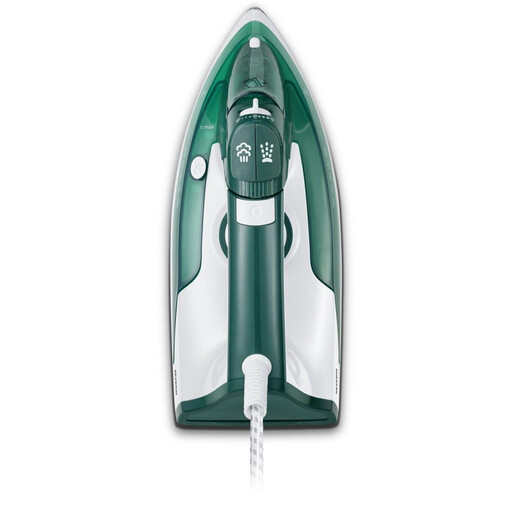
For cotton shirts, if you want to switch between steam and dry ironing.
2400 W; removable 175-ml water tank; variable steam output up to 30 g/min; steam boost 85 g/min; anti-drip and anti-scale functions.
 No image available
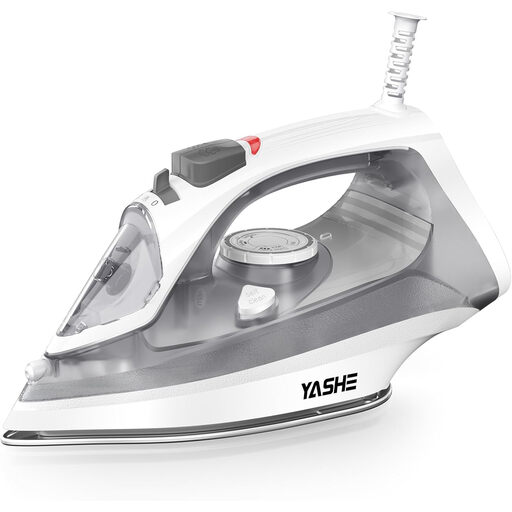
For shirts, if a transparent tank and self-cleaning function are among your priorities.
2300 W; 300-ml water tank; continuous steam 25 g/min; steam boost 150 g/min; non-stick soleplate, anti-drip and self-cleaning function.
 No image available
For shirts, if you want to switch between steam and dry ironing as needed.
350-ml water tank; five temperature settings; vertical steam and self-cleaning function.
 No image available
For shirts, if you want to compare continuous steam and steam boost as separate features.
2500 W; 250-ml tank; continuous steam up to 40 g/min; steam boost 160 g/min; anti-drip and anti-scale system.
 No image available
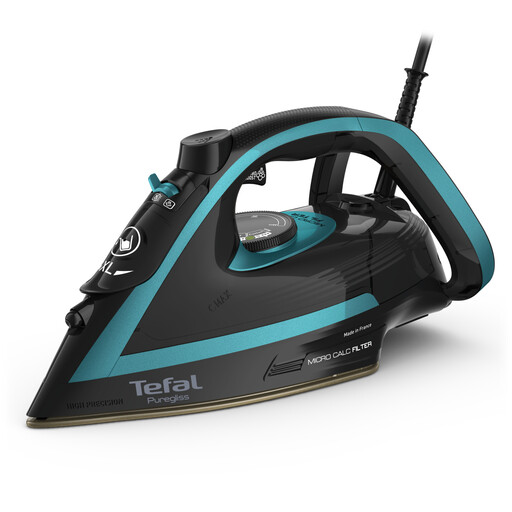
For shirts, if you also want to consider anti-drip, limescale protection and automatic shut-off when choosing an iron.
Continuous steam up to 50 g/min; steam boost up to 280 g/min; vertical steam; anti-scale filter and anti-drip feature.
No. The highest setting isn’t determined by the fibre name alone. GINETEX recommends checking the care label on each garment for its maximum ironing temperature. Check the label before using steam, too.
First, check the instructions for your specific model. Philips lists limescale build-up, a temperature that’s too low while steam is switched on, and using the steam boost too often as possible causes for some of its irons. These tips don’t necessarily apply to every make.
Not without first clarifying the purpose of the purchase. Under § 13 BGB, a consumer is someone who buys mainly for purposes outside their trade, business or profession. § 312g BGB provides consumers with a right to cancel distance and off-premises contracts; this can’t be assumed for a purchase made mainly for business purposes. Before ordering, check in what capacity you’re buying and which terms and conditions apply.
No. The Federal Institute for Occupational Safety and Health distinguishes CE conformity marking from the voluntary GS mark, which involves independent testing. A CE mark alone doesn’t prove that an independent body has tested the product. Also check the appliance details and instructions for use.