Occasional skirt ironers
If you usually iron just one skirt, easy handling and a compact size are often more important than a large water tank.


For the occasional skirt or a single item, a steam iron is usually the obvious starting point. If you regularly iron larger loads, the bigger tank of a steam generator can mean fewer pauses to refill. First check the care label on the skirt, then consider storage space, ease of handling and maintenance. A steam generator is not automatically the better or more energy-efficient choice just because it produces more steam; the German Environment Agency notes that steam generators generally use more electricity than steam irons.
If you usually iron just one skirt, easy handling and a compact size are often more important than a large water tank.
If you regularly iron several suitable skirts or other items one after another, tank capacity, ease of refilling and space for the base and hose are all important considerations.
Precise handling can be useful around seams, waistbands and pleats. At the same time, check the care labels for the fabric and any trims.
A good fit if: you iron individual skirts or have limited space for setting up and storage.
Consider: you may need to refill the built-in tank more often during longer sessions.
A good fit if: you regularly iron other items as well as skirts and have space for the base, hose and tank.
Consider: it takes up extra space and needs maintenance; a larger tank does not automatically mean a shorter ironing time.
A good fit if: the care label on the skirt rules out steam but allows ironing.
Consider: the garment's permitted temperature is still the deciding factor; check the manual to see whether your chosen model can be used without steam.
The proportions refer to consumers choosing an iron for cotton skirts; each row represents their main buying consideration.
| Consideration | What to check | Who it's especially important for |
|---|---|---|
| Appliance type for quick sessions | Compare the type of appliance, space required, tank and continuous steam output for the specific model. | If I usually iron just one skirt, I want to be able to set up the appliance without an additional steam generator base. Consumers whose main concern is quick, individual ironing sessions make up roughly 40 %. |
| Fewer refills when ironing larger loads | Compare continuous steam and steam boost separately; consider tank capacity, ease of refilling and space requirements. | If I have several suitable items to iron one after another, having enough water is more important to me than a compact storage solution. Consumers whose main concern is ironing larger loads make up around 30 %. |
| Control around waistbands, seams and pleats | Check for a precision tip and suitable temperature and steam settings. | When I'm ironing narrow seams, waistbands or pleats, I want to guide the iron precisely and follow the care label. Consumers who prioritise precise work on skirt details make up about 20 %. |
| Maintenance and energy use | Check the steam control, automatic shut-off and descaling method for the model. | If I use my appliance regularly, I want to adjust the steam to suit the garment and make the recommended descaling routine easy to fit into everyday life. Consumers whose main concern is keeping maintenance and energy use low make up approximately 10 %. |
The care label on each individual garment determines how it can be treated. GINETEX Germany also highlights symbols for ironing without steam and for garments that must not be ironed.
Check the care label before choosing your settings. If it says not to iron, don't iron the skirt; if it rules out steam, iron without steam.
Treating a garment contrary to its care label can damage the skirt.
A short burst of steam doesn't tell you how much steam is produced over a whole ironing session.
Compare the figures for continuous steam and steam boost separately, and take tank capacity and ease of refilling into account.
Higher steam output figures are no guarantee of a shorter ironing time or lower electricity use. The German Environment Agency notes that steam generators generally use more electricity than steam irons.
Choose a steam generator only if its tank and handling suit the amount of laundry you actually iron.
The base and hose need extra space, and you should also factor in the maintenance required.
The FreeStyle 3 is a steam iron range; the FI 3194 BK model was named a favourite in F.A.Z. Kaufkompass's steam iron test.
The Express Protect SV9202 is a steam generator option for longer ironing sessions. Tefal lists a removable 1,8-l tank for this model.
According to Philips, the 7000 Series DST7040/80 steam iron has a 300-ml tank and variable steam settings.
The Focus Excel DW5310D1 is a steam iron with a specified precision tip and manual steam and temperature settings.
This selection includes steam irons for individual skirts and steam generators for longer sessions with more laundry.
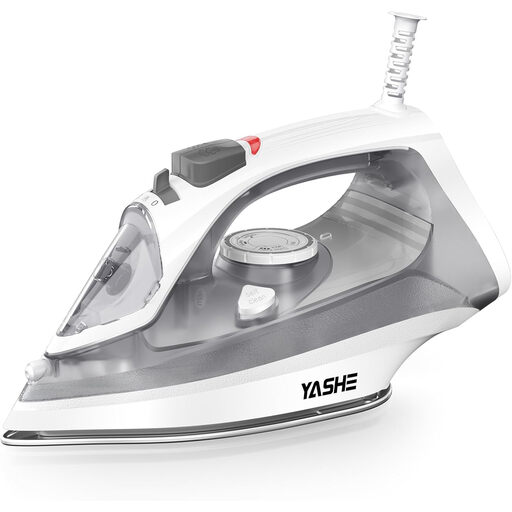 No image available
This compact steam iron is suited to individual skirts or occasional ironing.
300-ml water tank; 150 g/min steam boost; non-stick soleplate; self-cleaning and anti-scale function.
 No image available
This handheld iron is an option if you iron individual skirts rather than larger loads.
Automatic cleaning function; anti-drip system.
 No image available
A steam iron for individual skirts, with on-appliance controls for adjusting steam and temperature.
280 g/min steam boost; vertical steam; automatic shut-off.
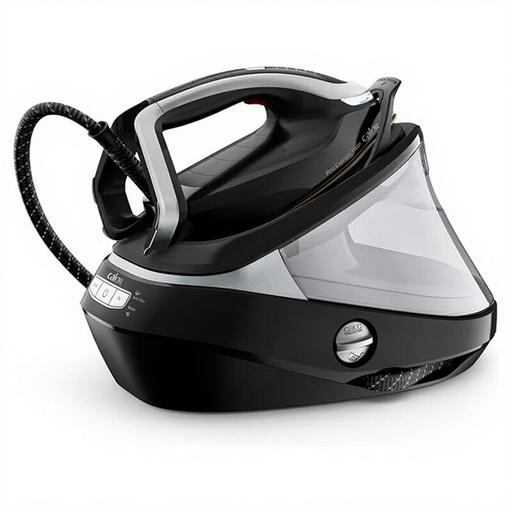 No image available
A steam generator can suit longer ironing sessions if you have room in your utility room for the base, hose and tank.
Removable 1,2-l tank; 180 g/min continuous steam; 800 g/min steam boost.
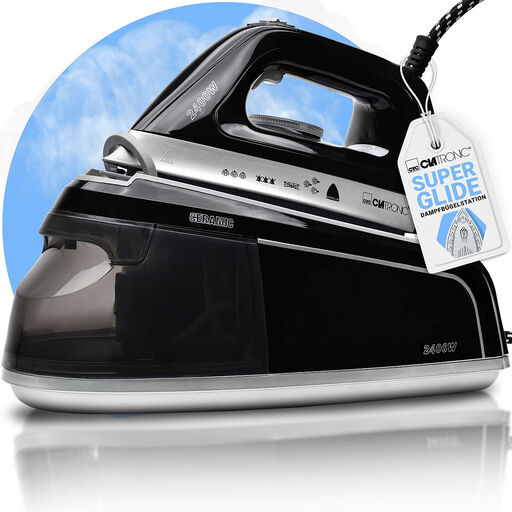 No image available
This steam generator is an option for longer ironing sessions if the tank and extra space it needs suit your room.
Removable 1,2-l tank; ceramic soleplate; up to 80 minutes' operating time.
No. The care label on the specific skirt is what matters, not just the word ‘cotton’. GINETEX Germany also shows symbols for ironing without steam and for garments that must not be ironed; temperature guidance can vary between symbol charts. So always follow the label on the garment.
As well as space for ironing, allow room for the base and hose, and check the dimensions of the specific model. Tefal lists a length of 1,6 m for both the steam hose and the power cable on the SV9202; these figures apply to this model.
Follow the descaling instructions for the specific model. Tefal lists a removable limescale collector for the SV9202; the Philips DST7040/80 uses a process called Quick Calc Release. These methods vary by model and are not interchangeable.
When you buy from a business seller in the EU, you are generally entitled to at least two years of statutory protection from the date you receive the goods. Contact the seller; this is separate from any voluntary manufacturer's guarantee.
CE marking is required for electrical and electronic equipment covered by the relevant EU regulations. Check the marking on the specific product or in its documentation; a CE mark is not independent proof of performance.