
Lieferung heute & morgen

Qualitätsgarantie

Willkommens-Angebote freischalten: KOSTENLOSE Lieferung | Bis zu 80 % RABATT | Kostenlose 30-Tage-JoyPlus-Testphase
App herunterladen
A jewellery box should keep necklaces, rings, earrings and watches organised and easy to find. In practice, however, it's not just about looks and colour. An unsuitable compartment layout, flimsy drawers or the wrong dimensions can make your jewellery storage impractical within a short space of time.
If you check a few technical details before buying, you can avoid the typical mistakes. The following criteria will help you choose the right jewellery box for your dressing table, bedroom or wardrobe.
Multiple levels or drawers don't automatically mean plenty of usable space. Narrow compartments are ideal for rings and earrings, for example, but unsuitable for large bangles or sunglasses. So before you buy, check which accessories you actually need to store.
A jewellery box with drawers is a good choice when it offers a variety of compartment sizes. For a smaller collection, a compact jewellery box with a single, well-organised level may be sufficient.
A jewellery box with a glass lid makes it easier to see the contents and can help keep dust out. However, it doesn't automatically protect against scratches or moisture. For that, you need a suitable interior lining, closed compartments and a dry place to keep it.
A jewellery storage box with a mirror also needs enough space to open and use it properly. On a narrow shelf or in a crowded wardrobe, this extra feature can be more of a hindrance than a help.
A foldable storage box made of non-woven fabric and cardboard is space-saving and lightweight. It's suitable for scarves, clothing, accessories or other light household items. However, it's not automatically suitable for heavy watches, hard jewellery pieces or damp rooms.
When choosing a fabric box for shelves, pay attention to the compartment dimensions, the maximum load capacity and the care instructions. Some models fit standard cube shelving units, while others require specific internal measurements.
Measure the available space before you buy in width, depth and height. Also consider the room needed for drawers or a hinged lid when open.
For a dressing table, compact models around 25 to 30 centimetres wide are often easy to accommodate. A tall jewellery cabinet with multiple levels uses vertical space but needs a stable spot. For storage inside a wardrobe, compare the external dimensions with the shelf or compartment.
The interior layout should suit your personal collection:
A jewellery organiser with lots of small compartments can be helpful for an extensive collection. If you mainly own larger jewellery pieces, you'll need more open or wide sections instead.
Jewellery boxes are made from materials including plastic, MDF, PU, velvet, polyester, non-woven fabric and cardboard. The choice of material affects stability, weight and cleaning.
A model made from MDF with a PU finish and velvet lining is generally more rigid than a lightweight fabric box. For shelf storage and rarely used items, foldable boxes made of non-woven fabric can be more practical. Always follow the maximum load guidelines. This also applies to stackable boxes and drawer units.
Many materials should only be cleaned with a soft, dry or slightly damp cloth. Fabric and cardboard boxes are typically not designed for the washing machine, full immersion or permanently damp environments.
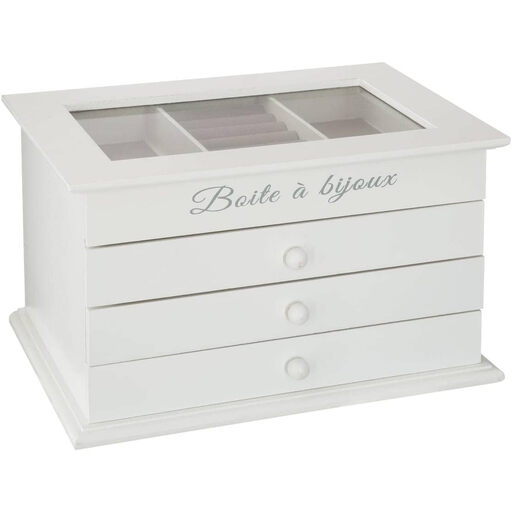
Why this product fits the profile: The compact size of 25 × 17 × 15 cm is ideal for getting started and can be placed on a dressing table or chest of drawers. Three drawers allow you to separate different accessories easily.
The specific external dimensions make the space requirement clear. The drawers reduce the messy stacking of small items.
Three drawers, PS plastic construction and a space-saving format for everyday home use.
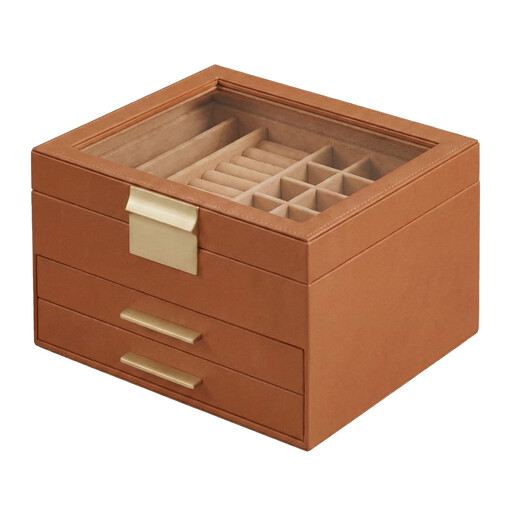
Why this product fits the profile: The glass lid lets you see the contents, while three levels and two drawers accommodate different types of jewellery. MDF, PU, velvet and glass are listed in the product specifications.
The compartment layout is more specific than just advertising the size: small items are organised on top, while larger accessories find space in the drawers.
Transparent glass lid, velvet lining, two drawers and external dimensions of 20.3 × 23.1 × 13.5 cm.
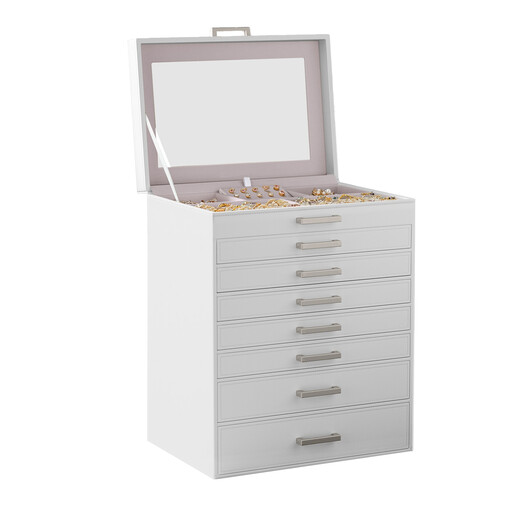
Why this product fits the profile: The vertical design with eight levels and a separate watch section is aimed at extensive collections. The dimensions of 30.2 × 21.4 × 39 cm should be checked against your intended location beforehand.
The designated watch compartment prevents all accessories from being thrown into a single section. The vertical shape saves width on your surface.
Eight levels, padded watch section, clear glass top display, plus MDF and velvet elements according to the product description.
We've put together a full, regularly updated list of products that fully meet these strict selection criteria and the safety regulations in force in the EU.
For a dressing table, choose jewellery boxes whose lids and drawers remain fully accessible. In a wardrobe, lightweight fabric boxes or a stackable storage box are more practical. When using shelf compartments, make sure the box not only fits in but can also be pulled out easily by its handle or ring.
For a gift, neutral colours and a clearly visible interior layout are usually the most versatile. A jewellery box with a mirror or glass lid can look decorative, but it should suit your interior style and the available space.
That depends on your collection and where you plan to put it. For just a few rings and earrings, a compact model is sufficient. For watches, long necklaces and bracelets, multiple levels or larger drawers make more sense. Measure the available space and compare it with the external dimensions of the box.
Necklaces should ideally be stored individually in long compartments or on dedicated hooks. Small jewellery items can be sorted in separate inserts. An overfilled drawer increases the risk of necklaces getting tangled together.
Foldable boxes are mainly suitable for light accessories, scarves and clothing. For valuable or delicate jewellery pieces, models with a sturdy construction, internal compartments and a soft lining are usually more appropriate. Regardless of the box type, jewellery and its storage should be kept dry and away from direct heat.