
Lieferung heute & morgen

Qualitätsgarantie

Willkommens-Angebote freischalten: KOSTENLOSE Lieferung | Bis zu 80 % RABATT | Kostenlose 30-Tage-JoyPlus-Testphase
App herunterladen
A jigsaw puzzle can keep a child interested for a long time – or end up unused after the first attempt. Often, the problem isn’t the child but an unsuitable number of pieces, an overly complicated picture or flimsy materials. So if you’re buying a jigsaw puzzle for a child, don’t just look at familiar characters or eye-catching packaging.
‘Age 4+’ or ‘age 8+’ is a useful guide, but it doesn’t replace checking the piece size, picture and the child’s experience. A 15-piece jigsaw puzzle for a child aged 3+ with large pieces may suit a beginner better than a more challenging puzzle with a similar age recommendation.
Small parts that could be swallowed are a particular concern for young children. Always follow the safety advice on the packaging and product page. A jigsaw puzzle isn’t suitable for children below the stated minimum age, even if they’re already confident playing with toys.
A 100-piece jigsaw puzzle for children offers more of a challenge than a 15-piece one, but it won’t be the right choice for every child. A detailed picture with lots of similar colours can be harder than a puzzle with more pieces and clearly defined shapes.
It makes sense to increase the difficulty gradually: start with a frame puzzle, then move on to 40 to 60 pieces, followed by a 100-piece or 200-piece jigsaw puzzle. Older children might enjoy puzzles with 258 or 368 pieces, particularly if they also include a story or a mystery to solve.
A Disney jigsaw puzzle, a dinosaur puzzle or a picture featuring popular characters from a TV series can help keep a child motivated. However, the picture doesn’t tell you much about the thickness of the cardboard, how well the pieces fit together or how the puzzle can be stored. Details such as precision-cut pieces, a matt, glare-resistant finish and a linen-textured finish are more specific than general claims about quality.
Check the age recommendation against the child’s actual patience and concentration span. Sets with several pictures are useful for schools and childcare settings, as they can offer different levels of difficulty or encourage children to play together.
Sturdy cardboard pieces are a good choice for frequent use. A precise cut makes it easier to fit the pieces together, while a matt finish can reduce distracting reflections in bright rooms. This is particularly useful at a desk or in a group setting.
Printed outlines on frame puzzles help children work out where the pieces go. A poster can provide a reference for more challenging children’s puzzles. Before buying, also check whether the set includes a storage box, a metal case or resealable packaging.
A picture with clearly defined areas makes it easier for beginners to find their way around. Many children find it easy to recognise themes such as animals, vehicles and dinosaurs. By contrast, fantasy and night-time scenes with lots of similar colours can be more challenging.
When choosing a gift for a child, think about their interests as well as their age. A dinosaur puzzle could suit a child who loves prehistoric creatures, while a Disney jigsaw puzzle or one featuring horses may appeal more to children who enjoy familiar characters and stories.
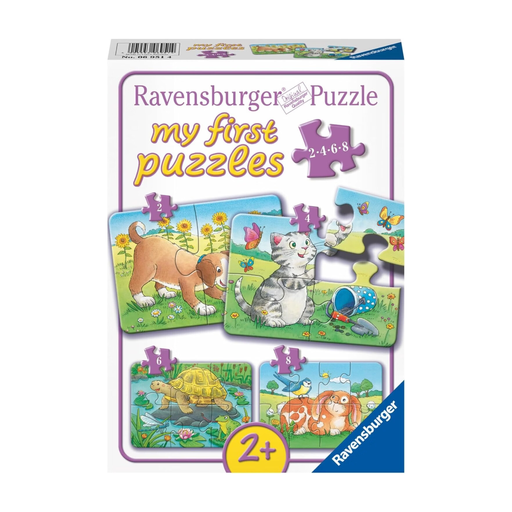
Why this product suits this profile: Four puzzles with gradually increasing difficulty and child-friendly animal pictures offer a step-by-step introduction from age 2.
The increasing difficulty means a single puzzle is less likely to become too easy or too difficult too quickly.
Recommended for children aged 2+, with sturdy cardboard pieces and four different difficulty levels, according to the product description.
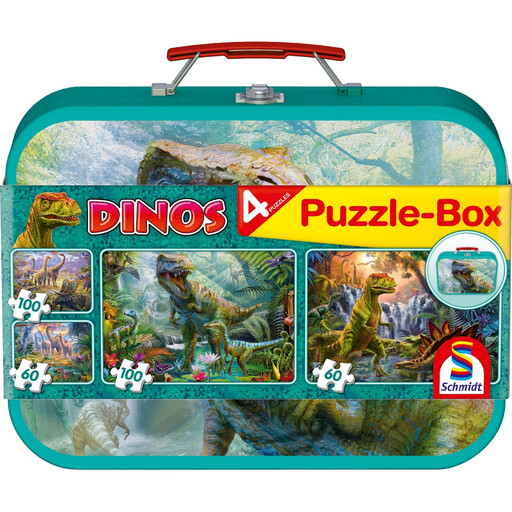
Why this product suits this profile: According to the product information, the set includes four dinosaur pictures with 2×60 and 2×100 pieces and is suitable for children aged 6+.
The different piece counts let children choose a puzzle to suit their mood and experience.
A metal case for storage, four pictures and a poster with cutting lines, according to the product description.
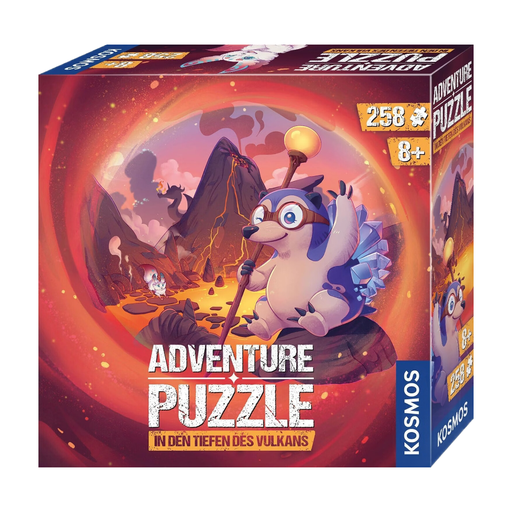
Why this product suits this profile: This puzzle combines 258 pieces with an interactive adventure story. According to the product information, it’s suitable for children aged 8+ and for 1 to 3 players.
The added story offers an alternative to a picture-only puzzle and can give children a structure for playing together.
258 pieces, app support according to the product description, and suitable for up to three players.
Ravensburger jigsaw puzzles for children often feature frame designs and clearly structured formats for beginners. One example is the 40-piece puzzle featuring Anna and Elsa, suitable for children aged 4+. For children aged 6+, Schmidt Spiele offers themes including forest animals, dinosaurs and Bibi & Tina. From age 8, options include 200-piece pictures featuring Lilo & Stitch, unicorns and fantasy themes.
When choosing puzzles for schools, nurseries or childcare settings, sets with several pictures in one box, robust packaging and different piece counts are particularly practical. Before you buy, consider your storage space, group size and how long you’d like each puzzle session to last.
We’ve put together a complete, regularly updated list of products that meet these strict selection criteria and fully comply with the safety regulations in force in the EU.
It depends on the child’s age, experience and the picture. A beginner aged 2+ will benefit from a small number of large pieces. Puzzles with 15 to 48 pieces may suit children aged 3 or 4+. Jigsaw puzzles for children aged 6+ often have between 60 and 150 pieces; 200 pieces are usually better suited to older or more experienced children.
Store puzzles somewhere dry, ideally flat or in the box they came in. Sorting them by picture or piece count helps prevent pieces from different puzzles getting mixed up. Metal cases or sturdy boxes are practical for puzzles that get used often.
A learning jigsaw puzzle can help children practise visual recognition, matching and problem-solving through play. For group settings, make sure there’s enough space, the pieces are a suitable size for the children’s ages and it’s easy to check for missing pieces. Safety advice and age recommendations should always be followed.