
Lieferung heute & morgen

Qualitätsgarantie

Willkommens-Angebote freischalten: KOSTENLOSE Lieferung | Bis zu 80 % RABATT | Kostenlose 30-Tage-JoyPlus-Testphase
App herunterladen
A juicer makes it easy to prepare fresh fruit and vegetable juices at home. There’s a wide choice, from fast centrifugal juicers and slow juicers to electric citrus presses. However, claims such as “maximum juice yield”, “especially quiet” or “whole fruits” don’t automatically mean a particular appliance is right for you.
What matters is the actual size of the feed chute, how easy the juicer is to clean, which types of produce it can handle and how much it can hold. Check these points before you buy to avoid ending up with an appliance that’s impractical after just a few uses.
A juicer with a large feed chute can reduce the need to chop apples, carrots or cucumbers beforehand. However, you’ll still need to remove hard pips, peel and any unsuitable ingredients. A wide chute is only useful if the design lets you feed produce in and push it down safely.
So, check:
The wattage shows how much electrical power the juicer draws, but it doesn’t tell you on its own how much juice it will produce or whether it can handle hard ingredients. A centrifugal juicer typically runs at a higher speed, while a slow juicer presses ingredients more slowly. So, when choosing, also consider the speed, operating time, overheating protection and which ingredients the appliance can process.
Look for specific details such as 150 W, 400 W or 800 W, the number of speed settings and the maximum continuous operating time.
A juicer that’s easy to clean should come apart without complicated steps. If the appliance has a sieve or filter, rinsing it straight after use is especially important, as fruit fibres can dry on. Removable, dishwasher-safe parts make everyday use easier. The motor unit, on the other hand, must never be immersed in water.
A slow juicer, also known as a cold-press juicer, uses an auger and operates at a lower speed. This type is often a good choice if you regularly want to process leafy greens, soft fruit and a variety of ingredients. Juicing can take longer, and each part needs to be cleaned thoroughly after use.
A centrifugal juicer chops fruit and vegetables using a rotating sieve. It can handle many hard ingredients and may produce juice quickly. It can also be noisier and produce more foam. Check whether it has a foam separator, a drip-stop spout and a pulp container that’s large enough.
For a single glass of juice, a compact appliance with a container capacity of around 400 to 800 millilitres is often enough. Families may prefer a larger juice container and a roomy pulp container. Depending on the model, figures such as 1.5 litres or 1.8 litres may refer to the juice container, the pulp container or the internal processing chamber. So, read the specifications carefully.
Look for:
With a cold-press juicer, don’t assume that hard pips, ice cubes or frozen ingredients are suitable. Always follow the instruction manual.

Why this product suits your needs: This vertical juicer is designed for smaller kitchens and occasional fruit and vegetable juices. Two speed settings make it easy to adjust for different ingredients.
Removable parts and automatic separation of juice and pulp mean fewer manual steps. The stated juice capacity is 600 ml.
400 W motor, according to the product details, two speed settings and a compact vertical design.
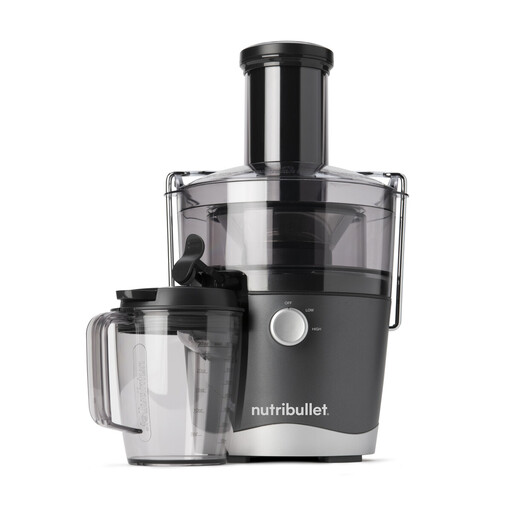
Why this product suits your needs: The 3-inch feed chute and 1.5-litre capacity are designed for households that often make larger quantities of juice.
Two speed settings and a removable pulp container that the manufacturer says is dishwasher-safe make the product specifications easier to assess.
800 W motor, according to the manufacturer, 1.5-litre capacity and a sealable 800 ml juice cup.
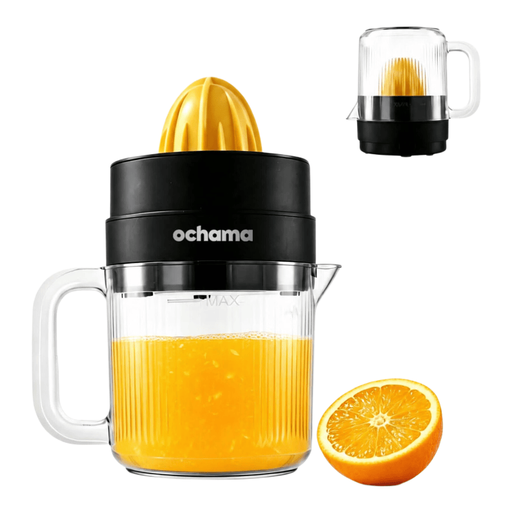
Why this product suits your needs: This electric juicer is designed specifically for oranges, lemons, mandarins and similar citrus fruits.
Its blade-free design makes it clear that this model isn’t intended for hard vegetables or pips.
1.4-litre capacity, removable parts and a citrus-pressing mechanism rated at 30 W, according to the product description.

Why this product suits your needs: This model combines a 75 mm feed chute with a 1.25-litre juice jug and a 2-litre pulp container.
A foam separator, drip stop and safety lock help address common issues when pouring and operating the juicer.
800 W motor, two speed settings and removable parts that the manufacturer says are dishwasher-safe.
We’ve put together a complete, regularly updated list of products that meet these strict selection criteria and fully comply with the safety regulations in force in the EU.
A centrifugal juicer is often a good choice for hard ingredients such as apples, carrots and cucumbers. A slow juicer may suit a wider range of soft and fibrous ingredients. Always check the instruction manual, as not every model is approved for every type of fruit and vegetable.
Its lifespan depends on how often you use it, how well you clean it, which ingredients you process and whether you stick to the maximum operating time. Remove fruit fibres straight after use, don’t overload the motor and avoid putting unsuitable hard ingredients through the juicer. If you notice any damage to the cable, sieve or casing, stop using the appliance.
Electricity consumption depends on the motor’s power rating and how long you use the appliance. A juicer rated at 800 W will use less energy during ten minutes of operation than it would during an hour of continuous use. So, running costs depend on how long you spend juicing, how often you use it and its power rating in watts.