
Lieferung heute & morgen

Qualitätsgarantie

Willkommens-Angebote freischalten: KOSTENLOSE Lieferung | Bis zu 80 % RABATT | Kostenlose 30-Tage-JoyPlus-Testphase
App herunterladen
A juicer can make preparing fruit and vegetable juices at home easier. However, electric juicers, slow juicers and citrus presses differ considerably in terms of intended use, noise levels, cleaning and capacity. If you focus only on wattage or marketing claims, you can quickly end up with a machine that does not suit your everyday routine.
A high power rating alone says little about whether a juicer is actually suitable for your needs. The pressing or centrifugal system, how the ingredients are processed, the feed chute and the permitted operating time are also important. A slow juicer, for example, works at a low speed using an auger, while a centrifugal juicer processes fruit and vegetables with a rapidly rotating sieve.
A juicer with a large feed chute can reduce the need to pre-cut apples and other fruit. This is practical for everyday use. However, you should still check how many individual parts need cleaning after use and whether fruit fibres collect in the sieve or pressing chamber. The description “easy to clean” is therefore only meaningful when the design, removable parts and cleaning method are clearly explained.
Not every machine is suitable for every ingredient. Citrus presses are designed for oranges, lemons and similar fruit. Depending on its design, a slow juicer can also process leafy greens or firmer types of fruit. Bananas, avocados, ice cubes, hard stones or fibrous ingredients, on the other hand, are unsuitable for many machines. Check the instructions before buying and before using the appliance for the first time.
A citrus press or orange juicer is a sensible choice if you mainly want to process oranges, lemons, mandarins or grapefruits. Models with a pressing cone operate without cutting blades and can be easy to use thanks to automatic separation of juice and pulp.
A slow juicer or cold-press juicer crushes and presses ingredients using an auger. This design is suitable for many types of fruit and vegetables and separates the juice from the pulp. Depending on the size of the feed chute, preparation may require varying amounts of effort.
An electric juicer with a centrifugal system usually processes ingredients quickly. This can be useful when preparing individual glasses in the morning. At the same time, the speed, noise level and subsequent cleaning of the sieve are important points to check.
An opening measuring 80 to 135 mm can reduce preparation time. Nevertheless, hard stones must be removed, and very large or fibrous ingredients may need to be cut into smaller pieces. Smaller juice containers are often sufficient for a single-person household. A juicer for the family, on the other hand, should provide separate containers for juice and pulp, as well as a capacity of around 1 to 1.8 litres.
Removable components should be accessible without complicated tools. With some appliances, they can simply be rinsed with water, while others require a brush for the filter or pressing auger. The motor housing must not be immersed in water.
A BPA-free juicer may be important to buyers who pay attention to the material used for parts that come into contact with juice. It is important to check whether the manufacturer explicitly states that BPA-free materials are used. You should also consider the 220–240 V mains voltage, a stable base, an automatic switch-off or overheating protection, and the guidance on maximum operating time.
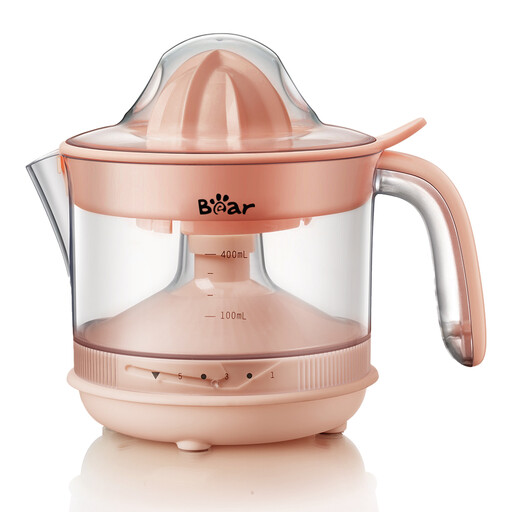
Why this product suits this profile: This compact citrus press is designed for oranges and lemons, making it suitable for households that want to prepare fresh citrus juice without using a knife or dealing with complicated settings.
The design is clearly identified as a citrus press. The 110-mm feed chute, five adjustable pulp settings and removable parts are all specified clearly.
30 W power, 400 ml capacity, 50 rpm, non-slip base and BPA-free materials according to the product details.
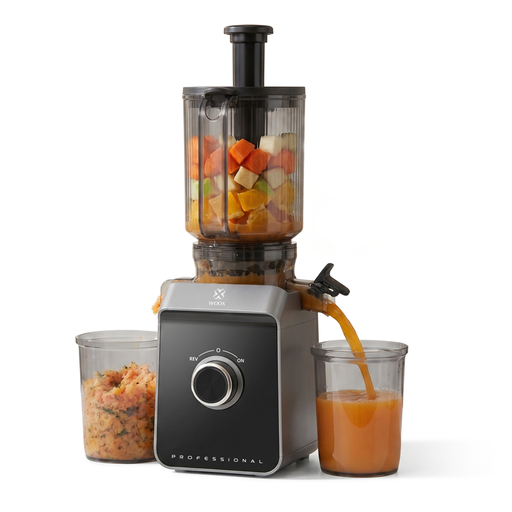
Why this product suits this profile: This slow juicer is aimed at users who regularly process fruit and vegetables and value separate juice and pulp containers.
The 130-mm opening reduces the need to pre-cut ingredients. The manufacturer states an operating noise level of under 72 dB, overheating protection and removable, dishwasher-safe parts.
150 W power, 1.8-litre chamber, 600-ml juice cup and 836-ml pulp container.
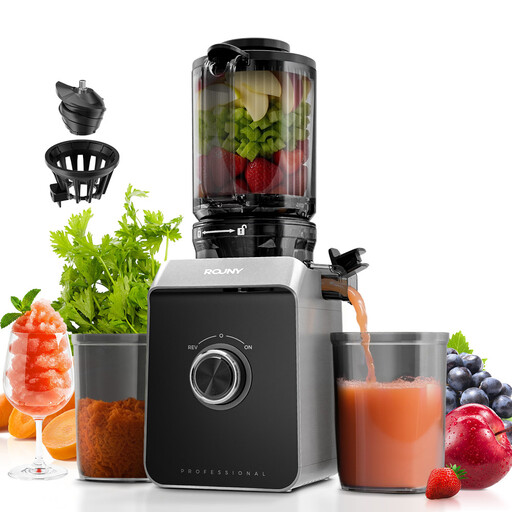
Why this product suits this profile: This model combines a large feed chute with a 1.8-litre capacity, making it suitable for households that regularly prepare several portions.
The filter-free design is intended to make rinsing easier. A reverse function can help if ingredients become stuck in the pressing chamber.
130-mm feed chute, 50 rpm, 150 W, copper motor and BPA-free construction according to the product description.
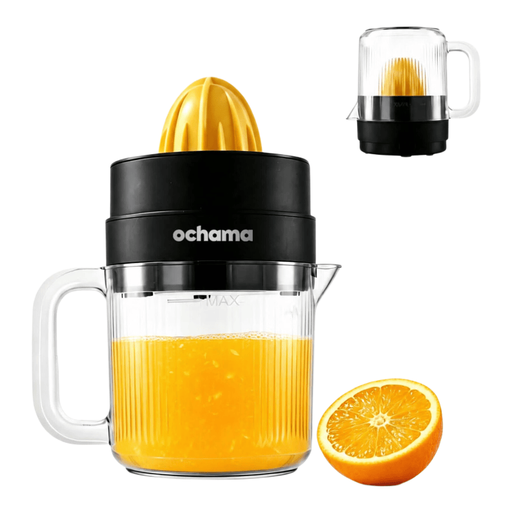
Why this product suits this profile: This semi-automatic orange juicer is suitable for families who want to prepare larger quantities of citrus juice with minimal manual effort.
The product description clearly limits its use to citrus fruit. This makes its intended purpose clearer than generalised juicer claims.
1.4-litre capacity, 30 W, blade-free design, pulp separation and removable parts for cleaning.
We have put together a complete, regularly updated list of products that fully meet these strict selection criteria and the safety regulations applicable in the EU.
The ongoing electricity costs depend on the power consumption and how long the appliance is used. A 30 W appliance uses considerably less energy over ten minutes than a 600 W model running for the same length of time. However, you should also consider the permitted operating time when deciding which appliance to buy. Frequent short uses may be more practical for a household than long, uninterrupted operating cycles.
It is not possible to give a general figure for a juicer’s lifespan. It depends on the motor, materials, care, ingredients and compliance with the manufacturer’s instructions. Hard stones, ice cubes or unsuitable fibrous ingredients can place greater strain on the components. After each use, remove any remaining juice and clean the removable parts according to the instructions.
A citrus press is sufficient for oranges, lemons and similar fruit. If you want to process apples, carrots, cucumbers or a range of vegetables, choose a slow juicer or a centrifugal juicer specifically designed for these ingredients. Before buying, compare the permitted ingredients, feed chute size, container capacity and cleaning requirements.