
Lieferung heute & morgen

Qualitätsgarantie

Willkommens-Angebote freischalten: KOSTENLOSE Lieferung | Bis zu 80 % RABATT | Kostenlose 30-Tage-JoyPlus-Testphase
App herunterladen
A juicer can make preparing fruit and vegetable juices much easier. However, appliances vary considerably in how they work, how easy they are to clean, their capacity and the ingredients they can process. If you focus only on wattage or bold advertising claims, you may end up buying a machine that is too noisy for everyday use, difficult to clean or unsuitable for your intended purpose.
This buying guide from the Joybuy Product Recommendation Officer explains what households and families in Germany should consider before buying.
A high-performance juicer can process hard ingredients such as carrots and apples quickly. However, wattage alone says little about juice yield, noise levels or continuous operation. A centrifugal juicer usually works quickly, while a slow juicer with a lower-powered motor presses more slowly and requires different preparation.
It is therefore also important to consider:
An easy-to-clean juicer does not necessarily mean that all parts are dishwasher-safe. With some appliances, you need to clean the filter and auger with a brush immediately after use. Residue from celery, carrots or pulp can otherwise dry onto the parts.
Before buying, check:
A juicer with a large feed chute reduces the amount of chopping required, but it does not replace the preparation of every ingredient. The peel should generally be removed from oranges and grapefruits. Hard stones, stalks and unsuitable ingredients can put strain on the filter or pressing mechanism.
Capacity specifications should also be examined carefully: a 600 or 700 ml juice jug is not the same as a large pulp container. For several people, the key consideration is how the two containers work together.
A slow juicer, also known as a cold-press juicer, processes ingredients slowly using an auger. This method is particularly suitable for users who are happy to take their time preparing juice and want to process a range of fruit and vegetables. However, a low speed does not automatically mean a higher juice yield for every ingredient. The result depends, among other things, on ripeness, water content and preparation.
A centrifugal juicer uses a rotating grating disc to separate the juice from the pulp quickly. It is an appealing option for larger quantities and shorter preparation times. However, operating noise, foaming and filter cleaning may be more significant considerations.
A juice press or citrus press, on the other hand, is designed for specific applications. An electric citrus press is suitable for oranges, lemons and grapefruits, but not as an all-purpose juicer for leafy vegetables or carrots.
The wattage is a comparable technical specification, but it should not be assessed in isolation. A 150-watt appliance may be designed as a slow juicer, while a centrifugal juicer with 600 to 1,000 watts is designed for rapid processing.
Multiple speed settings can be useful for:
Observe the manufacturer’s specifications for the maximum continuous operating time. For example, the WOOX MX0289 is recommended for a maximum of ten minutes of continuous operation, followed by a cooling period. According to the product specifications, the Adler AD 4130 is designed for typical operating intervals of around 15 to 20 minutes.
A small juice container may be sufficient for a single-person household. Families benefit from a larger pulp container and a suitably sized juice jug. At the same time, the appliance should fit on your worktop and be easy to store after use.
Pay attention to:
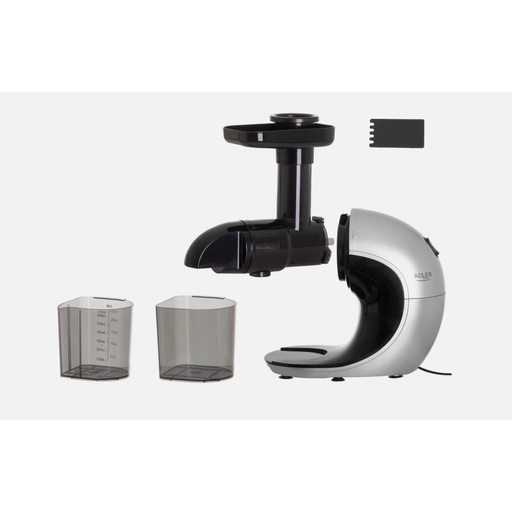
Why this product suits this profile: With 150 watts and a 650 ml container, this horizontal slow juicer is designed for smaller daily portions.
The clearly stated capacity and motor power make it easier to assess whether it is suitable for individual portions. However, the short feed chute means that ingredients need to be cut into pieces.
150 watts, 650 ml capacity and horizontal auger.
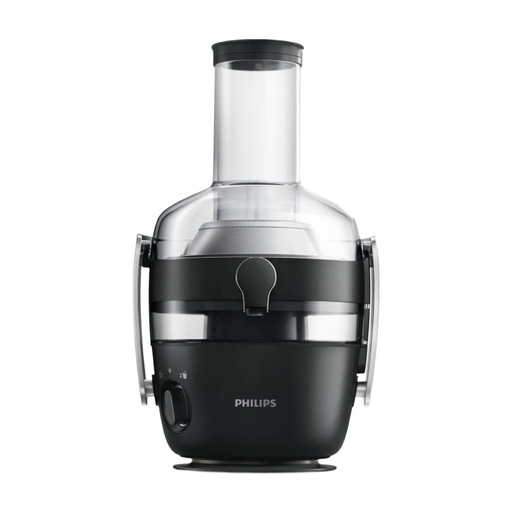
Why this product suits this profile: This electric juicer offers 1,000 watts, two speed settings, an 8 cm feed chute and a 1-litre juice container.
The wide feed chute reduces the amount of chopping required. QuickClean Plus and the removable parts, which are dishwasher-safe according to the product specifications, help avoid cleaning difficulties.
1-litre juice jug, 2.1-litre pulp container, drip stop and FiberBoost function.
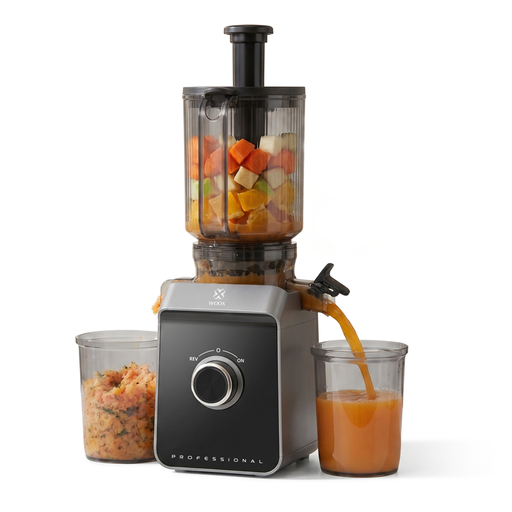
Why this product suits this profile: The large 130 mm feed chute, a 1.8-litre chamber and a 600 ml juice cup are designed for regular household portions.
The product specifications state a noise level below 72 dB and include overheating protection. Fibrous ingredients still need to be cut into pieces of around 3 to 4 cm.
130 mm feed chute, 836 ml pulp container and removable parts that are dishwasher-safe according to the product description.
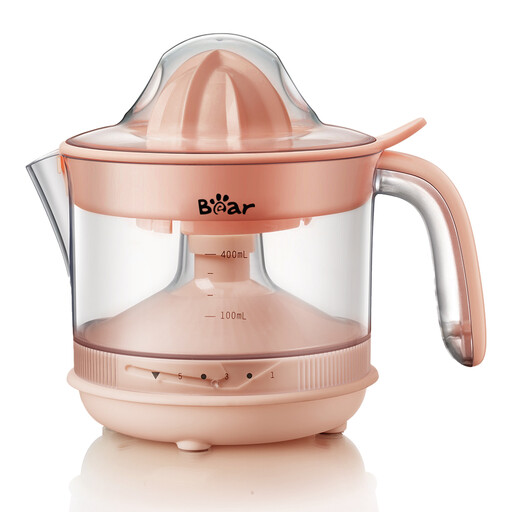
Why this product suits this profile: As a compact citrus press with a 400 ml capacity and five adjustable settings, this appliance focuses on oranges, lemons and similar fruit.
Its specialist design prevents unrealistic expectations: this is not a juicer for all types of fruit and vegetables, but an electric citrus press without a cutting blade.
30 watts, 400 ml capacity, five settings and removable design for easy cleaning.
Wash fruit and vegetables thoroughly, and remove hard stones, stalks and unsuitable peel. Depending on the instructions, fibrous ingredients should be cut into smaller pieces. Use only the supplied pusher and never reach into the feed chute.
After juicing, clean the filter, auger, containers and outlet promptly. Do not immerse the motor unit in water. Also follow the relevant instruction manual regarding operating time, reverse function and permitted ingredients.
We have put together a complete, regularly updated list of products that fully meet these strict selection criteria and the safety regulations applicable in the EU.
For versatile use, you can choose a slow juicer, cold-press juicer or centrifugal juicer. A slow juicer is designed for slow pressing, while a centrifugal juicer usually processes larger quantities more quickly. A citrus press is primarily suitable for citrus fruit.
Its lifespan depends on the quality of the materials, cleaning, operating time and correct use. Overloading, unsuitable ingredients and long periods of uninterrupted operation can put greater strain on the motor and filter. Regular cleaning and following the manufacturer’s instructions can help limit wear and tear.
In addition to the purchase price, the main ongoing costs are electricity and fruit and vegetables. The actual electricity costs depend on wattage, usage time and your electricity tariff. When used for short periods, electricity is usually a smaller cost factor than the ingredients themselves. Also check whether filters or other wear parts are available.