
Lieferung heute & morgen

Qualitätsgarantie

Willkommens-Angebote freischalten: KOSTENLOSE Lieferung | Bis zu 80 % RABATT | Kostenlose 30-Tage-JoyPlus-Testphase
App herunterladen
A juicer can make fresh drinks from oranges, apples, carrots or sugar cane. However, the right type depends heavily on the ingredients you want to process, how often you use the appliance and how much cleaning you are prepared to do. A device for the occasional orange at breakfast has different requirements from a sugar cane press for a market stall.
A high motor rating alone says little about juice yield, noise levels or everyday practicality. With an electric citrus juicer, the cone, lever mechanism and outlet design are also important. A slow juicer, on the other hand, works at a low speed using an auger. The key question is whether the appliance is designed for the ingredients you intend to use.
A large feed chute can reduce the need for chopping. Even so, you still need to remove hard stones, spoiled areas and, in some cases, the peel. Fibrous vegetables and sugar cane have different requirements from soft apples. Always check which ingredients the manufacturer specifically lists as suitable.
Removable parts, filters and pressing cones can reduce the cleaning effort. However, this does not necessarily mean that all components are dishwasher-safe. Some appliances may only be cleaned with a damp cloth or must not be immersed in water. Claims such as “easy to clean” should therefore be assessed against the specific cleaning instructions.
With a stainless steel juicer, the material specification should be as specific as possible. “Stainless steel” does not automatically describe every characteristic of the appliance. The BJ model is specified as being made from 304 stainless steel. This designation refers to a particular grade of stainless steel. Even so, you should also check the welds, stability, pressing lever and how easily the contact surfaces can be cleaned.
For electric appliances, mains voltage, cable routing and safe positioning on the worktop are also important. A non-slip base is just as relevant in a private kitchen as it is in a café or market stall.
A container with a capacity of 1.8 litres is better suited to several portions than a small juice collection container. A large feed chute can reduce the need for refilling, but it may also increase the appliance’s dimensions. Measure the available worktop space and take the height beneath wall units into account.
Noise levels also deserve consideration. The EUHOMY model is specified as producing an operating noise level of 60 dB, while the Ariete Vintage Citrus Juicer is listed at 44 dB. These are manufacturer or product specifications and may be perceived differently depending on the ingredients, room and usage conditions.
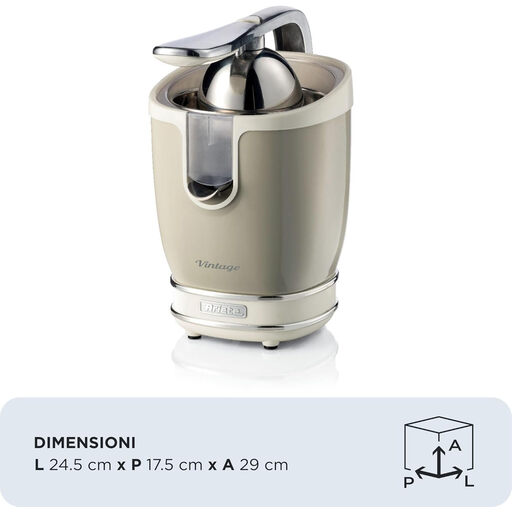
Why this product suits this profile: This electric citrus juicer is designed for oranges, lemons and similar fruit. The pressing lever can make preparing juice for breakfast easier when used regularly.
The product specifications list two pressing cones, a drip-free outlet and a 1-litre capacity. They also explicitly state that the appliance is not dishwasher-safe.
85-watt motor, 220-volt connection, a stated noise level of 44 dB, and stainless steel surfaces with a chrome finish.
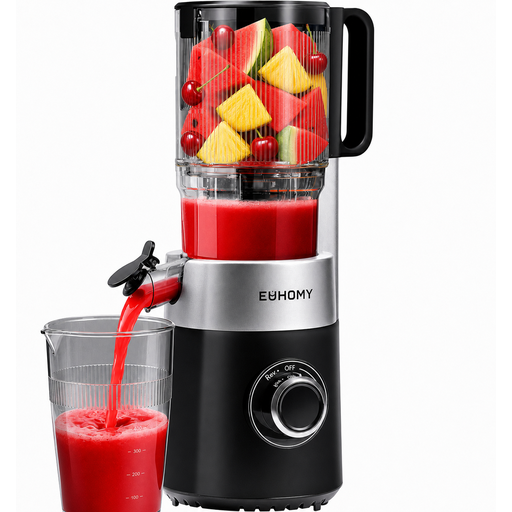
Why this product suits this profile: This cold-press juicer is aimed at households that regularly prepare fruit and vegetable juice and need a larger container capacity.
The design, with removable components and a three-stage filter system, helps address typical residue build-up. However, the “easy to clean” claim should still be checked against the enclosed instructions.
135 mm feed chute, 1.8-litre capacity, 220-watt motor and, according to the product description, an operating noise level of 60 dB.
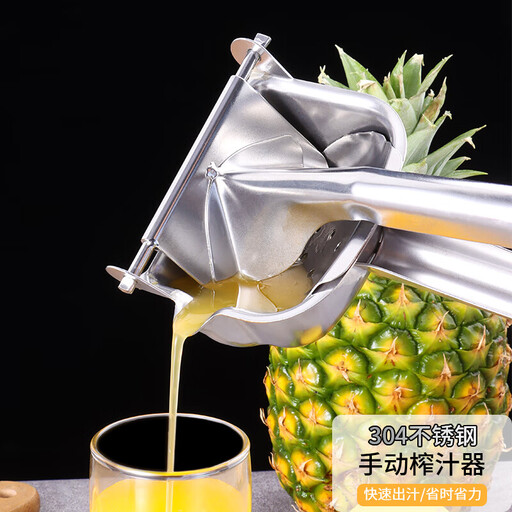
Why this product suits this profile: This manual sugar cane press is designed for sugar cane and requires no electricity. It is therefore suitable for homes, juice bars, cafés or market stalls with the relevant requirements.
The specific 304 stainless steel specification is more informative than an undefined metal description. Before buying, you should still check the available worktop space, the force required to operate the lever and how accessible the contact surfaces are for cleaning.
Manual operation without electricity and, according to the product description, a 304 stainless steel construction focused on sugar cane juice.
We have put together a complete, regularly updated list of products that fully meet these strict selection criteria and the safety regulations applicable in the EU.
Check the following before placing your order:
For occasional oranges, a manual press is usually sufficient. If you want to make several glasses, an electric citrus juicer with a pressing lever may be more practical. Look for cones suitable for different fruit sizes, a drip-free outlet and clear cleaning instructions.
A traditional centrifugal juicer often separates the juice from the pulp using a rapidly rotating sieve. A slow juicer crushes and presses the ingredients at a lower speed. This can affect the texture of the juice, but it does not provide a basis for making a general statement about its nutritional quality.
Clean the juicer as soon as possible after use, before the pulp dries on. Rinse the filter and pressing cone according to the manufacturer’s instructions, do not use unsuitable abrasive cleaners, and check in advance whether individual parts are dishwasher-safe. With a sugar cane press, it is particularly important to remove fibrous residue from the pressing area and outlet.