
Lieferung heute & morgen

Qualitätsgarantie

Willkommens-Angebote freischalten: KOSTENLOSE Lieferung | Bis zu 80 % RABATT | Kostenlose 30-Tage-JoyPlus-Testphase
App herunterladen
A juicer can make preparing fruit and vegetable juices part of your daily routine. However, citrus presses, slow juicers and centrifugal juicers differ considerably when it comes to ingredients, cleaning, noise levels and capacity. If you focus only on wattage or sweeping marketing claims, you can easily end up buying a device that does not suit your everyday needs.
A 600-watt electric juicer can process ingredients quickly. However, that does not automatically make it the right choice for every type of fruit. The design, filter system and preparation of the ingredients also affect the result. A slow juicer, for example, operates at a low speed and uses a pressing screw, while a centrifugal juicer separates the pulp using a sieve.
A juicer with a large feed chute can accommodate apples or larger pieces. Even so, hard pips, stalks and particularly firm ingredients may need to be removed or chopped, depending on the model. A chute measuring 80, 130 or 135 millimetres is therefore a useful specification, but it does not mean every ingredient can be added whole.
Fine sieves can catch residue, but they must be rinsed thoroughly after use. A juicer with pulp separation also requires containers or outlets for the juice and pulp. Check whether the removable parts are easy to access and whether the motor unit may only be cleaned with a damp cloth.
For one person, 300 to 400 millilitres may be sufficient. Families are more likely to benefit from a juice container holding around 1 litre or more. The stated capacity should also be considered alongside how the appliance is actually used: a large container means fewer interruptions to refill it, while a compact device takes up less worktop space.
Look for removable components, clear operating instructions and a clear distinction between washable parts and the motor housing. The motor housing of the devices presented here must not be immersed in water. Unplug the appliance before dismantling it.
For a model described as a BPA-free juicer, the manufacturer’s corresponding material specification should be verifiable in the product information. Electrical appliances for German households should also be compatible with the available power supply. The mains-powered devices mentioned here are specified for a supply of 220–240 volts.
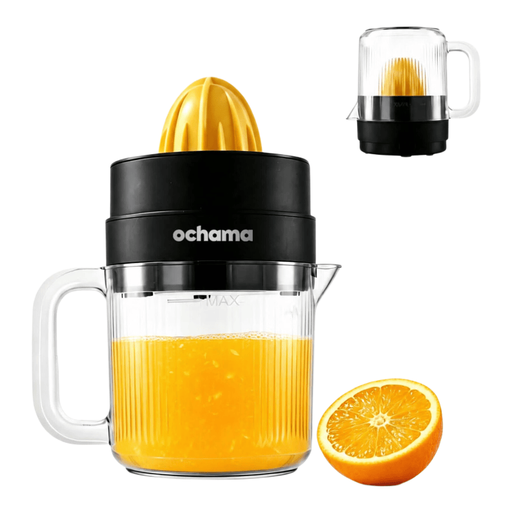
Why this product suits this profile: This electric citrus press is designed for oranges, lemons and other citrus fruits. With a capacity of 1.4 litres, it is suitable for preparing several glasses at home.
Its design is clearly limited to citrus fruit. This avoids giving the impression that the appliance is suitable for hard or fibrous ingredients.
30-watt motor, 1.4-litre capacity, removable parts and pulp separation according to the product description.
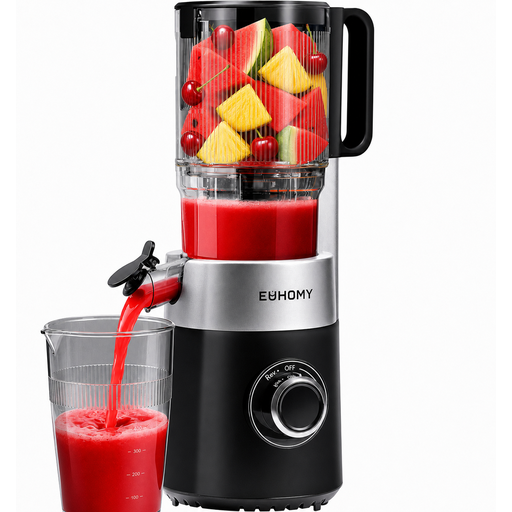
Why this product suits this profile: This cold-press juicer is aimed at households that want to process larger quantities of fruit and vegetables regularly.
The 135-millimetre feed chute is specified clearly. At the same time, bear in mind that ingredients may need to be prepared according to their size and firmness.
220-watt motor, 1.8-litre capacity, 60 decibels according to the product specifications, triple filter system and two glasses included.

Why this product suits this profile: This centrifugal juicer is an interesting option for anyone who wants to prepare juices quickly from suitable fruit and vegetables.
The manufacturer’s guidance specifically lists unsuitable ingredients such as bananas, avocados, sugar cane and maize. This makes it easier to plan how the appliance can be used realistically.
600-watt power, wide feed chute, stainless-steel construction and BPA-free material specification according to the product description.
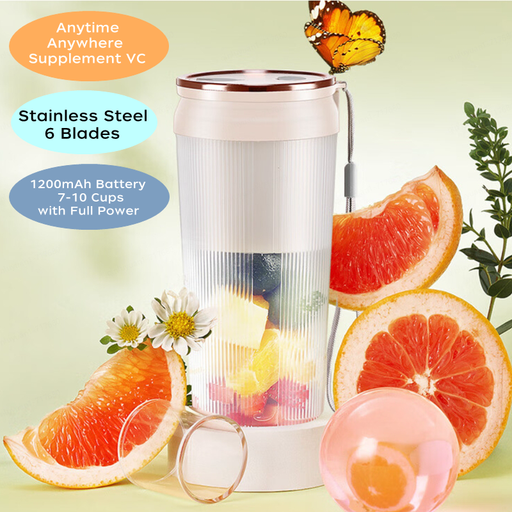
Why this product suits this profile: With a capacity of 300 millilitres, this portable juicer is designed for small portions made from soft, prepared ingredients.
Its limited capacity makes it clear that the appliance is not intended for large family-sized quantities. Ingredients must be cut into pieces measuring 1 to 1.5 centimetres.
1200-mAh battery, washable cup and double-click start according to the product description.
We have put together a complete, regularly updated list of products that fully meet these strict selection criteria and the safety regulations applicable in the EU.
For versatile use, a slow juicer or cold-press juicer is generally the best option. An electric citrus press, on the other hand, is specially designed for citrus fruit. Before buying, check which ingredients are explicitly listed as suitable and read the guidance on pips, hard fibres and starchy pulp.
The lifespan depends on how often it is used, the ingredients processed, cleaning and compliance with the recommended operating times. Remove hard pips, do not overload the appliance and follow the guidance on the maximum continuous operating time. Removable parts should be cleaned immediately after use to prevent residue from drying on.
You can calculate the ongoing electricity costs from the power rating, usage time and electricity tariff: divide the wattage by 1,000, then multiply it by the operating time in hours and the price per kilowatt-hour. Short uses generally result in low individual costs. Depending on the recipe, the cost of fruit, vegetables and any replacement parts may have a greater impact on your household budget.