
Lieferung heute & morgen

Qualitätsgarantie

Willkommens-Angebote freischalten: KOSTENLOSE Lieferung | Bis zu 80 % RABATT | Kostenlose 30-Tage-JoyPlus-Testphase
App herunterladen
A dead car battery or a flat tire rarely happens at a convenient time. Especially with older vehicles or during the cold months, such breakdowns can derail your entire day. Instead of waiting for roadside assistance, a combination device with a jump starter and an air compressor offers a self-sufficient and practical solution.
This article serves as a guide. It outlines objective criteria for selecting the right device and presents a selection of models with different specialisations to help you make an informed purchasing decision.
The market offers a wide variety of devices. To find the right model for your needs, a few technical parameters are crucial.
The peak current, measured in Amperes (A), is one of the most important metrics for a jump starter. It describes the maximum current the device can deliver for a short burst to start the engine.
Always check the manufacturer's specifications regarding compatibility with your engine displacement (in litres) to ensure the 12V jump starter is suitable for your vehicle.
An integrated compressor turns the device into a multifunctional tool. Pay attention to the following features:
Modern jump starters often double as a powerful jump starter power bank. The battery capacity, usually specified in milliampere-hours (mAh), determines how many times you can start a vehicle or charge your mobile devices.
Important additional features include:
Based on the criteria mentioned, we have compiled a selection of devices that cover different needs.
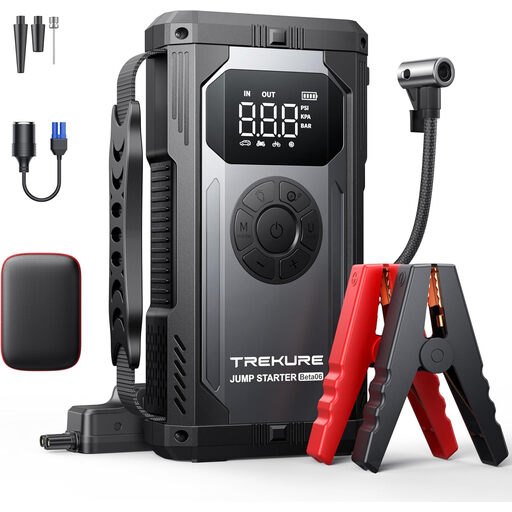
Why it stands out: The TREKURE Beta06 is an all-in-one device that combines high jump-starting power with an efficient compressor. With a peak current of 5500 A, it is designed for almost all petrol engines and for diesel engines up to 10.0 litres. The integrated compressor reaches a pressure of up to 150 PSI with an airflow rate of 35 litres per minute. A special feature is its force start technology, which the manufacturer claims works even on completely dead 12V batteries.
Pros:
Who is it for? For drivers of large vehicles like SUVs, motorhomes, or vans, as well as for anyone looking for a comprehensive emergency solution for battery and tire issues in a single device.
If you already own a separate compressor and instead prioritise maximum starting power or an especially fast charging function, the following models might be worth considering. These devices do not have an integrated compressor.
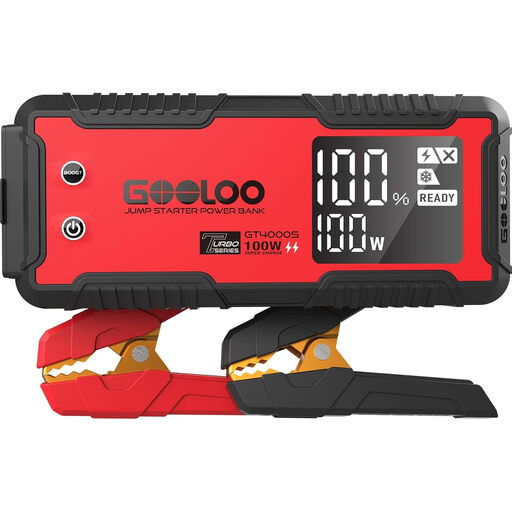
Why it stands out: The GOOLOO GT4000S focuses on extreme starting power and charging speed. With 4000 A of peak current, it can start petrol engines up to 12.0 litres and diesel engines up to 10.0 litres, according to the manufacturer. Its standout feature is the 100W two-way fast charging, which allows the device to be fully recharged in just over an hour while also serving as a powerful power bank for laptops.
Who is it for? For users who place the highest priority on starting power for very large engines and extremely fast charging times, and can do without an integrated compressor.
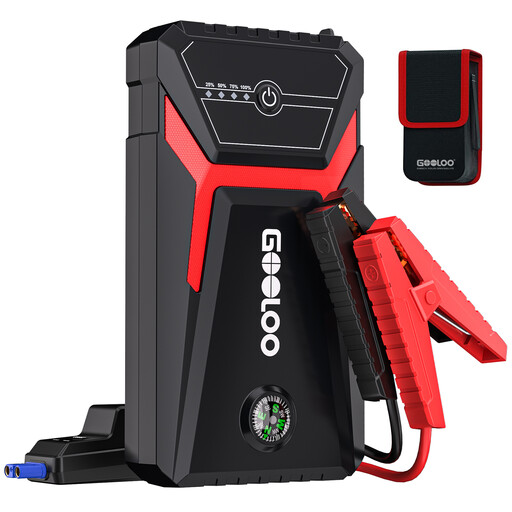
Why it stands out: The GE1500 model from GOOLOO is a more compact and lightweight alternative. With 1500 A of peak current, it is designed for petrol engines up to 6.0 litres and diesel engines up to 4.0 litres. It is a pure jump starter with a power bank function and serves well as a space-saving emergency kit for standard passenger cars.
Who is it for? For drivers of small to mid-size cars who are looking for a lightweight, handy, and straightforward emergency solution and do not need an integrated compressor.
The models presented here are a selection to illustrate different user profiles. If you want to compare more options or are looking for a device with different specifications, you can find a broader overview in our Car Jump Starter Battery category.
It is recommended to fully charge the jump starter every 3 to 6 months, even if it hasn't been used. This ensures the battery is ready for an emergency and helps maintain its lifespan. Always refer to the manufacturer's specific recommendations in the user manual.
Yes, provided the device has a sufficiently high peak current. Diesel engines require more power to start than petrol engines. Therefore, pay close attention to the manufacturer's specifications regarding suitability for diesel engines and the maximum supported engine displacement.
The peak current (Peak Amps) is the maximum amperage the device can deliver for a very short moment to engage the vehicle's starter and turn over the engine. A higher peak current is necessary for larger engines, engines with high compression (like diesels), or in very cold temperatures.