
Lieferung heute & morgen

Qualitätsgarantie

Willkommens-Angebote freischalten: KOSTENLOSE Lieferung | Bis zu 80 % RABATT | Kostenlose 30-Tage-JoyPlus-Testphase
App herunterladen
A dead car battery or a flat tyre always happens at the worst time—usually far from the nearest garage. A jump starter with an air compressor promises to be a reliable all-in-one solution for such breakdowns. However, the market is flooded with devices making bold advertising claims. Many vehicle owners invest in a unit that fails at the critical moment.
As your Joybuy Product Recommendation Officer, I'm here to help you separate the wheat from the chaff. We'll highlight the most common pitfalls and show you which technical specs truly matter, so you can make an informed decision and avoid falling for exaggerated marketing.
Before you decide on a model, you should be aware of the typical flaws that often only surface in an emergency with cheap or poorly designed devices.
To avoid a bad purchase, you should focus on objective, verifiable performance data. These three parameters are crucial for function and safety.
The peak current, measured in Amperes (A), is the maximum current the device can briefly deliver to start the engine. This is the most important value for the jump-starting function.
Always check the manufacturer's specifications for the maximum engine displacement (in litres) for both petrol and diesel engines.
A compressor's performance is indicated in PSI (Pounds per Square Inch) or BAR. Most car tyres require a pressure between 2.0 and 2.5 BAR (approx. 30-36 PSI).
The function as a power bank with jump starter and compressor depends on the battery capacity, which is stated in milliampere-hours (mAh). A higher capacity means you can perform more jump-start attempts or charge your smartphone more often. However, the integrated protection mechanisms are more important. Look for at least 8 safety features, including:
Here are three models that represent a considered choice for different user profiles, based on their technical specifications and features.
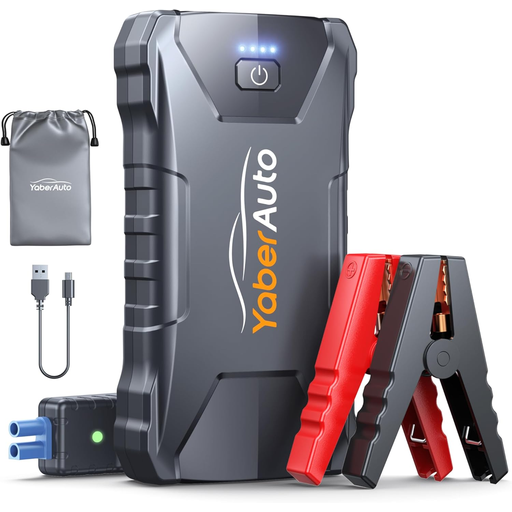
Why This Fits Their Persona: Ideal for drivers of small to mid-size cars looking for a compact and straightforward emergency solution. The device is small enough for the glove box yet offers sufficient power for most common engines.
The device features 10 built-in safety protections, including reverse polarity protection. Clear specifications on engine compatibility (up to 7.0L petrol / 5.5L diesel) prevent the purchase of an underpowered unit.
Extremely compact and lightweight: At just 0.340 kg, it's easy to store and carry. Integrated Power Bank: The USB output allows for charging mobile devices on the go.
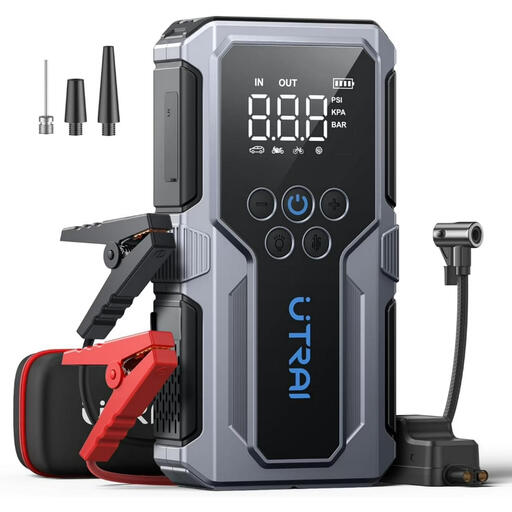
Why This Fits Their Persona: A well-balanced solution for drivers of SUVs, estate cars, or mid-size diesel vehicles. The combination of 3000A peak current and a 150 PSI compressor covers most everyday breakdown scenarios.
The digital compressor with pressure pre-setting and automatic shut-off bypasses the problem of underpowered or imprecise tyre inflators. The LED display clearly shows all relevant information.
Powerful 3000A Peak Current: Suitable for petrol engines up to 8.5L and diesel engines up to 6.5L. Smart LCD Display: Shows battery status and tyre pressure in real-time.
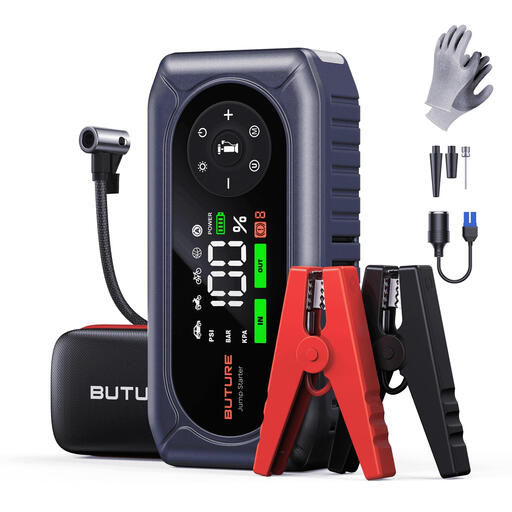
Why This Fits Their Persona: The right choice for owners of large SUVs, vans, boats, or motorhomes. This BUTURE jump starter offers maximum power reserves for demanding jump-starts, even in extreme temperatures.
With a true 4500A peak current, this device exposes the exaggerated claims of many competitors. According to the manufacturer, its honeycomb cooling technology reduces heat generation by 30%, preventing compressor overheating.
Massive Power: Starts petrol engines up to 9.0L and diesel engines up to 8.0L. Advanced Cooling: Enables more reliable and prolonged use of the compressor.
We have compiled a complete, up-to-date list of products that fully meet these strict selection criteria and relevant safety regulations.
To ensure the longevity and readiness of the internal battery, most manufacturers recommend fully charging the device every 3 to 6 months, even if it hasn't been used. This prevents a deep discharge of the battery. Always refer to the specific instructions in your model's user manual.
That depends on the size of the diesel engine. A 2000A starter is often sufficient for smaller diesel engines (e.g., up to 5.5 litres displacement). For larger engines, especially in cold outdoor temperatures, a model with 3000A or more is recommended, as diesel engines have higher compression and require more power to start. Always compare the manufacturer's specifications with your vehicle's engine size.
This is not recommended. The compressors in these combination devices are designed for emergency use, such as inflating a flat tyre or correcting pressure. To avoid overheating, manufacturers generally advise against running the compressor for more than 10 minutes at a time and allowing it a cooling-down period afterwards.