
Lieferung heute & morgen

Qualitätsgarantie

Willkommens-Angebote freischalten: KOSTENLOSE Lieferung | Bis zu 80 % RABATT | Kostenlose 30-Tage-JoyPlus-Testphase
App herunterladen
A dead car battery or a flat tyre always happens at the worst possible time – usually on the way to work, on holiday, or at night on a deserted country road. A multifunctional jump starter with an air pump promises a quick and straightforward solution. But the market is flooded with devices boasting impressive numbers and grandiose promises. If you're not careful, you can easily invest in a device that fails in an emergency.
As your Joybuy Product Recommendation Officer, I'm here to help you separate the wheat from the chaff. We'll highlight the most common pitfalls when buying and show you which technical specs truly matter, so you can make an informed decision for your safety.
Many products advertise features that are of little practical relevance or serve to distract from fundamental flaws. Pay close attention to these three points to avoid a bad purchase:
To objectively evaluate a device's performance, you should focus on the following verifiable metrics. These provide insight into its actual suitability for your vehicle and your needs.
Check the specifications for engine size compatibility. Manufacturers usually state the maximum engine displacement (in litres) for petrol and diesel engines that the device is designed for. Diesel engines generally require a more powerful starting impulse due to higher compression. A portable jump starter should therefore always be chosen to match your own vehicle.
The maximum pressure (in Bar or PSI) is less important than the airflow (L/min). A value of 25 L/min or more ensures that a standard car tyre can be inflated in just a few minutes. A good electric tyre inflator should also have an automatic shut-off feature: you set the target pressure, and the compressor stops by itself once it's reached. This prevents over-inflation and makes it safer and more convenient to use.
The battery capacity, given in milliamp-hours (mAh), determines how many jump-start attempts are possible or how many times you can charge your smartphone. This turns a jump starter with an air pump into a comprehensive automotive emergency kit. Look for the following features:
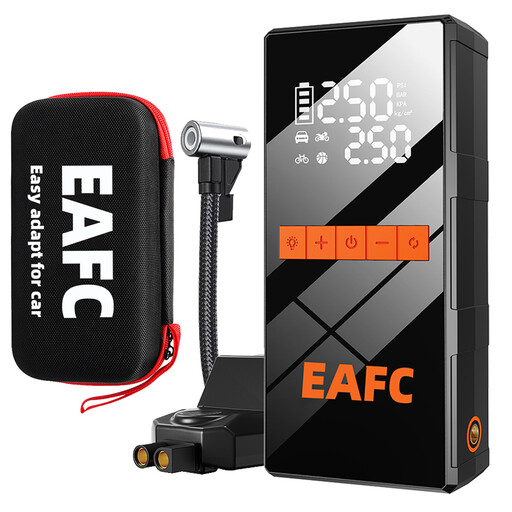
Why This Fits Their Persona: Ideal for drivers of small and compact cars who want basic protection for the most common breakdowns without a large investment. The 4-in-1 device covers jump-starting, tyre inflation, power bank, and flashlight functions.
The device provides realistic performance figures for engines up to 4.0L petrol/2.0L diesel, rather than advertising exaggerated peak currents. The compressor features an automatic shut-off.
Compact design for storage in the glove compartment. Integrated safety clamps protect against incorrect use.
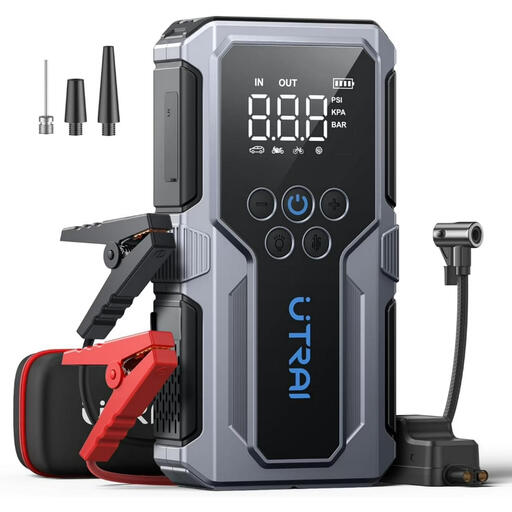
Why This Fits Their Persona: For commuters and families who need a reliable and powerful device for mid-size to premium vehicles (including SUVs). The high battery capacity and fast-charging ports are practical for long journeys and charging multiple devices.
The clear 2-inch LED display shows battery level and tyre pressure, eliminating guesswork. The 10 built-in protection mechanisms, including reverse polarity protection, minimise the risk of user error.
Powerful performance for engines up to 8.5L petrol/6.5L diesel. 15000mAh power bank with Quick Charge ports (USB and USB-C).
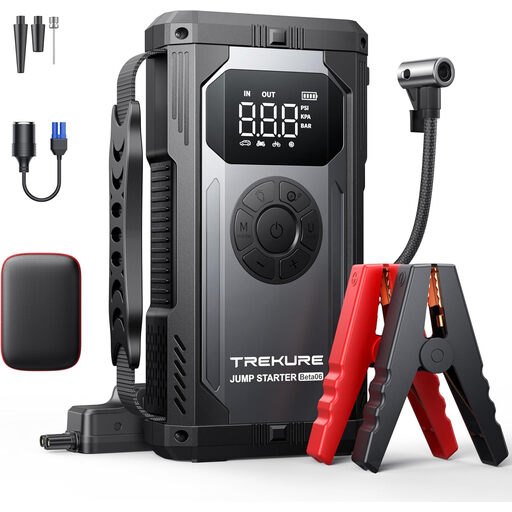
Why This Fits Their Persona: Perfect for owners of large vehicles, motorhomes, or for campers who need an off-grid power supply. The high power output reliably starts even large diesel engines, and the DC output can power 12V devices like cool boxes or vacuum cleaners.
This model combines a high peak current with the ability to start large diesel engines up to 10.0L. The compressor is specified at 35 L/min, which ensures rapid inflation and bypasses the trap of an underpowered compressor.
Very high battery capacity (23800mAh) and a DC cigarette lighter adapter for maximum versatility when camping and travelling.
We have compiled a complete, up-to-date list of products that fully meet these strict selection criteria and relevant safety standards.
Most manufacturers recommend checking the device every 3 to 6 months and recharging it if necessary. This ensures that the battery has a sufficient charge in an emergency. You can find the exact intervals in your model's user manual. Regular maintenance is crucial to maximising the life of the lithium battery.
Not necessarily. As mentioned earlier, the peak current is only a brief maximum value. It is more important that the starting power (cranking current) and the specified engine compatibility (displacement in litres for petrol/diesel) match your vehicle. An oversized device for a small car offers no practical advantage but can be more expensive and bulkier.
Yes, these devices are designed for use in cars and typically have an operating temperature range of about -20°C to +60°C. However, you should avoid leaving the device in direct sunlight on the dashboard for extended periods in high summer, as extreme heat can affect the battery's lifespan. In winter, its performance may be slightly reduced at very low temperatures, but it will still be functional.