
Lieferung heute & morgen

Qualitätsgarantie

Willkommens-Angebote freischalten: KOSTENLOSE Lieferung | Bis zu 80 % RABATT | Kostenlose 30-Tage-JoyPlus-Testphase
App herunterladen
By the Joybuy Product Recommendation Officer, August 30, 2026
A dead car battery or a flat tyre rarely happens at a convenient time. In moments like these, a reliable multi-function device is worth its weight in gold. A jump starter with an integrated compressor promises to solve both problems. However, the market is filled with devices whose performance claims often promise more than they deliver. Before you make a decision, it's crucial to understand the common pitfalls that can lead to a bad buy.
A common problem is exaggerated performance specs. Manufacturers advertise very high peak current ratings (Amps) that, in practice, are often unattainable, especially in cold temperatures or when used as a jump starter for a diesel vehicle. Another shortcoming is the compressor itself. Many budget-friendly models overheat quickly or fail to generate the pressure needed for modern tyres, rendering the car tyre inflator aspect useless. Finally, the quality of the internal battery cells is critical. Low-quality batteries lose their charge quickly when not in use and have a short lifespan, making the entire portable jump starter useless.
To ensure your device works in an emergency, you should carefully examine three core technical parameters. These form the foundation of a functional car emergency kit.
Peak current, measured in Amps (A), is the maximum energy the device can deliver for a brief moment to start the engine. A common mistake is to focus only on this value. What's crucial is the compatibility with your engine:
A good car battery booster delivers not only a high peak current but also a stable starting current over several seconds.
The ability to inflate a tyre depends on two values: the maximum pressure and the airflow rate.
The capacity of the internal battery, specified in milliamp-hours (mAh), determines how many times you can jump-start a car or charge your devices. A capacity between 10,000 mAh and 20,000 mAh is a good benchmark. Ensure the device also functions as a jump starter power bank and includes USB ports for charging smartphones or tablets. An integrated LED light with various modes (flashlight, strobe, SOS) is a useful addition for breakdowns in the dark.
Instead of making a blanket recommendation, we've matched products to different types of drivers and their specific needs.

Why This Fits Their Persona: Ideal for drivers who want a single, powerful solution for both battery and tyre emergencies. Perfect for families, long-distance drivers, and owners of vehicles with large engines (up to 9.0L petrol / 8.0L diesel).
The high peak current of 4500A is designed for large engines, bypassing the trap of underpowered devices. The 150 PSI compressor with presets and auto-shutoff is a practical, real-world feature, not just a marketing gimmick.
Combines very high jump-starting power with a full-featured digital compressor. Its robust build and wide operating temperature range ensure reliability.
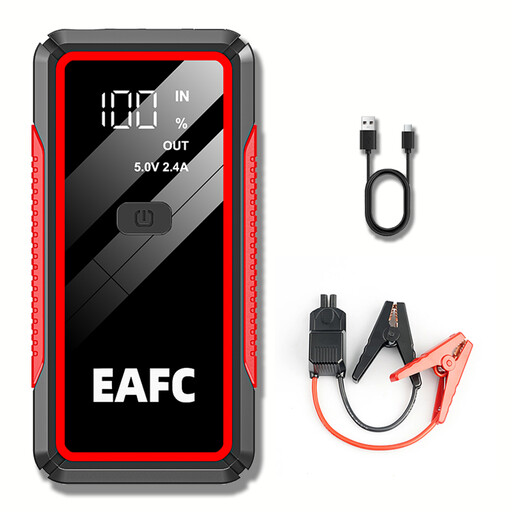
Why This Fits Their Persona: For drivers of larger SUVs or diesel vehicles (up to 6.0L petrol / 4.0L diesel) who prioritise maximum starting power and already own a separate compressor.
This device focuses on one job: jump-starting. The high peak current of 2000A is tailored for demanding engines, avoiding the pitfall of multi-function gadgets that don't excel at any single task.
High starting power in a compact package. Its temperature resistance from -10°C to +85°C ensures functionality in extreme conditions.

Why This Fits Their Persona: For city drivers with standard petrol cars or motorcyclists who need an extremely compact and lightweight device for the glove box or a backpack.
This model avoids the trap of being oversized. It isn't meant for large diesel engines but provides a reliable, space-saving solution for its intended use case, without unnecessary bulk.
Extremely compact and lightweight design (approx. 330g). Also serves as a reliable jump starter power bank for mobile devices.
We have compiled a complete, real-time list of products that fully satisfy these strict selection criteria and UK safety regulations.
Even when not in use, the battery will slowly discharge. It is recommended to fully charge the device every 3 to 6 months to maintain battery health and ensure it's ready for an emergency. Most models have a charge level indicator.
Yes, but it's crucial to choose the right model. Due to their higher compression, diesel engines require a significantly higher starting current. Pay attention to the manufacturer's specifications for engine size compatibility for diesel engines and select a device with a correspondingly high peak current (typically 2000A or more for common diesel cars).
Yes, a maximum pressure of 150 PSI (approx. 10.3 BAR) is more than sufficient for all common car, SUV, and motorcycle tyres. The typical tyre pressure for cars is between 2.2 and 2.8 BAR (approx. 32-40 PSI). The high-pressure reserve ensures that the compressor does not have to operate at its performance limit.