
Lieferung heute & morgen

Qualitätsgarantie

Willkommens-Angebote freischalten: KOSTENLOSE Lieferung | Bis zu 80 % RABATT | Kostenlose 30-Tage-JoyPlus-Testphase
App herunterladen
A dead car battery or a flat tire always happens at the worst possible time. A jump starter with a compressor promises to be a reliable solution for both problems. However, the market is flooded with devices boasting impressive numbers and bold promises. In practice, many of these products prove to be inadequate, leading to frustration when you need them most.
As your Joybuy Product Recommendation Officer, I'm here to help you separate the wheat from the chaff. We'll highlight the most common pitfalls and clarify which technical specifications truly matter, so you can make an informed decision for your emergency jump starter.
Many devices advertise features that offer little real-world benefit. Pay close attention to these three points to avoid falling for empty marketing promises:
To ensure your 12V jump starter works reliably in an emergency, you should check three core aspects:
Ignore the peak current value alone. Instead, look for explicit compatibility with your engine type and displacement. Manufacturers usually specify the maximum engine sizes for petrol and diesel engines the device is designed for (e.g., "for up to 9.0-litre petrol and 8.0-litre diesel engines"). A jump starter for petrol and diesel should always provide clear compatibility information. Diesel engines fundamentally require more starting power than petrol engines due to their higher compression.
A high-quality device features smart jumper cables with at least eight protection functions. The essential ones are:
These features make it safe for novices to use and protect your vehicle's electronics.
A useful compressor is defined not by its maximum pressure, but by its practical performance. Look for the following features:
Here are some recommendations tailored to different user needs.

Why This Fits Their Persona: Ideal for drivers of SUVs, station wagons, and sedans looking for a versatile and safe device for daily family use and holiday trips. The combination of a powerful jump starter and a practical compressor covers the most common breakdown causes.
The device clearly specifies its suitability for large engines (9.0L petrol/8.0L diesel) and features 10 protection functions. The compressor offers a practical preset function, which solves the problem of uncontrolled inflation.
5-in-1 functionality (jump starter, compressor, power bank, LED light). The compressor's automatic shut-off and the clear LCD display enhance operational safety and convenience.
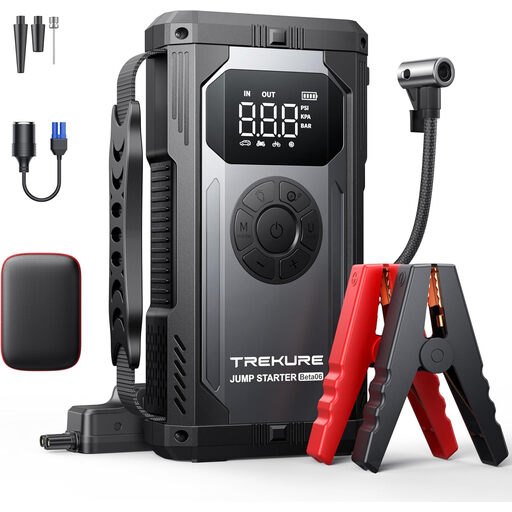
Why This Fits Their Persona: Designed for owners of motorhomes, light-duty vans, or vehicles with large-displacement diesel engines. The high power reserve is crucial for demanding jump-starts, even in cold weather.
With 5500A peak current and explicit suitability for all petrol and up to 10.0L diesel engines, it bypasses the pitfall of insufficient power. The manual override ("force start") function is a clear feature for professional use on completely dead batteries.
Very high starting power and a high compressor air flow rate (up to 35 L/min). The DC output (cigarette lighter socket) allows for powering other 12V devices like portable coolers.
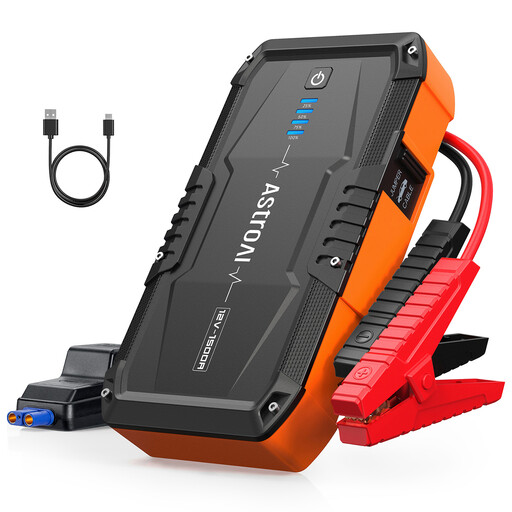
Why This Fits Their Persona: For drivers of small and compact cars who want an extremely compact and lightweight jump starter for the glove box. The focus is purely on the emergency jump-starting function, without the extra bulk of a compressor.
This device focuses on the essentials: safe jump-starting. It features 8 protection functions and a special "BOOST" mode for deeply discharged batteries, avoiding the pitfall of insufficient power for its specified vehicle class.
Very compact and lightweight (approx. 430 g). The metal clamps and smart cable are designed for durability and safety. A great choice if a compressor is not needed.
We have compiled a complete, up-to-date list of products that fully meet these strict selection criteria and safety regulations.
Even when not in use, the internal battery is subject to self-discharge. To ensure full performance in an emergency, most manufacturers recommend fully charging the device every 3 to 6 months. Refer to the specific instructions in your model's user manual.
Yes, modern devices with smart protection features are designed to be safely used by novices. The integrated reverse polarity protection is the most important feature here: it prevents sparks and damage, even if you accidentally connect the red and black clamps to the wrong battery terminals. Nevertheless, always read the user manual carefully before the first use.
No, absolutely not. A 12V jump starter is designed exclusively for vehicles with a 12V electrical system (most cars, motorcycles, and SUVs). Attempting to start a 24V system (as found in most trucks and buses) can destroy both the jump starter and the vehicle's electronics, and it poses a significant safety risk.