
Lieferung heute & morgen

Qualitätsgarantie

Willkommens-Angebote freischalten: KOSTENLOSE Lieferung | Bis zu 80 % RABATT | Kostenlose 30-Tage-JoyPlus-Testphase
App herunterladen
A dead car battery or a flat tire always happens at the worst time—usually on the way to work or at the start of a vacation. A portable jump starter with compressor promises a quick fix for both problems and is a key component of a comprehensive car emergency kit. But the market is flooded with devices boasting impressive specs that often don't live up to their claims in practice.
As your Joybuy Product Recommendation Officer, I'll help you see through the marketing hype. We'll focus on the facts so you can make an informed decision and avoid the most common pitfalls.
Many devices advertise high-performance specs, but the reality is often different. Pay attention to these three points to avoid a bad purchase:
To find the right jump starter, don't be dazzled by marketing buzzwords. Instead, focus on these three verifiable criteria.
The most important value is the starting current that can be delivered consistently over several seconds. This determines whether the device can reliably start your engine.
A good compressor is more than just an emergency fix. Pay attention to the airflow rate in liters per minute (L/min). A value over 20 L/min is a good benchmark for acceptable performance on car tires. Devices with 35 L/min or more can also fill larger tires (e.g., from an SUV or camper van) in a reasonable amount of time without overheating. An automatic shut-off function when the target pressure is reached is also an important convenience and safety feature.
A high battery capacity is the foundation of a versatile multi-function jump starter. A capacity of over 15,000 mAh (based on the internal cells) is recommended to ensure multiple jump-start attempts and device charging. Modern devices act as a full-fledged power bank with jump starter and should have up-to-date ports:
Based on the criteria above, we have identified a few models that are particularly well-suited for specific user groups.
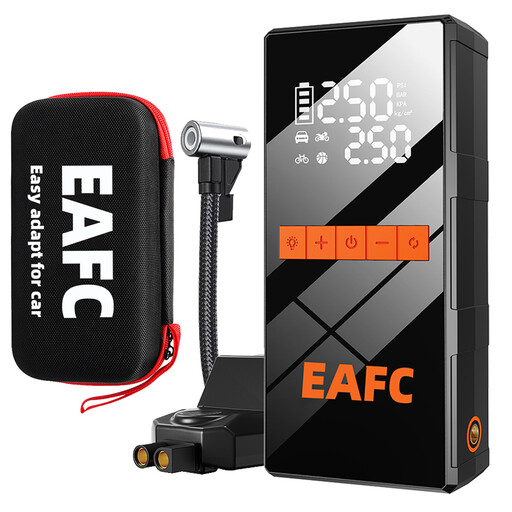
Why This Fits Their Persona: Ideal for drivers of small and compact cars with petrol engines who are looking for a solid 4-in-1 emergency solution. The device offers sufficient power for common vehicles and covers the most important functions (jump starter, compressor, power bank, LED light) at an attractive price.
The performance specs (1200 A peak, for petrol engines up to 4.0L) are realistic for the target audience and don't create false expectations. The focus is on functional basic features without exaggerated marketing claims.
Combines the four most important emergency functions in a very compact and lightweight housing. The compressor's automatic shut-off feature enhances user safety.
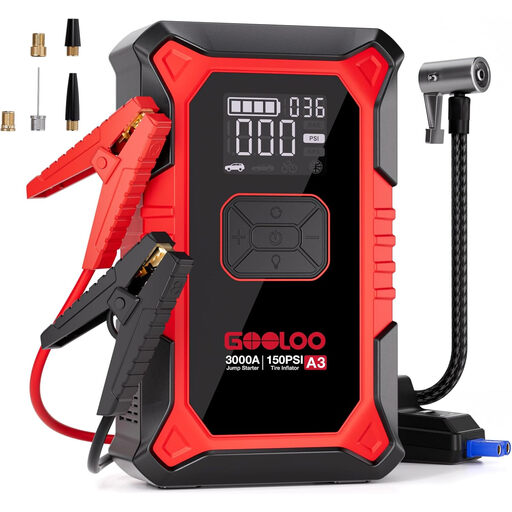
Why This Fits Their Persona: Perfect for owners of SUVs, vans, or larger sedans with diesel engines. This device offers high power reserves for starting the engine and a powerful compressor that can quickly inflate even large tires—a reliable companion for family outings and trips.
This model avoids the weak compressor trap with an explicitly stated high airflow rate of 35 L/min. The 3000 A peak current is appropriate and practical for the specified engine classes (up to 9.0L petrol / 6.5L diesel).
Features a "BOOST" button for deeply discharged batteries and preset inflation modes (Car, Bike, Ball), which simplifies operation. The large LED display is easy to read even in sunlight.
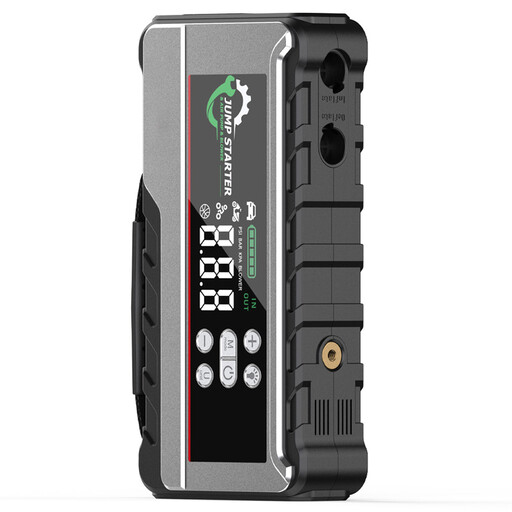
Why This Fits Their Persona: For users who expect maximum functionality and state-of-the-art technology. The ability not only to start the car but also to fast-charge a laptop via PD65W makes this device a true mobile powerhouse for commuters, digital nomads, and outdoor enthusiasts.
This model avoids the inaccurate battery capacity trap by highlighting a clear, future-proof charging feature (PD65W). This is a verifiable performance metric that goes far beyond vague mAh ratings and offers real added value.
The PD65W fast-charging function via USB-C is a standout feature, allowing the device itself to be recharged in about 1.2 hours. The additional blower function for inflating and deflating items like air mattresses adds to its versatility.
We have compiled a complete, up-to-date list of products that fully meet these strict selection criteria and relevant safety regulations.
To maintain the life of the internal battery, it is recommended to fully charge the device every 2 to 3 months, even if it has not been used. Lithium batteries lose their charge over time, and regular maintenance ensures that the battery booster is ready for an emergency. Always follow the specific instructions provided by the manufacturer.
Yes, many modern jump starters have a "Boost" or "Override" function. This allows you to jump-start batteries with very low or no remaining voltage. However, this function should be used with caution and exactly according to the instructions, as some of the automatic safety checks (e.g., reverse polarity protection) may be bypassed. A jump starter cannot repair a faulty battery, but only enable the engine to start.