
Lieferung heute & morgen

Qualitätsgarantie

Willkommens-Angebote freischalten: KOSTENLOSE Lieferung | Bis zu 80 % RABATT | Kostenlose 30-Tage-JoyPlus-Testphase
App herunterladen
A dead car battery on a cold morning or a flat tyre on the way to your holiday – breakdowns like these are more than just an annoyance. They cost time, stress, and often money for a roadside assistance service. A jump starter with compressor promises to be the multi-functional tool you need for any emergency. However, the market is crowded, and many devices don't live up to their advertising claims. This guide will help you recognise the typical pitfalls and make an informed decision.
As your Joybuy Product Recommendation Officer, I filter the essential information for you, so you can find a reliable device that fits your vehicle and your needs.
Many buyers are guided by marketing buzzwords that mean very little in practice. Pay special attention to these three points to avoid a bad purchase:
To find the right portable jump starter, you should focus on objective, technical parameters. These three factors are crucial for performance and safety.
The peak current, measured in amps (A), indicates the maximum current the device can deliver for a short time to start the engine. This is the most important value for compatibility with your vehicle.
The compressor's performance is often stated in PSI (Pounds per Square Inch) or Bar. A value of 150 PSI is common and more than enough for car tyres. However, the airflow rate, measured in litres per minute (L/min), is more important. A higher value means the tyre will inflate faster. A useful feature is the automatic shut-off, where the compressor stops once the preset target pressure is reached. This prevents over-inflation and makes operation more convenient.
A high-quality battery booster is more than just a power bank. Look for a robust housing and smart safety clamps. The following protection mechanisms are essential:
The quality of the clamps themselves is also an indicator. Solid, all-metal clamps with thick cables offer better conductivity and durability than basic plastic clamps.
Based on the criteria above, we have identified some models that are well-suited for specific user profiles.

Why This Fits Their Persona: This model offers a balanced combination of performance and functionality for the most common vehicles on UK roads, including petrol SUVs and mid-sized diesel cars. It's a reliable all-rounder for families and commuters.
With 4500A peak current, it provides enough reserve power for engines up to 8.0L diesel, avoiding the trap of underpowered devices. The 10 integrated protection features directly address safety concerns.
The digital compressor with automatic shut-off is practical and precise. The easy-to-read LCD display shows all relevant information at a glance.
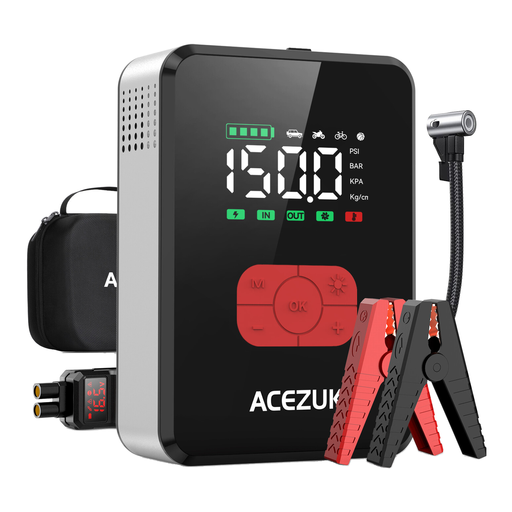
Why This Fits Their Persona: Ideal for owners of motorhomes, vans, or large SUVs with high-displacement diesel engines. Anyone needing maximum starting power for demanding conditions will find the necessary power reserves here.
The 7000A peak current rating and its suitability for diesel engines up to 12L displacement directly address the pitfall of underpowered devices. The patented clamp with a display and warning buzzer minimises user error.
Its enormous power is the clear advantage. The robust, weather-resistant housing and smart clamps offer additional safety and durability for roadside assistance.
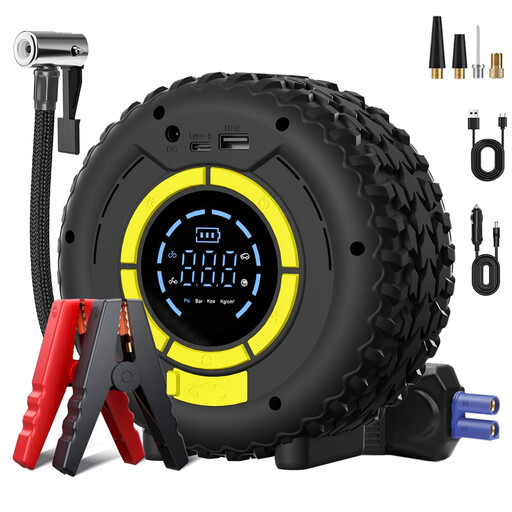
Why This Fits Their Persona: Weighing just 600g and with compact dimensions, this device is ideal for drivers of small and compact cars who are looking for a space-saving emergency solution that fits in the glove compartment. Perfect for the urban commuter.
It doesn't try to be a powerhouse for trucks. Its performance is realistically rated for 12V petrol and smaller diesel vehicles. Despite its size, it includes essential safety features and a functional compressor.
Its biggest advantage is portability. The dual LCD for pressure and battery status is a useful feature in this class. It also serves as a compact jump starter power bank.
We have compiled a complete, real-time list of products that fully satisfy these strict selection criteria and UK safety regulations.
Check the information in your vehicle's manual or on the battery itself. As a rule of thumb: 1500A is often sufficient for petrol engines up to 2.0L, while larger petrol engines and small diesels up to 2.0L should have 2000-2500A. For diesel engines over 2.5L, especially in vans or motorhomes, 3000A or more is recommended to ensure a reliable start, even in the cold.
Even when not in use, the internal battery will slowly self-discharge. Most manufacturers recommend fully charging the device every 2 to 3 months to maintain battery life and ensure it's ready in an emergency. Modern devices have very low self-discharge and often hold their charge for over 6 months.
Yes, this is possible, but it requires patience. A car jump starter with an airflow rate of 35-45 L/min can inflate a typical car tyre (e.g., from 0 to 2.5 Bar / 36 PSI) in about 5-8 minutes. Pay attention to the manufacturer's instructions on the maximum continuous running time of the compressor (often 10-15 minutes) to avoid overheating.
I hope this overview helps you with your decision. Drive safely.
Your Joybuy Product Recommendation Officer