
Lieferung heute & morgen

Qualitätsgarantie

Willkommens-Angebote freischalten: KOSTENLOSE Lieferung | Bis zu 80 % RABATT | Kostenlose 30-Tage-JoyPlus-Testphase
App herunterladen
A dead car battery or a flat tyre can bring any trip to an unexpected halt. A jump starter with an air compressor promises to solve both problems with a single device. However, the market is flooded with models boasting impressive numbers and bold promises. In practice, many of these devices prove to be unreliable, leading to frustration instead of the quick help you need.
As your Joybuy Product Recommendation Officer, I'm here to help you identify common marketing traps and make an informed decision. We'll focus on the technical specifications that truly matter, ensuring you find a device that will perform reliably in an emergency.
Before we look at the features to seek out, it's crucial to understand the most common shortcomings that often only become apparent after purchase.
To avoid these pitfalls, you should focus on three verifiable technical parameters. These will determine whether a jump starter is a worthwhile investment or just an expensive toy.
The required peak current depends directly on your vehicle. A 12V jump starter must provide enough power for the engine's displacement and type.
Always check the manufacturer's specifications for the maximum recommended engine size for both petrol and diesel engines.
The maximum pressure rating in PSI or Bar is only half the story. The crucial factor for practical usability is the airflow rate, specified in litres per minute (L/min). A good value is over 20 L/min to avoid turning the inflation of an average car tyre into a test of patience. Features like a digital pressure gauge, preset modes (Car, Bicycle, Ball), and an automatic shut-off when the target pressure is reached are important quality indicators that significantly enhance convenience and safety.
The capacity, measured in milliamp-hours (mAh), determines how many times you can jump-start a car or charge your smartphone. A higher capacity is advantageous but also makes the device larger and heavier. More important than the raw capacity figure, however, are the integrated protection mechanisms. A high-quality portable jump starter must include the following safety features:
Here are three models that represent a considered choice for different user profiles, based on their objective technical data and features.
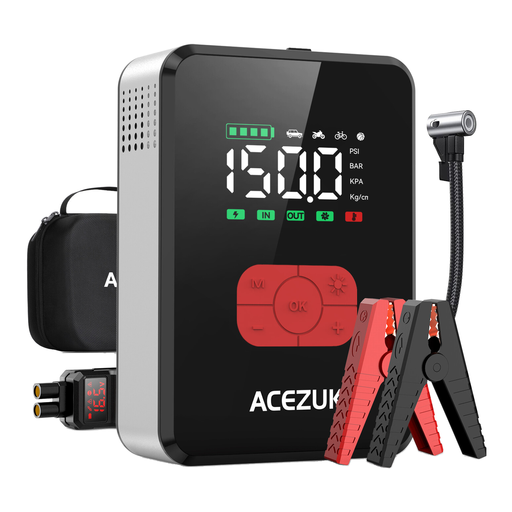
Why This Fits Their Persona: This model is designed for demanding tasks. With a high power rating and suitability for diesel engines up to 12 litres, it offers the necessary reserves for SUVs, vans, or motorhomes. The rugged housing and high battery capacity make it a reliable companion for long journeys and outdoor activities.
It counters the "weak peak current" trap by delivering power that, according to the manufacturer, is rated for large diesel engines where standard units often fail.
High starting power for large engines; intelligent compressor with a large 3.3-inch display and presets; robust, weather-resistant construction.
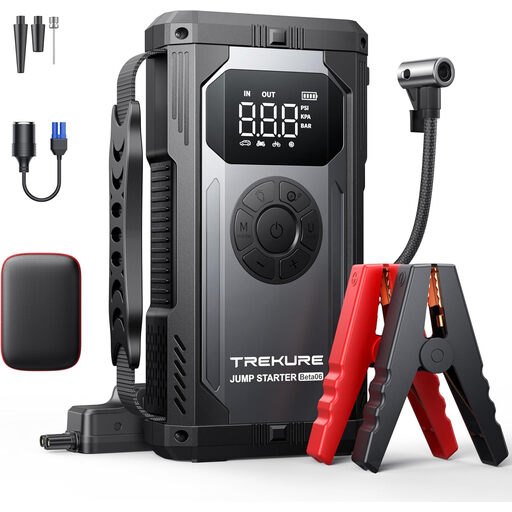
Why This Fits Their Persona: For drivers of common passenger cars and SUVs who need a reliable and safe all-round device. The emphasis on 10-fold safety mechanisms and an intelligent chip appeals to users who value simple, error-proof operation. The combination of solid performance and an efficient compressor covers the most common breakdown scenarios.
This model addresses the "useless compressor" trap with a high inflation speed (35 L/min) and an automatic shut-off function. Its comprehensive protection circuits also minimise the risk of failure due to incorrect use.
Comprehensive safety protection features; efficient compressor with preset modes and an LCD display; forced start function for deeply discharged batteries.
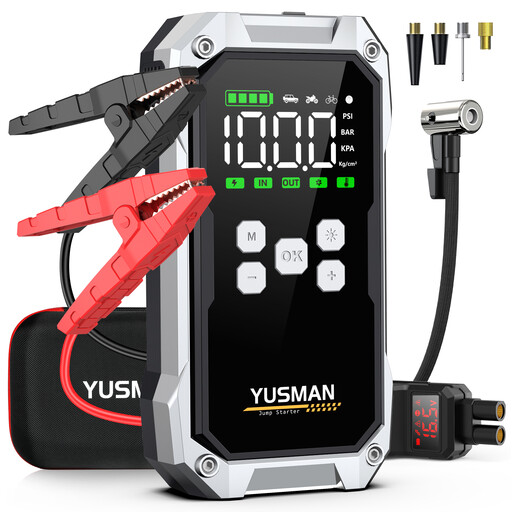
Why This Fits Their Persona: A practical and multifunctional solution for everyday use. With 5000A peak current and suitability for a wide range of petrol and diesel engines, it provides a solid baseline for most standard vehicles. The clear LCD for displaying tyre pressure and the simple operating process make it a great choice for users looking for straightforward emergency equipment.
It avoids the "gimmick feature" trap by focusing on useful core functions. The LCD for tyre pressure and the smart clamps with warning signals offer real added value over purely marketing-driven features.
Excellent value for money; clear LCD for monitoring tyre pressure; compact and lightweight design.
We have compiled a complete, up-to-date list of products that fully meet these strict selection criteria and rigorous safety standards.
To maintain battery life and ensure the device is ready in an emergency, it is recommended to fully charge it every 2 to 3 months, even if it hasn't been used. Most modern devices have low self-discharge, but regular maintenance is essential.
Yes, it's possible, but you must check the device's specifications carefully. A jump starter for diesel engines requires a significantly higher starting current than one for a petrol engine. Look for the manufacturer's rating for maximum diesel engine displacement and choose a model with a correspondingly high peak current (typically 3000 A or more).
Not necessarily. An extremely high peak current is not required for a small car with a petrol engine and offers no additional benefit. It's more important that the power matches your vehicle and that the device has reliable, certified safety features. An oversized unit is often just more expensive and heavier without providing any practical advantage for your specific vehicle.