
Lieferung heute & morgen

Qualitätsgarantie

Willkommens-Angebote freischalten: KOSTENLOSE Lieferung | Bis zu 80 % RABATT | Kostenlose 30-Tage-JoyPlus-Testphase
App herunterladen
A dead car battery or a flat tyre always happens at the worst possible time – usually on a cold morning or on your way to an important appointment. A jump starter with a compressor promises a quick and easy solution. However, the market is flooded with devices boasting impressive specs and bold claims. Many drivers invest in a unit that fails when they need it most or proves to be impractical.
As your Joybuy Product Recommendation Officer, I'm here to help you spot the common marketing traps and make an informed decision. We'll focus on the facts that truly matter, so you can be prepared for any breakdown without spending money on unnecessary features.
Before we look at the important technical specifications, let's highlight the three most common issues that lead to a bad purchase.
To avoid these traps, you should check three core parameters. These determine whether a device is suitable for your needs.
As mentioned, the peak current (Peak Amps) is a marketing figure. More relevant is the starting current (Cranking Amps), which indicates the actual power the device can deliver for several seconds to turn the engine over.
The capacity, given in milliampere-hours (mAh), determines how many start attempts are possible or how many times you can charge your smartphone. A 12V battery booster with 10,000 to 20,000 mAh offers a good balance of size and power for most use cases.
Also, pay attention to the battery type:
A portable car compressor is often advertised with its maximum pressure (e.g., 150 PSI or 10 Bar). This value is more than sufficient for car tyres. However, the airflow rate, measured in litres per minute (L/min), is more important. It determines how quickly the electric tyre inflator can actually inflate a tyre. A higher value means less waiting time on the roadside.
Here are some models tailored to different needs that avoid the pitfalls mentioned above.
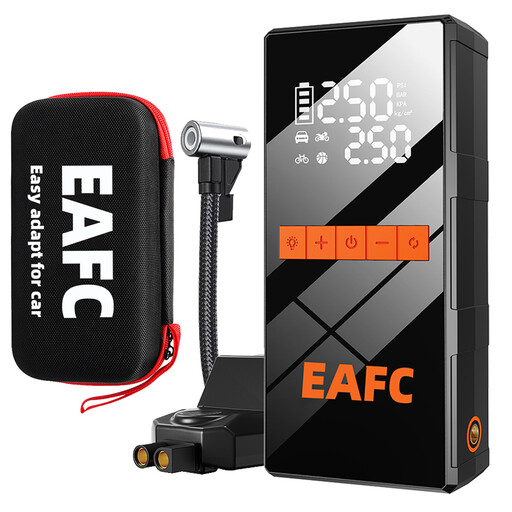
Why This Fits Their Persona: This 4-in-1 device is a practical solution for drivers of standard petrol or smaller diesel vehicles. It combines the most important emergency functions (jump starter, compressor, power bank, LED light) in a compact design that fits easily into the glove compartment.
It avoids the trap of exaggerated claims by stating clear performance limits (up to 4.0L petrol / 2.0L diesel). The focus is on versatile functionality for everyday breakdowns, not on unrealistic peak current ratings.
Combines the four most important functions in one device; automatic compressor shut-off when the target pressure is reached.
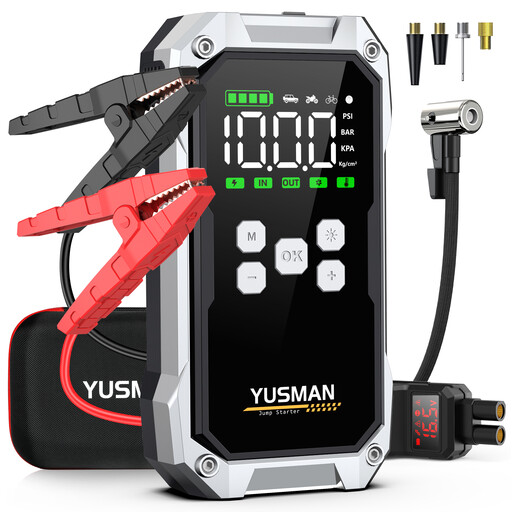
Why This Fits Their Persona: Ideal for owners of SUVs, vans, or vehicles with large diesel engines (up to 10.0L according to the manufacturer). The high battery capacity of 21800 mAh and the high peak current provide the necessary reserves for demanding jump-starts, even in cold temperatures.
This model counters the safety risk of low-quality clamps with an intelligent protection system. The clamps provide audible and visual warnings for incorrect connections, protecting against short-circuits, overheating, and reverse polarity.
High starting power for large engines; integrated 150 PSI compressor and comprehensive safety features.
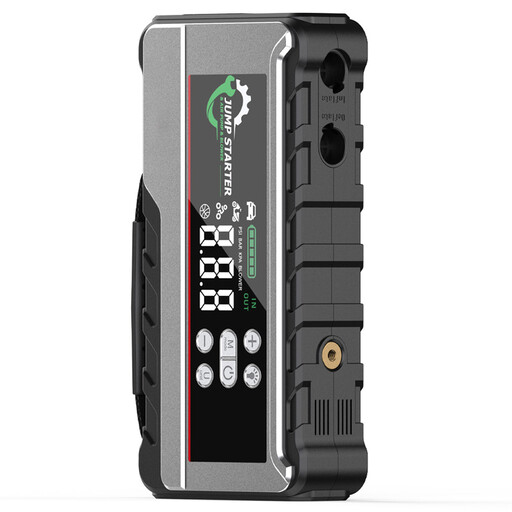
Why This Fits Their Persona: This device is more than just an emergency jump starter. With PD65W fast charging, it can power laptops and other demanding devices on the go. The additional blower function for inflating and deflating air mattresses or inflatable boats makes it a versatile tool for camping trips.
It addresses the rapid self-discharge trap with a very short recharge time. According to the manufacturer, the device is fully operational again in about 1.2 hours thanks to its fast-charging function and has a clear capacity rating (24800 mAh).
PD65W fast-charging function for laptops; unique blower function for inflating and deflating outdoor gear.
We have compiled a complete, up-to-date list of products that fully meet these strict selection criteria and UK safety regulations.
To counteract self-discharge and maximise the battery's lifespan, it is recommended to fully charge the device every 2 to 3 months, even if it hasn't been used. This ensures it is ready for an emergency.
Not necessarily. An extremely high peak current is not required for most passenger cars and is often just a marketing tool. Instead, look for a sufficient starting current that matches your vehicle's engine (displacement, petrol/diesel). An oversized unit offers no practical advantage but is often more expensive and more cumbersome.
Yes, most integrated compressors are capable of re-inflating a tyre with no air in it. However, the process will take significantly longer than simply topping up the air. The airflow rate (L/min) is the crucial factor for speed here. Consider this function a reliable emergency solution, not a replacement for a workshop-grade tool.