
Lieferung heute & morgen

Qualitätsgarantie

Willkommens-Angebote freischalten: KOSTENLOSE Lieferung | Bis zu 80 % RABATT | Kostenlose 30-Tage-JoyPlus-Testphase
App herunterladen
A dead car battery in the morning or a slow puncture on your way to work—such breakdowns are more than just an annoyance. They cost time, stress, and often money for roadside assistance. A jump starter with a compressor promises to be a compact, all-in-one solution for these very emergencies. But the market is flooded with devices making bold promises, many of which prove useless in a real crisis.
As your Joybuy Product Recommendation Officer, I'll help you spot the common marketing traps and make an informed decision. We'll focus on the facts so you can find a reliable device that works when it matters most.
Before you invest, you should be aware of the three most common issues with low-quality devices that lead to frustration:
To avoid a bad purchase, you should focus on verifiable technical specifications. These three parameters are crucial for the function and longevity of your device.
Pay less attention to the advertised peak current and more to specific details on engine compatibility. Reputable manufacturers state which engine displacement sizes (in litres) for petrol and diesel engines their 12V jump starter is suitable for.
A good 12V electric tyre inflator is distinguished not only by its maximum pressure (often 150 PSI / approx. 10 Bar) but also by its functionality and safety.
A powerful device must also be safe. Look for integrated protection circuits. The following are indispensable:
Based on these objective criteria, we have identified a few models suitable for different users.
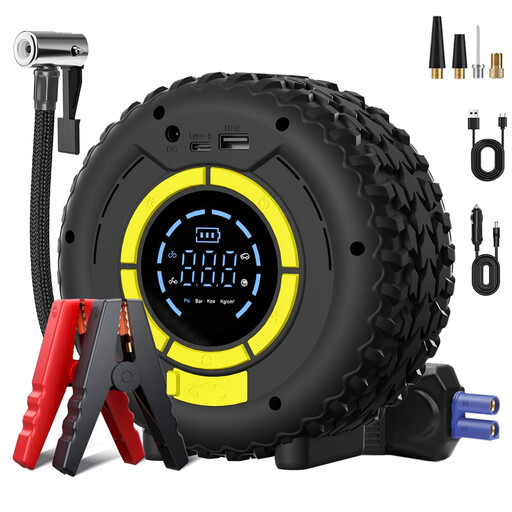
Why This Fits Their Persona: Ideal for drivers of standard petrol and smaller diesel vehicles who need a compact, easy-to-store, and straightforward device for everyday breakdowns. Weighing just 600g, it fits easily into the glove compartment.
The compressor features 4 preset modes and an automatic shut-off function, which minimises the risk of user error and inaccurate tyre pressure. Its performance specs are realistically rated for common 12V vehicles and are not exaggerated.
The clear digital display shows all essential information at a glance. The combination of its light weight, simple operation, and key emergency functions (jump starter, compressor, power bank, LED light) makes it a practical everyday companion.
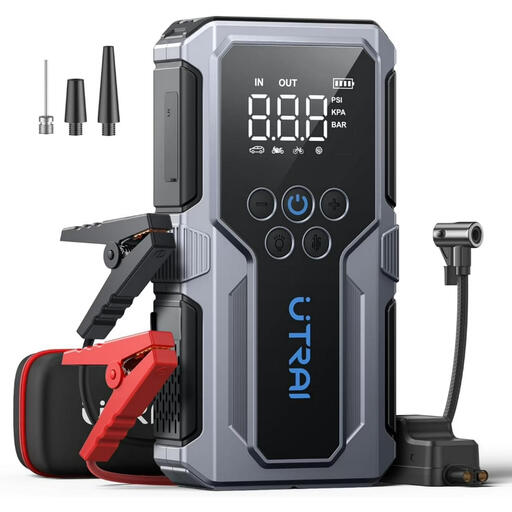
Why This Fits Their Persona: Perfect for drivers of SUVs, vans, motorhomes, or vehicles with large-displacement petrol (up to 8.5L) and diesel (up to 6.5L) engines. This is the right choice for anyone who needs maximum power reserves and reliability, even in cold weather.
This UTRAI jump starter avoids the trap of exaggerated performance claims by providing clear engine compatibility ratings. The high 3000A peak current is substantiated by its ability to start large diesel engines. The 10 safety features, including an indicator for correct connection, offer maximum security.
The high 15,000 mAh battery capacity and Quick Charge ports (USB/USB-C) make the device an extremely powerful power bank for on-the-go use. Its reliability in extreme temperatures (-20°C to 60°C) is a key advantage.
We have compiled a complete, up-to-date list of products that fully meet these strict selection criteria and German safety regulations.
1. How often do I need to charge a jump starter with a compressor? To maintain the battery's lifespan and ensure the device is ready in an emergency, it is recommended to fully charge it every 3 to 6 months, even if it hasn't been used. It's best to store the device at moderate temperatures and avoid extreme heat or cold.
2. Can I use a device like this to inflate a completely flat tyre? Yes, this is generally possible. However, it's important to know that these portable compressors are designed for emergencies and for topping up tyre pressure. Fully inflating a large tyre can take some time. Pay attention to the manufacturer's specified maximum continuous runtime (often around 10 minutes) to avoid overheating the unit.
3. Is a jump starter with a compressor also suitable for diesel vehicles? That depends on the specific model. An emergency jump starter for diesel engines requires significantly more starting power than one for a comparable petrol engine. Therefore, always check the manufacturer's technical specifications. Look for explicit information on suitability for diesel engines and the maximum supported displacement (e.g., "for diesel engines up to 6.5L"). Devices without this specification are often unsuitable for diesel cars.