
Lieferung heute & morgen

Qualitätsgarantie

Willkommens-Angebote freischalten: KOSTENLOSE Lieferung | Bis zu 80 % RABATT | Kostenlose 30-Tage-JoyPlus-Testphase
App herunterladen
A flat car battery, a slow tyre leak or a faulty charging cable can quickly become a problem when you're on the road. A jump starter with compressor combines several functions in one portable device: 12V jump starting, tyre compressor, power bank and LED emergency light.
To make sure your purchase isn't let down by exaggerated marketing claims or missing safety features, it's worth checking a few technical specifications carefully. Motor compatibility, the compressor's real-world performance and the quality of the safety clamps are particularly important.
Claims like 3,000 A, 5,000 A or 7,000 A usually refer to the maximum peak current. On their own, they don't tell you whether a jump starter is suitable for your vehicle. What also matters is whether the manufacturer specifies clear limits for petrol and diesel engines.
A small petrol engine generally needs different starting reserves than a large diesel engine, a van or an SUV. So you should compare the engine size and 12V electrical system ratings with your own vehicle.
A tyre compressor rated at 150 PSI may claim a high maximum pressure without actually reaching it quickly in continuous use. For everyday use, what also counts is the airflow rate, automatic shut-off, hose length and the permitted operating time.
With many compact devices, the compressor needs to cool down after several minutes of use. So it's important to check the operating instructions before buying and before using the device.
The USB function makes a portable jump starter handy for smartphones, tablets or dashcams. However, it won't charge a flat starter battery over a longer period like a stationary car battery charger would. The power bank function is intended as an additional emergency power source, not as a substitute for a charger with maintenance or repair programmes.
Look out for the following details:
Only attempt a jump start if the battery, cables and clamps are undamaged. A frozen, leaking or visibly damaged battery must not be started with a booster.
A jump start cable with safety clamps should be able to detect reverse polarity, short circuits, overheating and overcurrent. Audible or visual warnings help if the positive and negative terminals have been connected incorrectly.
Before buying, it's worth checking the cable length, the clamp opening width and the quality of the insulation. According to the manufacturers, several of the models below feature intelligent protection systems. However, this information does not replace correct use according to the operating instructions.
For an electric tyre pump, these features are useful:
The recommended tyre pressure can be found in your vehicle's owner's manual, often also on the B-pillar or inside the fuel filler flap. The compressor's maximum pressure is not automatically the permitted pressure for your tyre.
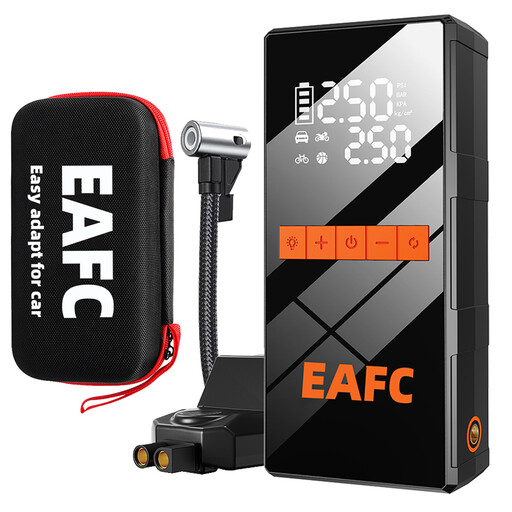
Why this product fits the profile: This model combines 12V jump starting, a compressor, power bank and LED light in a compact housing. According to the product specification, it is designed for petrol engines up to 4.0 litres and diesel engines up to 2.0 litres.
The specifications state specific engine limits, automatic compressor shut-off and multiple protection functions. This makes selection easier compared to relying on peak current claims alone.
150 PSI maximum pressure, LCD display, 8,000 mAh battery and three LED modes according to the product description.
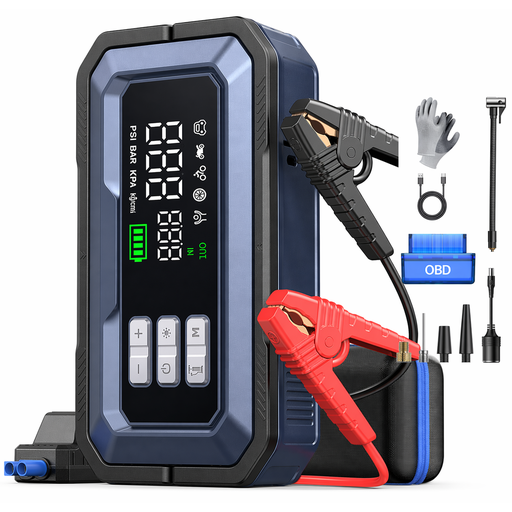
Why this product fits the profile: According to the manufacturer, this device supports 12V petrol vehicles, diesel engines up to 14 litres and hybrid vehicles. This makes it suitable for owners of larger vehicles too.
The product data separates starting current, peak current, battery capacity and vehicle type. Temperature monitoring for the battery and pump is also mentioned.
150 PSI, five pressure modes, 160W 12V output, OBD2 adapter and 18W PD charging function according to the product description.
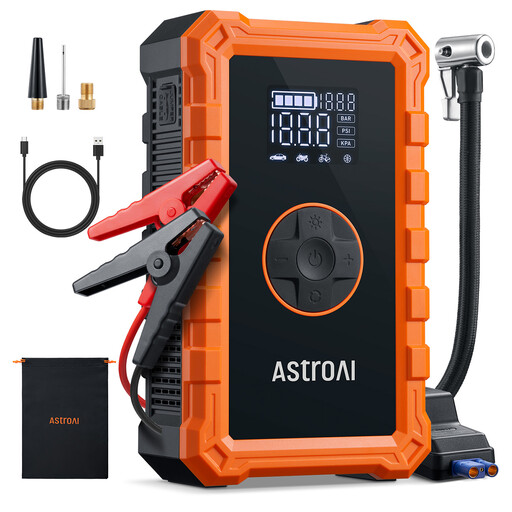
Why this product fits the profile: The specifications state suitability for petrol engines up to 6.0 litres and diesel engines up to 3.0 litres. This model suits commuters, travellers and campers with different vehicles.
The 2.4-inch display shows battery and tyre pressure. The stated minimum rest period of at least ten minutes after ten minutes of compressor operation highlights the thermal limitation.
150 PSI, automatic shut-off, five pre-settable pressure modes and USB ports according to the manufacturer.
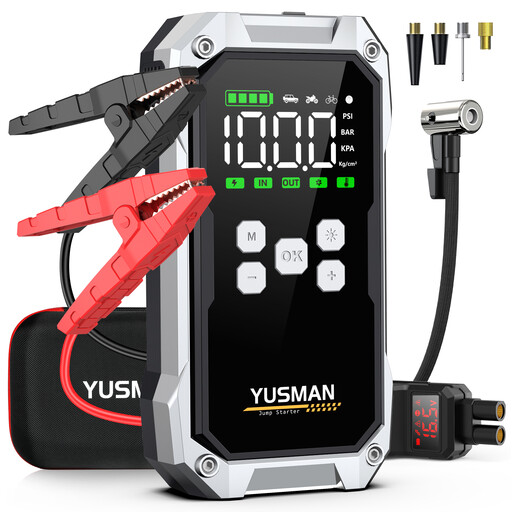
Why this product fits the profile: According to the product description, this device is designed for 12V vehicles as well as petrol and diesel engines up to 10.0 litres. This makes it potentially interesting for SUV, pick-up and van owners.
The smart clamps are said by the manufacturer to protect against reverse polarity, short circuit, overheating, overload and overvoltage. The battery should be sufficiently charged before starting.
5,000 A peak current, 21,800 mAh capacity, 150-PSI compressor, LCD display and four LED modes according to the product specification.
We've put together a complete, regularly updated list of products that fully meet these strict selection criteria and the safety regulations in force in the EU.
An LED emergency light with SOS or flashing function can increase visibility if you break down. However, it does not replace a hi-vis vest, warning triangle or a complete car emergency kit.
That depends on your vehicle. Check the engine type, displacement and 12V system. A device for 4.0-litre petrol engines is not automatically suitable for a large diesel engine. The vehicle limit stated by the manufacturer should not be exceeded.
This varies by model. Some devices recommend charging every two to three months, others every three to six or twelve months. Even when not in use, the charge level should be checked regularly, as low battery reserves can limit jump-starting capability.
For drivers who travel frequently, go camping or commute long distances, the combination of jump starter, tyre pump, power bank and LED light can replace several separate devices. If you only need to charge a battery occasionally, a stationary car battery charger might be more suitable. What matters is whether the functions actually match your vehicle and your personal usage profile.