
Lieferung heute & morgen

Qualitätsgarantie

Willkommens-Angebote freischalten: KOSTENLOSE Lieferung | Bis zu 80 % RABATT | Kostenlose 30-Tage-JoyPlus-Testphase
App herunterladen
A dead car battery or a flat tire always happens at the worst possible time—usually early in the morning on the way to work or at night on a deserted country road. In moments like these, a reliable emergency jump starter is worth its weight in gold. A jump starter with a compressor combines two essential tools in one compact device, promising independence from roadside assistance services.
But the market is flooded with devices making bold advertising claims. Many drivers invest in a multi-function tool, only to find out in an emergency that it lacks the power to get the job done or that the device fails after only a short time. As your Joybuy Product Recommendation Officer, I'll help you recognize the common pitfalls and make an informed decision.
Before you choose a model, you need to be able to separate marketing hype from genuinely important performance features. Pay close attention to these two points to avoid a bad purchase:
portable car air compressor is useless in an emergency.To ensure your emergency jump starter works when you need it most, focus on these three verifiable criteria.
The required power depends directly on the displacement and type of your engine. Diesel engines require significantly more power than gasoline engines due to their higher compression.
Jump Starter Diesel engines over 7.0L, 4000 A or more is recommended.12V battery booster must have smart clamps with protection mechanisms. Reverse polarity protection, short-circuit protection, overheating protection, and overvoltage protection are essential. These features protect your vehicle's sensitive electronics as well as the device itself.A good integrated electric tire inflator is defined by two key metrics:
The capacity of the internal battery, often given in milliamp-hours (mAh), determines how many times you can jump-start a car or charge your smartphone. A high capacity turns the device into a versatile jump starter power bank. Look for useful ports like USB-A (QC 3.0) and USB-C for fast-charging mobile devices, as well as a built-in LED flashlight with different modes (solid, strobe, SOS).
Here are some models that represent a considered choice for different user profiles, based on objective technical data.

Why This Fits Their Persona: This device is a pragmatic choice for drivers of standard passenger cars (gasoline or diesel) who are looking for an all-in-one solution for occasional emergencies without needing a premium budget. It reliably covers all the basic functions.
The manufacturer provides clear engine compatibility (up to 9.0L Gas / 8.0L Diesel). The 150 PSI compressor with auto-shutoff and 5 presets avoids the pitfall of a useless tire inflator. 10 protection features are integrated.
The 5-in-1 design, featuring an easy-to-read LCD screen that displays battery level and tire pressure, makes operation straightforward even for novices.
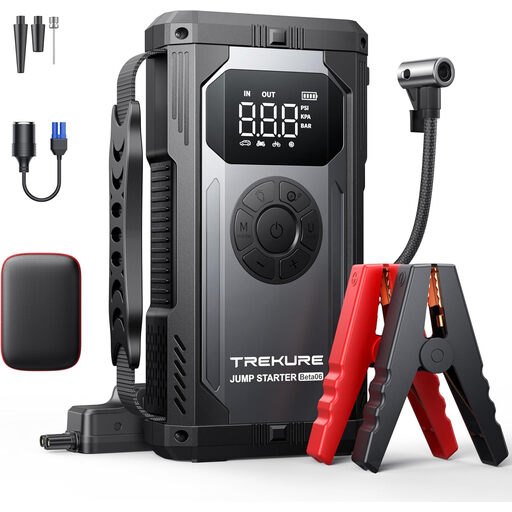
Why This Fits Their Persona: Ideal for owners of large SUVs, RVs, or vans with high-displacement diesel engines. This model offers high performance reserves for maximum reliability, even in extreme temperatures.
The high 5500 A peak current rating is substantiated by its specification for diesel engines up to 10.0L. The compressor's high airflow rate of 35 L/min directly addresses the pitfall of a slow tire inflator.
The combination of a very high peak current and an efficient compressor makes it a powerful solution for demanding vehicles. The force start function is useful for deeply discharged batteries.
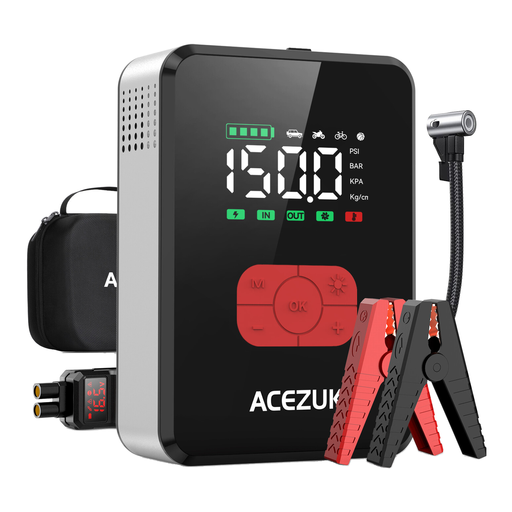
Why This Fits Their Persona: Perfect for commuters, campers, or people with multiple vehicles who want the highest level of performance and functionality. The large battery capacity ensures long-lasting readiness on trips.
The 7000 A rating for all gasoline and 12-liter diesel engines provides clarity. A special feature is the patented clamp with its own display and buzzer, which minimizes user error and safety risks.
The combination of an extremely high peak current, large battery capacity (26800 mAh), and the smart clamp with a display offers a high degree of safety and performance.
We have compiled a complete, up-to-date list of products that fully meet these strict selection criteria and safety regulations.
1. How often do I need to charge a jump starter with a compressor? Even when not in use, it is recommended to fully charge the device every 3 to 6 months. Lithium-ion batteries are subject to slow self-discharge. Regular charging ensures the battery maintains its capacity and is ready for an emergency. Most devices have a charge level indicator for easy monitoring.
2. Can I inflate a completely flat tire with one of these devices? Yes, models with a rating of 150 PSI (approx. 10 Bar) are designed for this. Inflating a standard passenger car tire from 0 to 2.5 Bar can take between 5 and 10 minutes, depending on the compressor's airflow rate. Pay attention to the manufacturer's specifications for maximum continuous runtime to avoid overheating the compressor.
3. Is using a battery booster safe for my modern car's electronics? Yes, as long as you choose a quality device with comprehensive safety features. Look for models with protection against reverse polarity, short circuits, overcharging, and overvoltage. These intelligent protection circuits prevent voltage spikes that could damage the Engine Control Unit (ECU) or other sensitive vehicle components. Always follow the manufacturer's instructions exactly.