
Lieferung heute & morgen

Qualitätsgarantie

Willkommens-Angebote freischalten: KOSTENLOSE Lieferung | Bis zu 80 % RABATT | Kostenlose 30-Tage-JoyPlus-Testphase
App herunterladen
A flat car battery always seems to happen at the worst possible moment: in the car park, before an early shift, or during a long journey with the family and luggage. A jump starter for cars can be a practical addition to your emergency kit in these situations. However, devices differ significantly in starting power, vehicle compatibility, charge level and extra features.
As Joybuy Product Recommendation Officer, I filter the most important details from product descriptions and organise them according to specific usage scenarios. This helps you avoid typical buying mistakes without relying solely on high amp ratings or long feature lists.
Figures like 2,000 A, 4,000 A or 8,000 A sound straightforward at first. However, when choosing a car battery starter, what really matters is the engine size and engine type for which the manufacturer has approved the device. A petrol engine requires different starting reserves depending on its displacement compared with a diesel engine. A heavily discharged or damaged battery can also make jump starting more difficult.
Always check the following:
A device rated for up to 4.0 litres petrol and 2.0 litres diesel is not automatically suitable for a large van or a heavy commercial vehicle.
The capacity in mAh describes the stored energy, but it does not alone indicate how well a portable jump starter can deliver high currents in short bursts. A compact jump starter for cars with a lower capacity may be sufficient for a small car, while SUV, van and camping users need extra reserves.
For everyday usability, charging time, charging port and maintenance charging are also important. According to product information, many devices should be recharged every three to six months. If this maintenance is forgotten, a power bank with jump start capability may not be sufficiently charged in an emergency, despite a high nominal capacity.
An integrated tyre pump for cars, LED light or USB power bank extends the usefulness, but it does not automatically make a device suitable for every vehicle. Particularly with a model featuring jump start with compressor, you should also pay attention to hose length, pressure units, automatic shut-off and the permitted operating duration.
Choose the starting power based on your actual vehicle, not just the advertised peak value. For many cars, a device in the mid-power range is sufficient. Diesel SUVs, vans, boats or vehicles with large engines may need higher reserves.
Look at the specific manufacturer's specification, for example "up to 8.0 litres petrol and 6.0 litres diesel". These figures should be understood as compatibility indicators, not as a guarantee for every condition of the vehicle battery.
A car battery booster should have reverse polarity protection, short-circuit protection, overcurrent protection and a clear status indicator. Smart clamps can warn you of incorrect connections audibly or visually. Nevertheless, the clamps must be connected correctly: Red to positive (+), black to negative (–) or a suitable earth point.
Most product manuals recommend cranking the engine for only a few seconds per attempt and leaving a pause between several starting attempts. A damaged, leaking or frozen battery must not be jump started.
A robust PC-ABS housing, a carry case and an easy-to-read display make using the device on the go much easier. For the UK, temperature limits are also relevant: devices should not be left permanently in the vehicle in direct summer heat. Lithium batteries must not be disposed of with household waste at the end of their useful life.
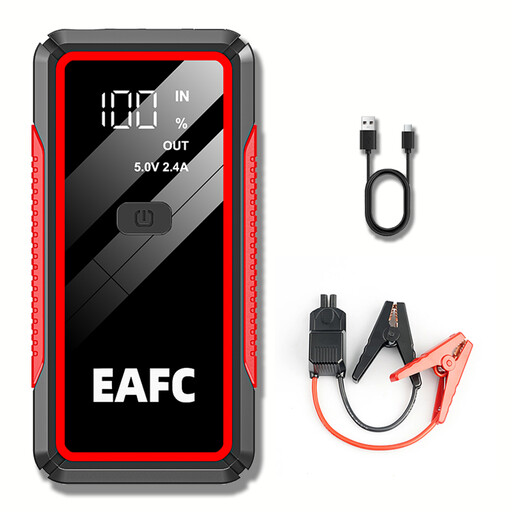
Why this product fits the profile: According to product information, this model offers 2,000 A peak current, a 10,000 mAh lithium battery and support for petrol engines up to 6.0 litres and diesel engines up to 4.0 litres.
The engine size specifications and safety features are more concrete than a simple amp rating. However, you should still check your own vehicle type before buying.
USB output, LCD display and LED light; compact dimensions of approximately 18 × 8.7 × 3.5 cm according to the product description.
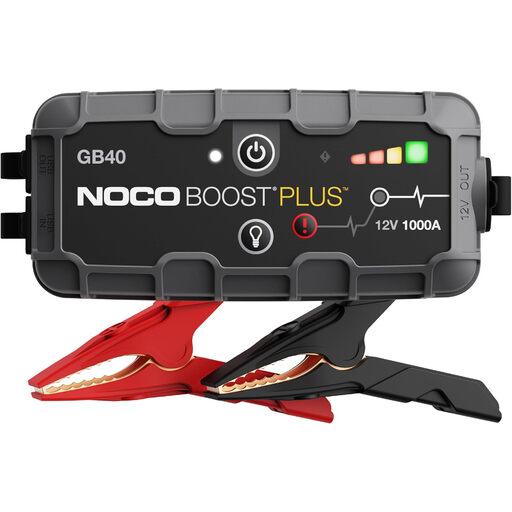
Why this product fits the profile: According to the product description, this device is designed for petrol engines up to 6.0 litres and diesel engines up to 3.0 litres, combining jump starting, LED light and power bank.
The UltraSafe construction is described with reverse polarity and spark protection. The vehicle limits still remain decisive.
IP65-certified housing according to product information, 100-lumen LED and USB-C charging cable included.

Why this product fits the profile: According to product information, this 5-in-1 device combines 12V jump starting for petrol engines up to 9.0 litres and diesel engines up to 8.0 litres with a 150 PSI compressor.
The compressor values, pressure units and automatic shut-off are specified. The recommended maximum running time of ten minutes should be observed.
LCD display, five inflation modes, four nozzles, LED light and ten listed protection functions.

Why this product fits the profile: The product data states 3,000 A peak current, a capacity of 59.2 Wh and support for petrol engines up to 8.0 litres and diesel engines up to 6.0 litres.
The LED display shows the device status. However, buyers should still check whether their vehicle has a 12V system before purchasing.
65-watt PD fast charging, digital display, LED light with three modes and, according to product information, ten protection functions.
We have put together a complete, regularly updated list of products that fully meet these strict selection criteria and the safety regulations in force in the EU.
With a hybrid vehicle, a booster may only be used on the designated 12V auxiliary battery. 24V systems on heavy lorries or construction machinery are not compatible with the 12V devices mentioned.
That depends on the engine type, displacement and battery condition. For a normal car, lower values may be sufficient. For diesel SUVs, vans or larger engines, higher reserves make sense. What matters most is the engine compatibility specified by the manufacturer.
The lifespan depends on battery quality, storage, temperature and charging care. If the device is not used for a long period, it should be recharged regularly according to the manual. A swollen, damaged or leaking device must not be used further.
Only models with an integrated compressor can perform this function. Check the maximum pressure, the available pressure units, the hose length and the automatic shut-off. For frequent use, the permitted operating duration of the compressor is also relevant.