
Lieferung heute & morgen

Qualitätsgarantie

Willkommens-Angebote freischalten: KOSTENLOSE Lieferung | Bis zu 80 % RABATT | Kostenlose 30-Tage-JoyPlus-Testphase
App herunterladen
A dead car battery or a flat tire always happens at the worst possible time. A reliable jump starter with an air compressor promises a quick fix and independence from roadside assistance. However, the market is flooded with devices boasting impressive technical specs that don't always live up to their claims in practice. Before making a purchase, it's crucial to understand the key features to avoid a bad investment.
As your Joybuy Product Recommendation Officer, I'm here to help you separate the wheat from the chaff. We'll highlight the most common pitfalls and show you what truly matters when choosing a multifunctional tool for your vehicle.
Many devices advertise impressive numbers, but the devil is in the details. Two issues in particular often lead to buyer's remorse:
To ensure your roadside emergency kit works reliably when you need it most, you should check three core aspects.
The most important metric is the ability to start your specific vehicle. Don't just look at the peak current; check the manufacturer's stated compatibility for engine sizes (displacement in litres).
A good tire inflator for your car should be more than just an emergency fix.
Modern devices are more than just jump starters; they are portable power hubs.
Based on the objective criteria above, we have identified models that offer a suitable solution for specific user profiles.

Why this model fits: Ideal for drivers of standard passenger cars (petrol or diesel) who are looking for a reliable and straightforward all-in-one solution for the most common breakdowns, without paying for extreme performance peaks they don't need.
The manufacturer provides clear compatibility limits (up to 9L petrol / 7L diesel), which allows for a realistic assessment of its performance and shifts the focus away from pure peak-current marketing claims.
Features a "BOOST" mode for deeply discharged batteries and 10 layers of safety protection, including reverse polarity protection. The USB ports function as a fully-fledged power bank.
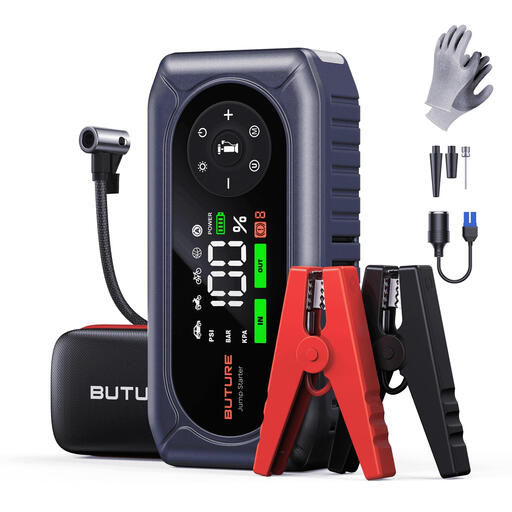
Why this model fits: This BUTURE BC02 is designed for demanding tasks. It provides the necessary power reserves for large-displacement petrol and diesel engines found in SUVs, vans, or RVs.
The integrated 150 PSI digital compressor, with 5 preset modes and automatic shut-off, directly addresses the issue of weak and impractical air pumps. You set the target pressure, and the device handles the rest with precision.
The high peak power of 4500A is rated for engines up to 9.0L petrol / 8.0L diesel. The easy-to-read LCD screen displays all relevant information, such as battery level and tire pressure, in real time.
We have compiled a complete, up-to-date list of products that fully meet these strict selection criteria and safety regulations.
1. How often should you charge a jump starter power bank? Most manufacturers recommend fully charging the device every 3 to 6 months, even if it's not in use. This helps maintain battery health and ensures the jump starter power bank is ready in an emergency. Store the device in a cool, dry place.
2. Can a jump starter with a compressor inflate any tire? Generally, yes, as long as the appropriate adapters are included. Most devices are designed for car, motorcycle, and bicycle tires. However, for very large tires, such as those on trucks or tractors, the inflation time can be very long, or the maximum pressure may not be sufficient. Always check the manufacturer's specifications for maximum pressure output (PSI/BAR).
3. Is a 4500A jump starter overkill for a standard passenger car? Not necessarily. While a smaller petrol car won't need the full power of a 4500A jump starter, the extra capacity doesn't hurt. The device only delivers as much current as the vehicle requests. However, the power reserves can be advantageous in extremely cold temperatures or with a severely discharged battery, offering greater peace of mind.