
Lieferung heute & morgen

Qualitätsgarantie

Willkommens-Angebote freischalten: KOSTENLOSE Lieferung | Bis zu 80 % RABATT | Kostenlose 30-Tage-JoyPlus-Testphase
App herunterladen
A dead car battery or a flat tire always happens at the worst possible time. A multifunctional jump starter with compressor promises a quick and straightforward solution. However, the market is flooded with devices boasting impressive technical specs that don't always deliver in practice. As your Joybuy Product Recommendation Officer, I'll help you identify the crucial features and avoid marketing traps, so you can make an informed decision.
Many devices advertise big numbers, but not all of them are relevant for a real-world breakdown scenario. Pay attention to these three points to avoid a poor investment:
To find the right device, focus on the following practical criteria.
Ignore the peak current figure and instead look at the manufacturer's recommendations for engine displacement (measured in liters). A 12V jump starter for a 2.0L gasoline engine has different requirements than a jump starter for a diesel with a 3.0L engine. Diesel engines fundamentally require a more powerful starting pulse due to higher compression. Check if the device is explicitly rated for your engine type and size.
The maximum pressure (in PSI or Bar) is secondary. A more crucial metric is the air flow rate in liters per minute (L/min). A value of 25 L/min or more is a good benchmark for acceptable inflation performance for car tires. An automatic shut-off function, which allows you to preset the target pressure, is an important convenience feature and prevents over-inflation.
The battery capacity (in mAh) determines how many jump-starts are possible or how many times you can charge your smartphone with the power bank jump starter. However, more important than a huge capacity are high-quality cells and an intelligent battery management system (BMS). Look for certified safety features like reverse-polarity, overcharge, and short-circuit protection. These are essential for safe use with sensitive vehicle electronics and form the basis of a reliable roadside emergency kit.
Here are some models tailored to the specific needs of drivers.
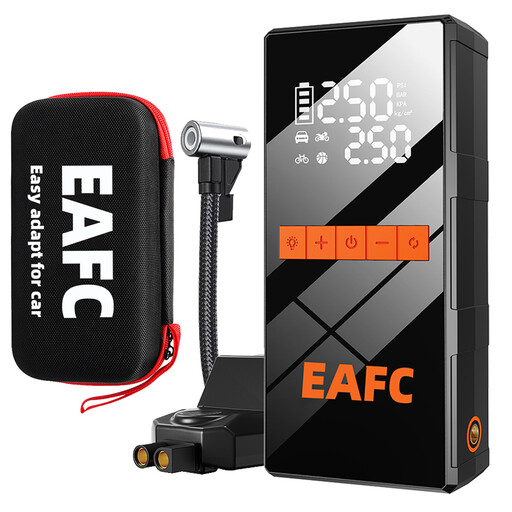
Why This Fits Their Persona: Ideal for drivers of gasoline cars up to 4.0L or smaller diesel vehicles who need a straightforward, all-in-one emergency solution. The compact device fits in the glove compartment and covers the most common breakdowns (dead battery, low tire pressure).
The device provides a clear and realistic engine recommendation (up to 4.0L Gas/2.0L Diesel) instead of advertising an inflated peak current. This way, you know exactly what it's designed for.
4-in-1 Functionality: Combines a jump starter, compressor, power bank, and LED flashlight in a very compact housing. Includes smart safety clamps.
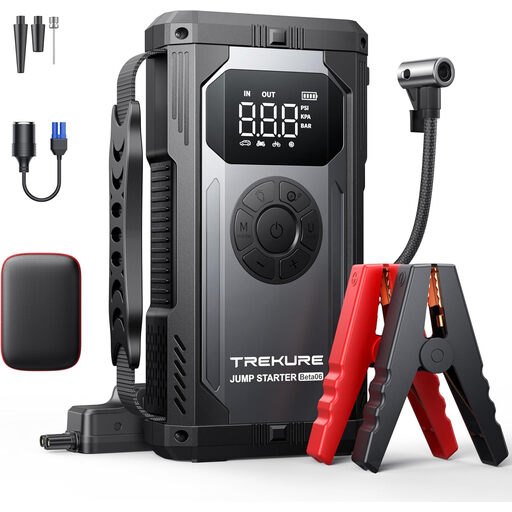
Why This Fits Their Persona: Perfect for owners of large-displacement vehicles like SUVs, vans, or diesel cars. It offers high power reserves for reliable starts even in cold weather and an efficient compressor for larger tires.
This model delivers not only a high peak current but also a solid air flow rate of 35 L/min. It bypasses the "weak compressor" trap and is designed for real-world use on large tires.
High Starting Power: With 5500A peak current, it's suitable for all gasoline engines and diesel engines up to 10.0L. Efficient Compressor: The high air flow rate significantly reduces waiting time during inflation.
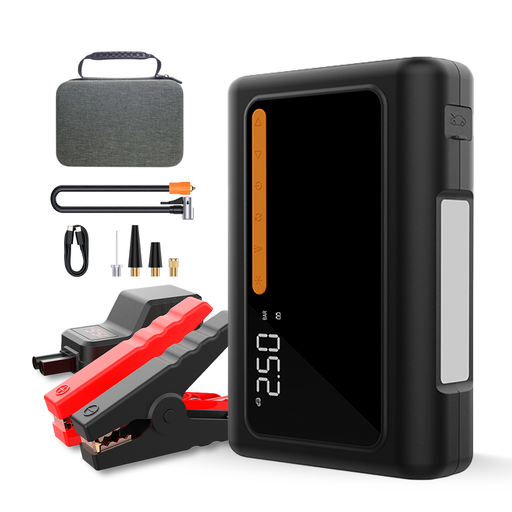
Why This Fits Their Persona: For users who value durability, safety, and modern technology. Ideal for use in extreme conditions, whether winter camping or in summer heat, where conventional lithium batteries reach their limits.
It directly addresses the "short-lived battery cells" weakness by using a sodium-ion battery. This technology promises a significantly higher cycle life and temperature resistance.
Innovative Battery Technology: Extremely temperature-resistant (-40°C to 80°C) and durable (≥ 6,000 cycles). Fast Charging: Thanks to PD60W support, the device itself is quickly ready for use again.
We have compiled a complete, up-to-date list of products that fully meet these strict selection criteria and comply with stringent safety regulations.
Even when not in use, the battery slowly self-discharges. It is recommended to fully charge the device every 3 to 6 months to maintain battery life and ensure it's ready in an emergency. Some modern devices with low self-discharge, like the GOKKCL GK01, require less frequent charging.
Yes, this is generally possible, but it can take some time depending on the tire size and the compressor's performance. Devices with a higher air flow rate (e.g., 35 L/min) have a clear advantage here. Pay attention to the manufacturer's specifications for the maximum continuous runtime of the compressor to avoid overheating.
Look for the manufacturer's explicit rating for diesel engines and the maximum supported displacement. A portable jump starter for a 2.0L diesel engine requires more power than one for a gasoline engine of the same size. If you drive such a vehicle, look for devices rated for diesel engines of at least 3.0L or more. Models like the TREKURE Beta06 are specifically designed for large engines.