
Lieferung heute & morgen

Qualitätsgarantie

Willkommens-Angebote freischalten: KOSTENLOSE Lieferung | Bis zu 80 % RABATT | Kostenlose 30-Tage-JoyPlus-Testphase
App herunterladen
A flat car battery often strikes when you’re under pressure: early in the morning, after a long period of standing, on a campsite, or out and about in winter. A car jump starter power bank can be a mobile alternative to jump leads and a second vehicle in these situations. However, it’s essential that the starting current, vehicle compatibility and safety features match your own car.
The Joybuy Product Recommendation Officer filters the most important details from product descriptions and organises them by typical usage scenarios.
Figures like 2,000 or 4,000 A usually refer to the maximum peak current. This value doesn’t automatically describe how well a device performs under every condition. Just as important are:
A 12V jump starter for a small car therefore doesn’t need the same power reserves as a booster for a large diesel SUV or van.
The capacity in mAh describes the stored electrical energy, but on its own it isn’t a reliable comparison value for starting ability. Figures can refer to different cell voltages, or to the nominal capacity versus the usable output capacity.
For example, the Porbi S306 states 12,800 mAh battery capacity and 7,200 mAh nominal output capacity. When choosing, you should therefore always consider peak current, starting current and vehicle compatibility together.
A mobile power bank for the car, an LED light or a built-in compressor are handy. But they don’t replace a suitable jump starter. A device with a car compressor with jump start can help with low tyre pressure, for example, but needs extra energy for that and is often larger and heavier.
First, check whether the device is explicitly suitable for petrol and diesel vehicles. The stated engine capacity limit is also crucial. A model for up to 6.0 litres petrol and 3.0 litres diesel isn’t automatically suitable for a larger diesel engine.
For motorcycles, boats, ATVs or snowmobiles, a compatible 12-volt system must also be present. 24-volt vehicles such as certain lorries or construction machinery are not readily compatible with the devices described here.
Look for smart clamps or comparable safety equipment. Useful features include:
Safety technology reduces the risk of incorrect operation, but doesn’t replace the correct connection: red clamp to positive, black clamp to negative or a suitable earth point as per the instruction manual.
Lithium batteries shouldn’t be left permanently in a hot vehicle. In summer especially, interior temperatures can exceed the permissible storage limits. Check the charge level regularly and recharge the device according to the instructions, often every two to six months.
A jump starter must not be used on visibly damaged, leaking or frozen batteries. After starting, the clamps should be removed promptly. When making repeated start attempts, the specified pauses must be observed.

Why this product fits the profile: This compact device is designed for 12 V petrol and diesel vehicles and, according to the product details, is suitable for cars, SUVs, motorcycles and boats.
The product data lists 1,200 A peak current as well as 600 A starting current, vehicle types and a charging time of around four hours.
Around 330 g weight, LCD display, USB output with 10 W and LED light with constant, flash and SOS modes.
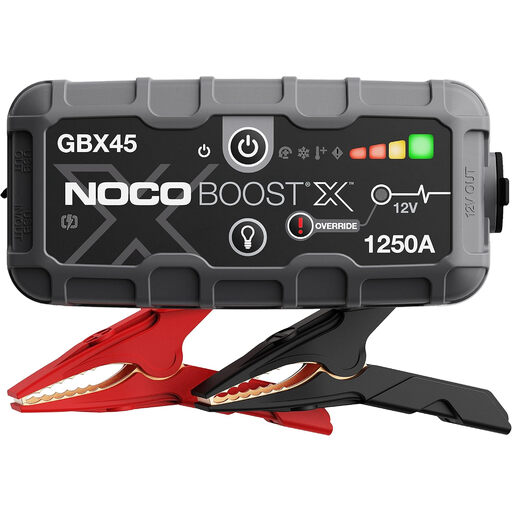
Why this product fits the profile: According to the product description, the stated vehicle compatibility extends to 6.5 litres petrol and 4.0 litres diesel.
The UltraSafe technology is described with reverse polarity protection and a spark-free design. The vehicle limits should still be checked.
1,250 A peak current, power bank function, IP65 rating and built-in LED lamp with seven light modes.
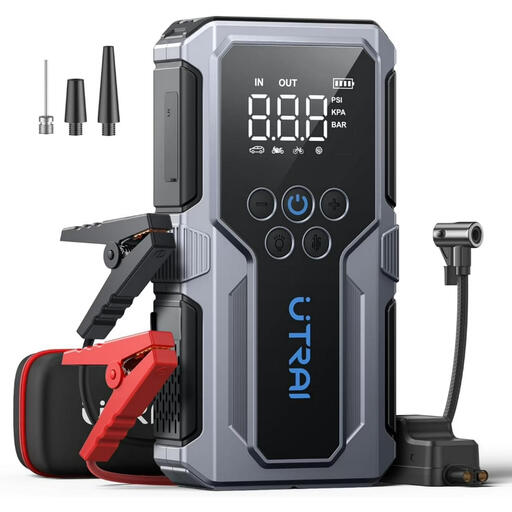
Why this product fits the profile: This combination device is aimed at SUV, van and campervan owners who want to combine jump starting and tyre inflation in one unit.
The specifications state 3,000 A peak current, 10 safety functions and a display for battery level, tyre pressure and inflation mode.
Built-in compressor up to 150 PSI, USB and USB-C charging ports and LED light with three modes.
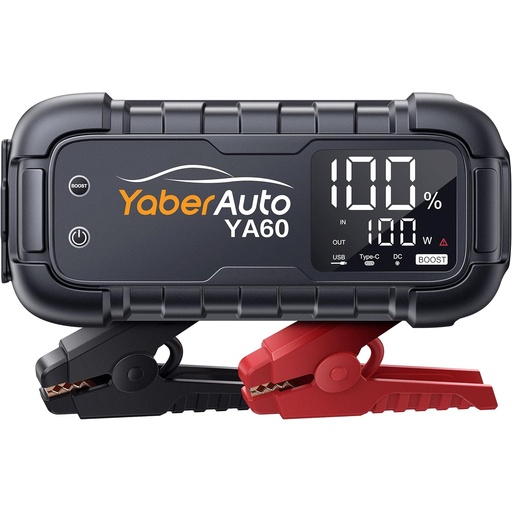
Why this product fits the profile: According to the product details, the device is intended for 12 V petrol engines and diesel engines up to 12.0 litres.
The product description lists 10 safety functions, 8 AWG cables and a manual boost mode for completely discharged batteries.
26,800 mAh, 65 W USB-C charging, two USB-A outputs, 150 W DC output and 600 lumen LED light.
We’ve put together a complete, regularly updated list of products that fully meet these strict selection criteria and the safety regulations in force in the EU.
The lifespan depends on cell quality, storage conditions, charging intervals and usage. Regular recharging, dry storage and protection from excessive heat can help maintain readiness. The manufacturer’s specifications and the condition of the battery are decisive.
That depends on the model and the battery’s condition. Some devices have a manual boost mode for very low voltage. However, a damaged, leaking or frozen battery must not be jump started. The instruction manual for the specific device is binding.
The electricity consumption mainly comes from recharging. In addition, USB functions or the compressor can draw energy. To keep the device ready for use, it should be recharged after a jump start and during longer storage periods according to the manufacturer’s instructions.