
Lieferung heute & morgen

Qualitätsgarantie

Willkommens-Angebote freischalten: KOSTENLOSE Lieferung | Bis zu 80 % RABATT | Kostenlose 30-Tage-JoyPlus-Testphase
App herunterladen
A dead car battery is more than just an annoyance—it can derail your plans and cause significant inconvenience, especially in the cold or in remote locations. A jump starter power bank, also known as a battery booster or jump starter, promises a quick and straightforward solution. But the market is flooded with devices making exaggerated claims. Many buyers only discover in an emergency that their supposed lifesaver is unsuitable or even dangerous.
As your Joybuy Product Recommendation Officer, I'll help you identify the common pitfalls and make an informed decision. We'll focus on the facts that truly matter so you can find a reliable device.
Before we dive into the key features, let's expose the marketing traps that often lead to a bad purchase.
To avoid these traps, you should focus on three verifiable core parameters. These will determine if a device is right for your needs.
The peak current (Peak Amps) is the maximum amperage the device can deliver for a short burst to crank the engine. Choosing the right value depends directly on your vehicle:
Pay attention to the manufacturer's specifications for the maximum recommended engine size (in litres) for petrol and diesel engines.
The capacity, measured in milliampere-hours (mAh), determines how many jump-start attempts are possible and how many times you can charge other devices. A high capacity is especially important if you also plan to use the device as a power bank for your laptop and in the car.
Check the available ports and their power output:
Safety is non-negotiable. A high-quality device will have intelligent jumper cables with a separate electronics box. This should offer at least the following protection features:
The clamps themselves should be robust, fully insulated, and made of solid metal (e.g., copper) to ensure a good connection and lossless power transfer.
Instead of presenting a confusing list, we're highlighting a model tailored to a clear user profile.
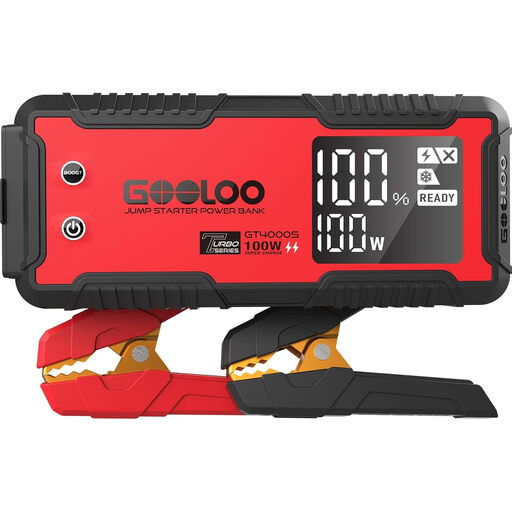
Why This Fits Their Persona: This model is designed for owners of SUVs, motorhomes, boats, or vehicles with large petrol and diesel engines. The high power reserve provides peace of mind, even in demanding conditions. At the same time, it serves as a powerful power bank for laptops and other devices, making it ideal for commuters, campers, and tech-savvy users.
With a peak current of 4000A and suitability for diesel engines up to 10.0L (according to the manufacturer), it bypasses the trap of insufficient power. The 100W fast-charging function counteracts the problem of slow charging times, and the 10 built-in protection technologies address the safety risk.
The key advantage is the 100W two-way fast charging: The device itself is fully recharged in about 1.2 hours and can simultaneously function as a fully-fledged charger for laptops (via USB-C). The informative 3.2-inch display clearly shows its status.
We have compiled a complete, real-time list of products that fully satisfy these strict selection criteria and UK safety regulations.
1. How often do I need to charge a jump starter power bank? Modern lithium-ion jump starters have a low self-discharge rate. Nevertheless, it's recommended to check the charge level every 3 to 6 months and top it up if necessary. Avoid storing it in a permanently hot or freezing car, as extreme temperatures can shorten the battery's lifespan.
2. Can a jump starter power bank damage my car battery? A high-quality device with intelligent safety clamps is designed to protect the vehicle's electronics. Reverse polarity protection is the most critical feature here. It prevents current from flowing if the clamps are connected incorrectly, thus protecting against short circuits and damage to the battery and the vehicle's ECU.
3. What is the difference between peak current and starting current? The peak current (Peak Amps) is the maximum value the device can deliver for a fraction of a second. The starting current (Cranking Amps) is the realistic power that can be sustained for several seconds to actually start the engine. Pay attention to both values, but primarily rely on the manufacturer's recommendations for engine size, as these indirectly account for the starting current.