
Lieferung heute & morgen

Qualitätsgarantie

Willkommens-Angebote freischalten: KOSTENLOSE Lieferung | Bis zu 80 % RABATT | Kostenlose 30-Tage-JoyPlus-Testphase
App herunterladen
A dead car battery is more than just an annoyance—it can derail your plans and, in the worst-case scenario, lead to an unsafe situation. A jump starter power bank promises a quick fix, but the market is confusing. Many products advertise impressive specs that often don't live up to their claims in practice. As your Joybuy Product Recommendation Officer, I'll help you identify the key features and avoid common purchasing traps.
Before you make a decision, you should be aware of three common problems that can lead to a bad purchase:
To make an informed decision, focus on the following three core parameters. These determine the reliability and versatility of your emergency car kit.
The most important metric is the starting current, not the peak current. Pay attention to the manufacturer's specifications for engine size compatibility. A clear statement like "for petrol engines up to 7.0L and diesel engines up to 5.5L" is far more meaningful than a simple amp rating. As a rule of thumb:
The capacity, listed in mAh, determines how many times you can jump-start your car or charge your smartphone before the power bank itself needs to be plugged in again. A device with 13,000 to 20,000 mAh offers a good balance of power and portability. Look for modern charging ports:
Modern devices are more than just a car jump starter. Useful extra features significantly increase its value:
Here are some recommendations tailored to different needs that avoid the pitfalls mentioned above.
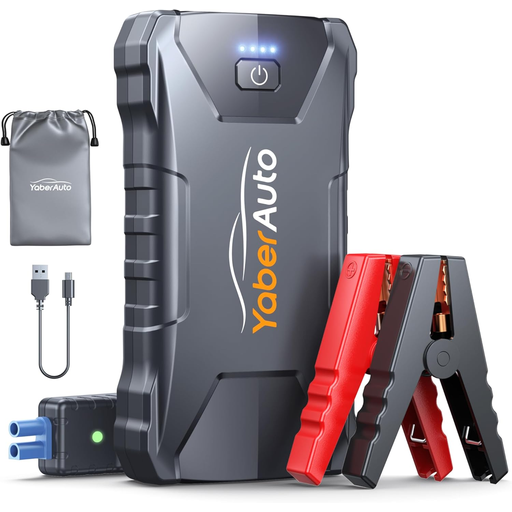
Why This Fits Their Persona: A compact and straightforward solution for drivers of standard passenger cars who are looking for a reliable, basic emergency kit. It fits easily in the glove compartment and also offers a power bank function for on-the-go charging.
The device features 10 advertised safety features, including reverse polarity protection. The clear specifications for engine compatibility (up to 7.0L petrol/5.5L diesel) are more practical than just peak amp ratings.
Very compact design; Integrated LED flashlight with 3 modes; USB-C input for recharging.
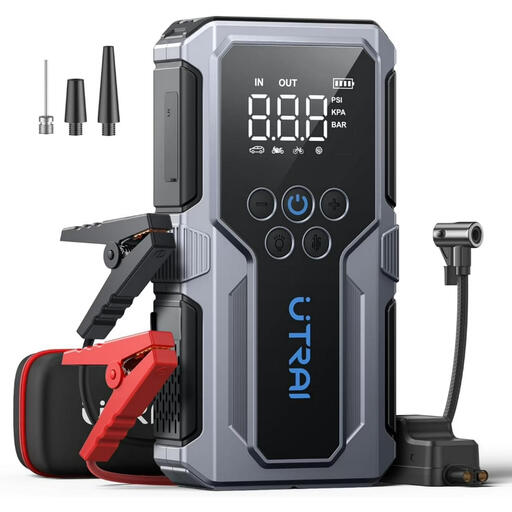
Why This Fits Their Persona: Ideal for owners of larger vehicles, SUVs, or campers who appreciate a multifunctional tool. The combination of a powerful jump starter and a 150 PSI compressor covers the two most common breakdown causes: a dead battery and flat tires.
The 2-inch LED display clearly shows battery status and tire pressure, eliminating guesswork. The compressor's automatic stop function prevents over-inflating tires. 10 safety features are also integrated.
5-in-1 functionality; High 3000A starting current for engines up to 8.5L petrol/6.5L diesel; Digital 150 PSI air compressor.
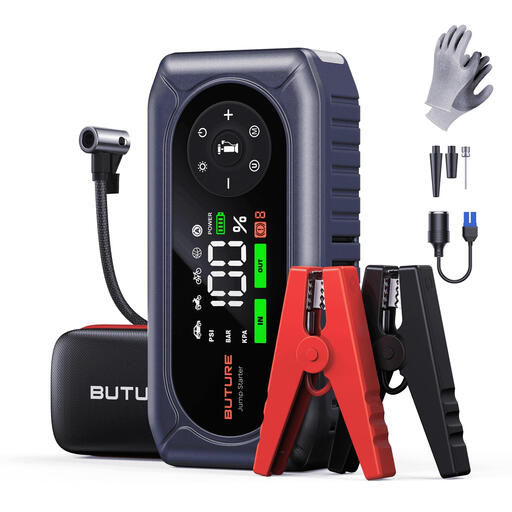
Why This Fits Their Persona: For users who need maximum power reserves—such as for large diesel engines, RVs, or commercial use. This device offers an extremely high starting current and is designed for repeated use under demanding conditions.
The explicitly mentioned honeycomb cooling technology addresses the problem of overheating in high-power devices. The 10-level protection system and clear LCD display create confidence and transparency during use.
Extremely high 4500A peak current for engines up to 9.0L petrol/8.0L diesel; Advanced cooling technology; Bright 500-lumen light.
Reliable lighting is an equally important part of any emergency kit. Discover our selection of robust and durable flashlights.
1. How often do I need to charge a jump starter power bank? Even when not in use, a power bank loses charge through self-discharge. It is recommended to fully charge the device every 3 to 6 months. This ensures it is ready for an emergency and extends the battery's lifespan.
2. Can a jump starter power bank damage my car? Modern, high-quality devices are equipped with comprehensive safety systems. Features like reverse polarity protection (prevents damage if the clamps are connected incorrectly), short-circuit protection, and overload protection make them very safe to use. As long as you choose a model with these safety features and follow the user manual, the risk of damaging your vehicle's electronics is minimal.
3. What does peak current (A) mean on a jump starter? Peak current is the maximum amperage the device can deliver for a very brief moment. This figure is useful for marketing, but for real-world use, the sustained starting current is more relevant. Instead of focusing solely on the amp number, it's more practical to look at the manufacturer's stated compatibility for specific engine sizes (e.g., "up to 7.0L petrol"), as this specification better reflects the device's real-world capability.