
Lieferung heute & morgen

Qualitätsgarantie

Willkommens-Angebote freischalten: KOSTENLOSE Lieferung | Bis zu 80 % RABATT | Kostenlose 30-Tage-JoyPlus-Testphase
App herunterladen
A dead car battery or a flat tire rarely happens at a convenient time. It usually occurs on the way to work, before an important appointment, or at the start of a holiday trip. In these moments, relying on roadside assistance or the help of strangers is not only time-consuming but also fraught with uncertainty. A multifunctional jump starter with an air compressor offers an independent and reliable solution.
These compact devices combine the function of a car jump starter power bank with a powerful tire inflator for your car. They are an essential component of a comprehensive roadside emergency kit. This article serves as an objective guide to help you select a suitable model. We will analyze the technical specifications and features so you can make an informed decision for your vehicle and your needs.
Choosing the right device depends on several technical factors. To make the best choice, you should consider the following three criteria.
The peak current, measured in Amperes (A), is the crucial metric that indicates whether the device has enough power to start your vehicle's engine. Large engines, especially diesel ones, require a higher peak current than small cars with petrol engines.
An integrated compressor, also known as a jump starter with an air pump, is more than just an emergency tool. Its performance is measured in PSI (Pounds per Square Inch) or Bar.
Modern jump starters are much more than just emergency tools. They also function as a portable power bank for your car battery and other electronic devices.
Based on the criteria above, we have compiled a selection of devices that stand out for their technical specifications and range of features.
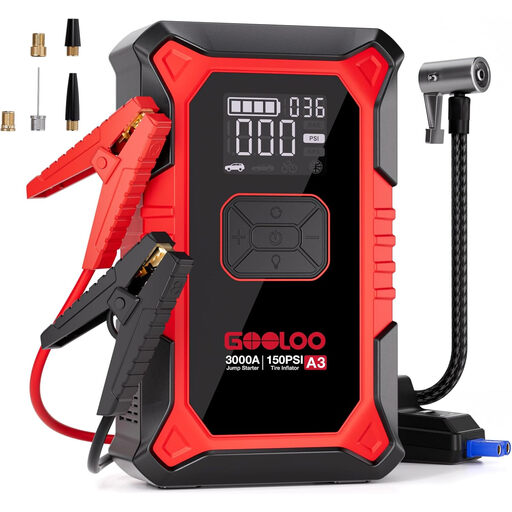
Why It Stands Out: The GOOLOO A3 is a versatile 7-in-1 device that combines high jump-starting power with a user-friendly compressor featuring five preset inflation modes.
Pros:
Who Is It For? This model is ideal for drivers looking for an all-in-one solution for various vehicle types and use cases, from jump-starting an SUV to inflating bicycle tires.
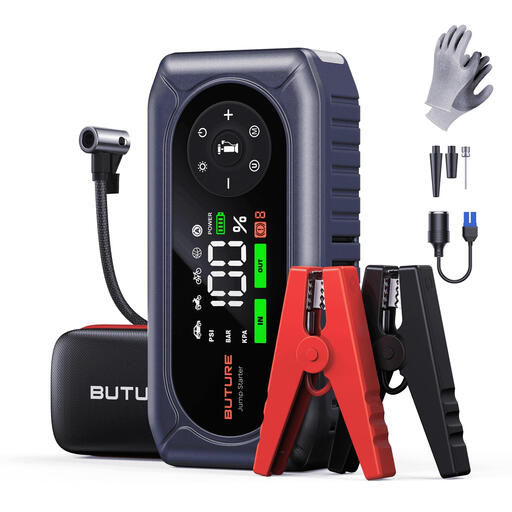
Why It Stands Out: The BUTURE BC02 delivers an exceptionally high peak current of 4500 A, making it suitable for even very large engines. Its honeycomb cooling technology enhances performance stability.
Pros:
Who Is It For? Owners of vehicles with large-displacement engines, such as large SUVs, vans, or RVs, who require maximum starting power and reliability even under demanding conditions.
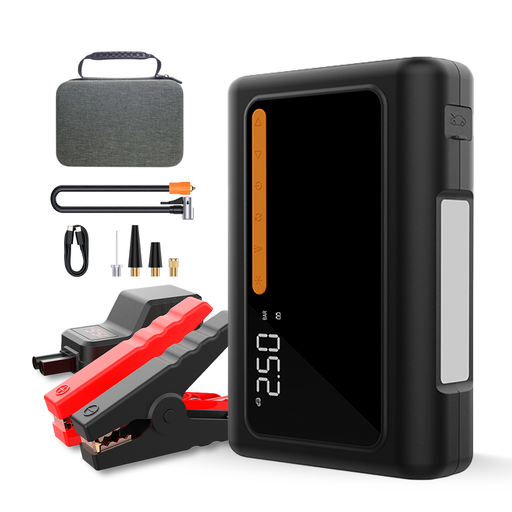
Why It Stands Out: The GOKKCL GK01 uses an innovative sodium-ion battery. This technology promises enhanced safety, a significantly longer lifespan, and an extremely wide operating temperature range.
Pros:
Who Is It For? For users who place the highest value on safety, longevity, and reliability in extreme temperatures. It's ideal for anyone who wants to store the device permanently in their car and not worry about maintenance for years.
The models featured here cover a wide range of requirements. If you haven't found the right device for your specific needs or vehicle, you can find more alternatives in our main category.
Discover our entire range of Jump Starters and find the perfect solution for your mobile independence.
If your car battery is dead, a jump starter is the quickest solution. First, turn off all accessories in the car (lights, radio, air conditioning). Connect the red clamp of the jump starter to the positive (+) terminal of the car battery and the black clamp to an unpainted metal part on the engine block or chassis (a ground point). Turn on the jump starter and, after a short wait, try to start the car. After a successful start, remove the clamps in the reverse order.
Most manufacturers recommend charging the device every 3 to 6 months to maintain the battery's performance. Models with a very low self-discharge rate, such as those with sodium-ion batteries, require less frequent charging. It is advisable to regularly check the charge level indicator, especially before long trips or at the beginning of the cold season.
Most integrated compressors are designed for standard tires on cars, motorcycles, and bicycles, offering sufficient pressure (often up to 150 PSI / 10.3 Bar). They may not be suitable for the very large tires found on trucks or special agricultural vehicles. Always compare the device's maximum pressure with your vehicle's recommended tire pressure.